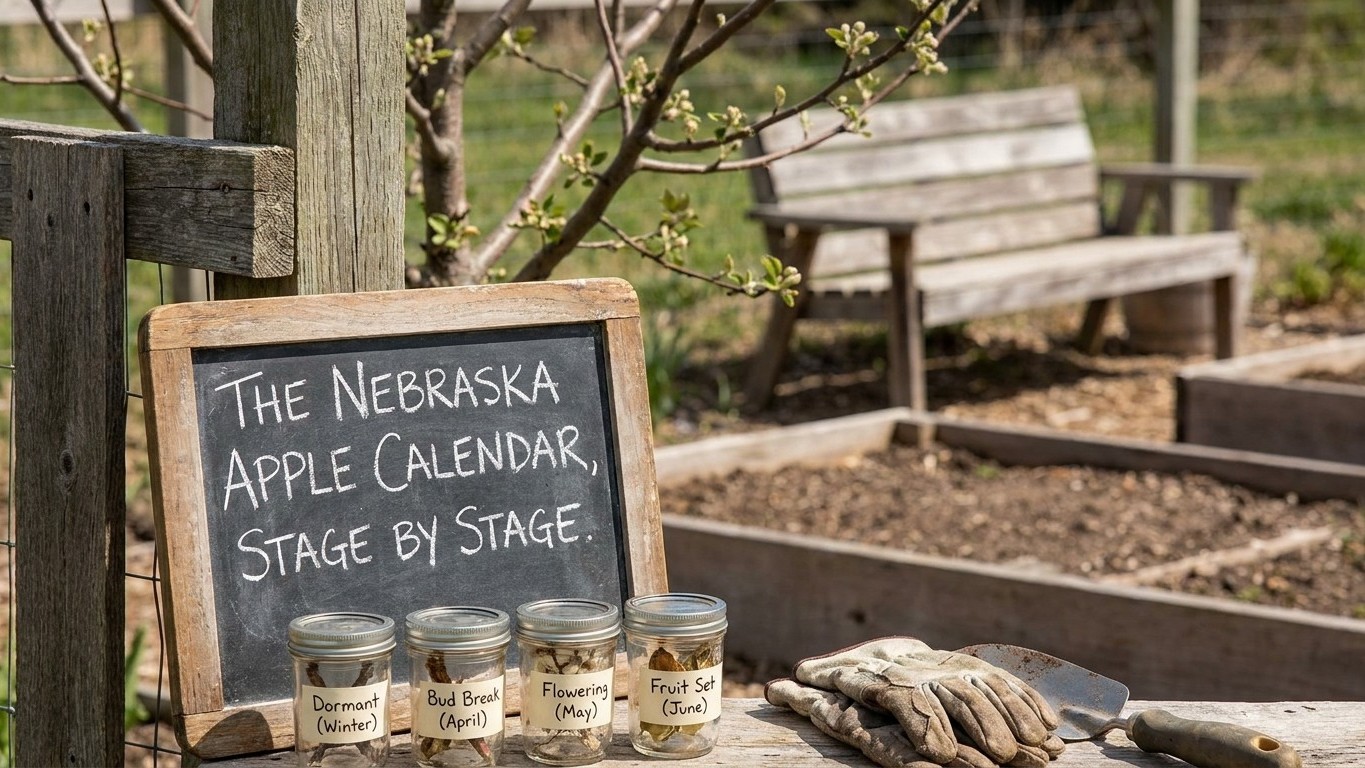

The stage that decides your whole apple season is bloom, and bloom lines up with the last frost, which lands April 12 to April 23 around Omaha. Everything else on the calendar, spraying, feeding, thinning, gets timed off how close it sits to that window, not off the month you’re looking at. So before you do anything else, walk out and check what stage your tree’s buds are actually in right now, then match that against the frost window instead of the date on the wall.
The short answer for Nebraska
Apple trees in Nebraska set their calendar around one hinge point: the average date of the last spring frost, which NOAA’s NCEI 1991-2020 climate normals put at April 12 to April 23 for the airport station near Omaha. Bloom for most mid-season varieties lands inside or right around that window, which is why bloom, not the calendar month, is the stage growers actually watch. Fall closes the season with the first freeze, dated to October 15 to October 26 at the same Omaha station, and the stretch between those two windows, close to five months, is the growing season a tree gets to move from bud break to a ripe apple.
That answer depends on three things. First, on where in the state you are: the Omaha figures come from one airport station, and a garden even a few miles into the suburbs or up on a ridge often sees the last frost arrive later and the first fall frost arrive earlier, sometimes by a week or two. Second, on the variety in the ground. An early-blooming cultivar like ‘Zestar!’ can be in full flower before an average frost date has even arrived, while a later bloomer such as ‘Liberty’ has more of the risk window behind it by the time it opens. Third, on winter cold. NOAA’s NCEI 1991-2020 normals put Omaha’s coldest month at a mean daily minimum of 13.6F, and that figure decides whether a given rootstock and cultivar survive an average winter at all, which is a separate question from whether it blooms on time.
The short version: check the stage of your own tree against the frost windows above, not the date on the wall, and treat the Omaha figures as a starting point your own county may push earlier or later.
Working through it

If you’ve already worked through site and rootstock, the groundwork covered in Growing Apples in Nebraska, the calendar below is what carries a tree through a season, stage by stage rather than month by month.
Dormancy

The tree is leafless, bark gray-brown, buds small and tight with dark scales. This is the stage for pruning and for any dormant-oil spray, done while the tree is fully shut down and well before growth restarts. It runs through the coldest part of winter, when Omaha’s mean daily minimum of 13.6F, from NOAA’s NCEI 1991-2020 normals, is what a hardy rootstock and cultivar need to get through without dieback.
Green tip

Buds swell and a sliver of green leaf tissue pushes through the bud scales. Growth has restarted, and from here the tree loses cold tolerance by the day. This stage typically shows in the weeks before Omaha’s last-frost window opens (April 12 to April 23, NOAA NCEI 1991-2020), though a warm stretch can pull it earlier.
Pink

Individual blossom buds are visible and still closed, showing pink at the tip before they open. This is the point to watch the forecast hardest, since a freeze now can damage flower parts that never show the injury until fruit fails to set later. Pink often lands right inside the Omaha frost window.
Bloom

Flowers are fully open, white with a pink blush at the base, in loose clusters at the branch tips. Bloom is the single most frost-sensitive stage a tree passes through, and for most Nebraska apple varieties it sits inside or just past the April 12 to April 23 window. Hold off on anything that would harm pollinators while flowers are open.
Petal fall

Petals brown and drop, littering the ground under the tree, and a small green fruitlet is left where each flower was. Once petals are down, feeding and irrigation can resume, since the frost risk that mattered most has largely passed for the season at the Omaha reference station, though a late frost can still reach petal fall in a colder pocket.
Fruit set

Fruitlets swell to marble size, still green, with the dried calyx visible at the tip. This is when thinning happens, pulling extra fruit so the ones left behind get enough size, and it’s also when pest pressure starts building, so the tree is worth checking closely through early summer.
Harvest
Fruit reaches full size and mature color, red, yellow, or green depending on the cultivar, several of which are named with days-to-maturity figures in The Best Apple Varieties for Nebraska. Early cultivars can be ready by late summer, later ones stretch toward the first fall frost, dated October 15 to October 26 at the Omaha station by NOAA’s NCEI 1991-2020 normals, and the safer rule is to pick before that window arrives rather than gamble on a few extra days of color.
What changes across Nebraska
The Omaha figures above come from one airport station in the eastern part of the state, and Nebraska stretches nearly 500 miles west from there into a different climate. The Panhandle, around Scottsbluff and Chadron, sits at a noticeably higher elevation, and higher elevation almost always means a shorter frost-free season. Expect green tip, pink and bloom to arrive later there than the Omaha dates suggest, and expect the first fall frost to arrive earlier.
The Sandhills, across north-central Nebraska, are made of loose sandy soil that holds little daytime heat overnight, so the swing between day and night temperature runs wider than in the river valleys further east. A tree there can face a harder overnight cold snap even after a mild daytime high, which matters most at the pink and bloom stages, when a few degrees decide whether flowers survive.
Low ground matters everywhere in the state, not just out west. Cold air is heavier than warm air and drains downhill, so a tree planted in a creek bottom or the low point of a yard collects that cold air on a clear, still night and can see frost when a spot fifty feet upslope stays clear. This has a bigger effect at pink and bloom than at dormancy, since by then the tree has lost most of its ability to shrug off cold.
None of this changes what stage decides the calendar. It changes when each stage is likely to fall relative to the Omaha windows given above, and the only way to know for certain is to watch your own tree and check your own county’s typical dates rather than assuming the reference-station figures transfer directly.
The mistakes this climate punishes
Some choices cost nothing in a mild climate and cost a whole crop in Nebraska. The three below show up at a specific stage, which is why catching them early matters more than catching them late.
- Planting an early-blooming variety on a low or exposed site. A cultivar that blooms early is already racing the frost window before it closes, and on a site that runs colder than average, a creek bottom or an open north slope, that bloom can land squarely inside a frost event most of the neighborhood avoids.
- Feeding or watering heavily late in the season. Nitrogen pushed on in late summer keeps a tree producing soft new growth right as the first fall frost approaches (October 15 to October 26 at the Omaha station, NOAA NCEI 1991-2020), and that soft growth is what gets killed back, weakening the tree going into winter instead of helping it.
- Assuming a variety bred for a milder region will simply survive here. A rootstock or cultivar without adequate cold hardiness for a winter where the coldest month averages a nightly minimum of 13.6F, as Omaha’s NOAA NCEI 1991-2020 normals record, can suffer trunk and graft-union damage that a hardier selection would shrug off.
Each of these shows up at a different point in the year. The early-bloom problem shows in April, right at pink or bloom. The late-feeding problem shows the following spring, when a tree that looked fine in October leafs out unevenly or turns up dead wood to prune out. The wrong-variety problem can take a full winter to show, and sometimes doesn’t show until a particularly cold one arrives and a marginal tree that survived two mild winters finally splits at the graft union.
Checking this against your county
The frost windows and winter minimum above are all measured at one station near Omaha, and staff who track conditions county by county are a better source for your own site than any single statewide date. The University of Nebraska-Lincoln Extension publishes local guidance and takes questions through county offices, and that’s the place to confirm frost dates, chill accumulation and variety performance for wherever you’re actually planting.
An extension office can also tell you whether a nearby weather station has better data for your exact location than the Omaha figures used throughout this page, which matters most if you garden west of the Missouri River valley or at any real elevation.
Common questions
Do I need two apple trees for pollination or will one alone fruit?
Most apple varieties need a second, different variety blooming nearby to set fruit, since they can’t reliably pollinate themselves. A few self-fertile types exist, but even those usually set a heavier crop with a pollinator partner in bloom at the same time, so plan on two compatible varieties or a neighbor’s tree within bee range.
My tree bloomed right on the average frost date and got hit anyway. Did I do something wrong?
Not necessarily. The April 12 to April 23 window from NOAA’s NCEI 1991-2020 normals is a 30 to 70 percent probability band measured at the Omaha airport station, not a guarantee, and a bloom that lands inside it always carries some frost risk. A site that runs colder than the station, a low spot or an early-blooming variety, raises that risk further.
How do I tell pink stage from bloom if I’ve never watched a tree through spring before?
At pink, the blossom buds are still closed but show pink color at the tip, clustered tight at the branch end. At bloom, those same clusters have opened into flat white flowers with a pink blush near the base. The gap between the two stages can be as short as a few days in a warm spring or stretch over a week in a cool one.
Can I still plant a new apple tree if I missed the ideal spring window?
Bare-root trees go in earliest, from dormancy through green tip, but a container-grown tree can generally be planted through most of the growing season as long as it gets consistent water afterward. Planting later just means a shorter first season of root establishment before the tree faces its first Nebraska winter, so watering through fall matters more than it would for a spring-planted tree.