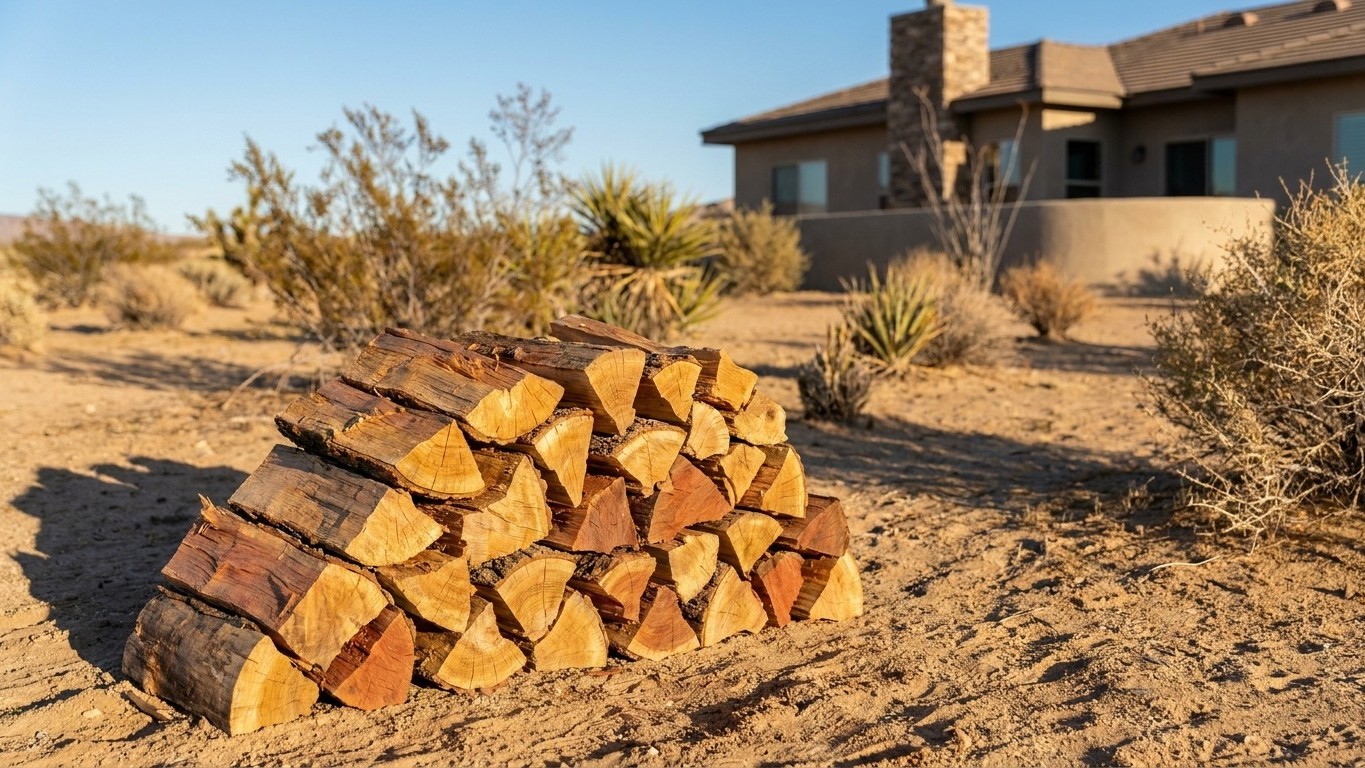

Winter here rarely turns brutal, but it still bites often enough that the wrong firewood choice means smoky evenings, disappointing heat, or a scramble for more logs mid-January. The reference numbers below settle the guesswork: how cold it actually gets, which woods pay off, and how much you really need to stack before the first freeze.
How cold it actually gets here
The average low during the coldest month at the Las Vegas reference station sits at 39.6°F, according to NOAA’s 1991-2020 Climate Normals. That’s the mean daily minimum, not the record low and not some cherry-picked cold snap. It tells you what a typical night looks like across the whole coldest month, and it’s the number that should shape every firewood decision you make.
Read plainly, 39.6°F means most nights don’t drop below freezing on average. That’s a mild reference climate by national standards. It changes the entire conversation around this page: firewood here is largely about comfort, ambiance, and backup heat rather than the make-or-break survival gear it is in places where winter lows sit deep in the teens or single digits.
That doesn’t mean wood heat is pointless. Cold snaps still happen, and when they do, a fireplace or wood stove running dense, well-seasoned logs is the difference between a cozy evening and a chilly one waiting on the furnace to catch up. Power outages during winter storms are also a real reason rural Nevada households keep a stack ready, since a wood stove doesn’t care whether the grid is up.
It’s worth being honest about geography too. The 39.6°F figure comes from the Las Vegas reference station, and it represents low-desert valley conditions. Higher elevations and northern parts of the state run colder in practice, sometimes considerably so, even though the specific figures for those areas aren’t part of this reference dataset. If you live at elevation or farther north, treat this number as a floor, not a ceiling, and lean toward the denser end of the wood choices below rather than the lighter end.
For most readers working from the Las Vegas reference climate, though, the practical takeaway is simple: you’re heating for comfort and resilience, not fighting off a genuine survival-level cold. That reframes how much wood you buy, how you season it, and which species are worth chasing down.
Which woods are worth the effort here
Density is what separates a wood that carries a house through a cold night from one that just crackles pleasantly for twenty minutes. A cord is a fixed volume, a stack measuring 4 feet by 4 feet by 8 feet, or 128 cubic feet total. A cord of dense hardwood packs far more actual wood mass into that same space than a cord of a lighter species, and mass is what burns into heat. According to Michigan State University Extension, a cord of well-seasoned hardwood delivers roughly 20 million BTU on average, comparable to about 145 gallons of #2 fuel oil or 215 gallons of LP gas. That average moves a lot depending on species and, more than anything, moisture content.
Red oak is the one species this reference data calls out specifically, and for a particular reason: it’s dense and burns long, which makes it a strong choice for overnight loads in a wood stove. But MSU notes it dries slowly because of its cell structure, so it needs more time seasoned than most hardwoods before it’s ready to burn clean. That tradeoff matters more in a mild climate like Nevada’s reference conditions, where you may only fire the stove intermittently and want each load to count.
Matching wood to the job
Given the reference climate here, a hybrid approach works better than chasing one “best” species. Dense hardwood earns its keep on the occasional hard-freeze night or for an overnight burn you want to still have coals from by morning. Lighter, faster-burning wood is better for starting a fire, for shoulder-season evenings when you just want a couple hours of ambiance, or for a stove you’re not asking to hold heat unattended.
| Wood category | Burn character | Best use | Smoke & sparks |
|---|---|---|---|
| Dense hardwood (e.g., red oak) | Long, steady burn once established; needs extra seasoning time | Overnight loads, cold-snap nights | Low smoke and sparks when properly seasoned |
| Lighter hardwood | Burns faster, easier to light | Shoulder-season evenings, mixed loads | Moderate smoke if underseasoned |
| Softwood/kindling-grade wood | Ignites quickly, burns hot but short | Starting fires, quick warm-ups | Higher sparking, more resin smoke |
None of this matters much if you can’t actually buy the wood seasoned. A locally available species you can get properly dried beats a prized species sitting green in someone’s truck bed. Ask sellers directly how long a load has been split and stacked before you commit, because that answer predicts your winter more than the species name on the invoice.
How much wood a winter takes
Any number you see published for “cords per winter” is close to meaningless without knowing your own situation. The honest answer is that it depends on three things you can actually evaluate for your house, not a one-size figure borrowed from a national average.
- Your local cold figure: a reference low near 39.6°F, as it is in the Las Vegas area, demands far less wood than a climate that regularly sits in the teens or single digits.
- How well your house holds heat: drafty windows, thin insulation, and an old fireplace with poor draft control all mean more wood burned for the same warmth.
- Whether wood is your main heat source or a supplement: a household burning wood strictly for evening ambiance next to a working furnace uses a fraction of what a household relying on wood as primary heat needs.
The mechanism that makes these variables move is straightforward: a poorly insulated house in a harder winter can burn double what a tightly sealed house uses in that same climate. That’s not a rounding error, it’s the difference between one cord and two, or two and four, depending on scale. Run your own situation down that list rather than trusting a flat number, because the same reference cold figure produces wildly different wood needs depending on how your house is built and how you use the stove.
For most households in the Las Vegas reference climate using wood as a supplemental or occasional heat source, the practical range tends to land on the lower end of what’s typical nationally, simply because the coldest-month average stays close to freezing rather than well below it. Households at higher elevation or leaning on wood more heavily should size up accordingly.
Drying wood in this climate
Seasoning matters more than species selection almost everywhere, and Nevada’s arid climate works in your favor here. Green wood can hold over 60 percent moisture, and that water has to boil off before the wood gives you any usable heat, which is energy stolen straight from your fire. The target, regardless of species or region, is 20 percent moisture or less. What gets you there is airflow and time, not direct sun exposure, so wood needs to be split and stacked loosely enough that air moves freely through the pile.
Low humidity speeds that process along compared to muggier climates, which is one advantage of heating a home in a dry desert environment. But that advantage doesn’t erase the calendar. Split green hardwood generally needs one full summer stacked properly before it reaches burnable moisture levels, and red oak specifically needs longer than that because of how its cell structure resists drying, per MSU’s findings.
This is where the most common local mistake shows up: cutting or buying green wood in spring and expecting it to be ready for the same winter. In most cases, it simply isn’t, no matter how dry and sunny the season feels. Wood seasoned this way still carries enough internal moisture to hiss, smoke, and underperform, even in a climate that dries laundry on a line in an afternoon.
The fix is planning a full season ahead: buy or cut wood in spring for next winter, not this one, and stack it split-side exposed to wind rather than piled in a heap or left in rounds. A moisture meter, cheap and widely available, takes the guesswork out entirely and tells you in seconds whether a piece has actually hit that 20 percent mark or is still holding water it shouldn’t be.