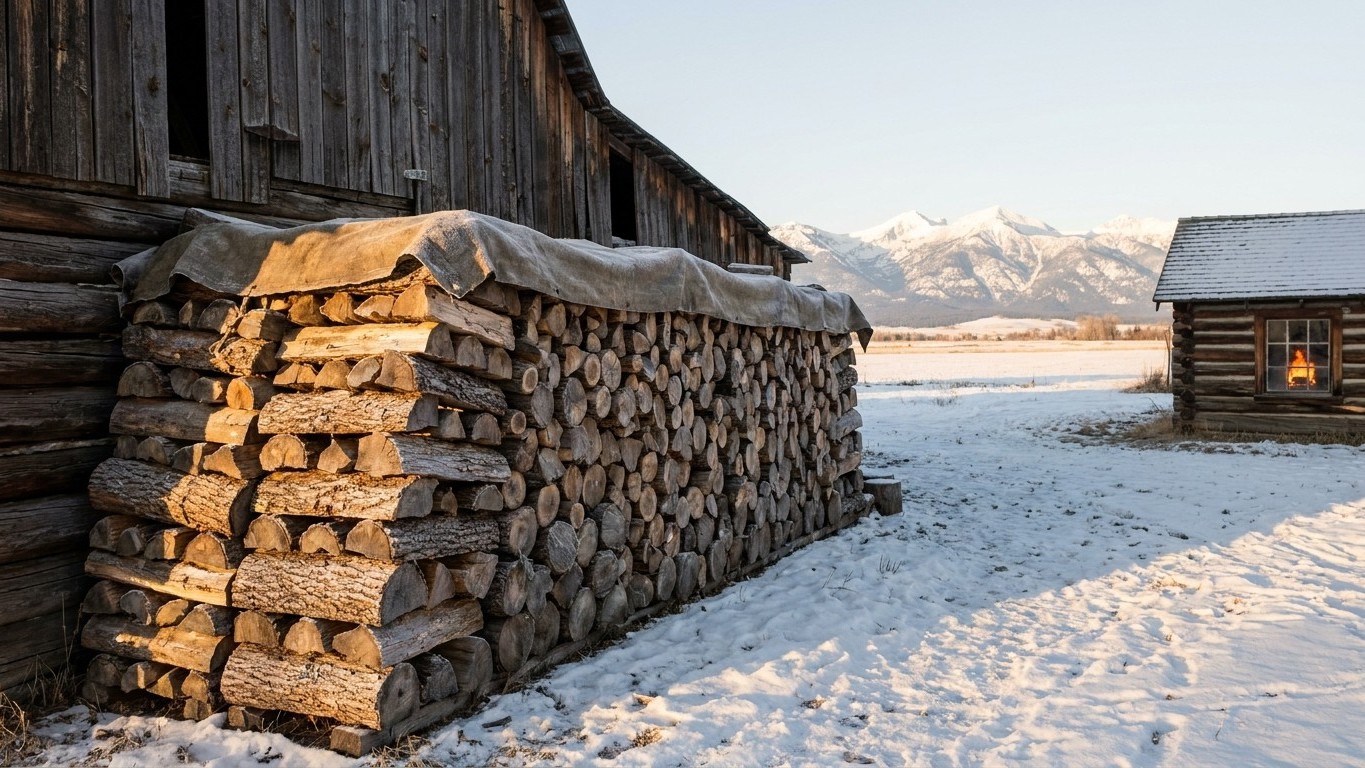

Cheyenne’s coldest month bottoms out at an average low of 18.1°F, according to NOAA Climate Normals. That number is the whole story for anyone asking what firewood Wyoming winters demand. Below freezing for weeks at a stretch changes what a cord needs to do for you: it’s not decoration, it’s the difference between a warm kitchen and a cold one at 3 a.m.
How cold it actually gets here

18.1°F is the mean daily minimum for the coldest month at Cheyenne, the reference station for this data. That’s not the record low, and it’s not some abstract monthly average. It’s the temperature the thermometer sits at, on average, every single night during the worst stretch of winter. Some nights will be milder. Plenty will be worse.
A figure like that puts Wyoming firmly in “wood heat matters” territory. Anything under 20°F for a sustained low means a house is losing heat fast, all night, every night, for weeks. If you’re heating with wood as a primary source, or even leaning on it heavily to cut a propane bill, that cold floor decides how much wood you burn and how dense it needs to be.
What this means for the stove
Above 40°F, firewood is mostly about a good evening and a nice smell. That’s not this climate. At 18.1°F, a stove or insert has to carry real heat load through the night, which means the wood you load before bed needs to still be producing coals eight hours later. That’s a density question first, a species-name question second.
It also means the shoulder seasons, October and April in a lot of Wyoming towns, aren’t really “shoulder” at all. Nights in the 20s aren’t rare in those months either, so the burning season runs longer than a lot of newcomers expect. Anyone budgeting wood for a winter here should count six months of real burning, not four.
None of this means every stick of wood needs to be the densest species available. It means the coldest nights need dense wood on hand, and the rest of the season can be filled with whatever burns clean and is easy to get. The next section breaks down which is which.
Which woods are worth the effort here
A cord is a fixed volume: 4 feet by 4 feet by 8 feet, 128 cubic feet total, stacked. That’s the legal and practical definition, and it matters because a cord of dense wood and a cord of light wood take up the exact same space in your woodshed but hand you very different amounts of heat. Michigan State University Extension puts well-seasoned hardwood at roughly 20 million BTU per cord on average, the rough equivalent of 145 gallons of #2 fuel oil or 215 gallons of LP gas. That average hides a wide spread, though, and the spread is exactly what a Wyoming winter forces you to pay attention to.
Denser hardwoods pack more wood fiber, and therefore more BTU, into that same 128 cubic feet. That’s the wood you want stacked closest to the door on the nights the thermometer is sitting at 18°F or lower: the overnight-burn wood, the stuff you load at 10 p.m. and still find coals from at 6 a.m. Lighter woods burn faster and hotter up front but drop off sooner, which makes them better suited to starting a fire, taking the chill off a fall evening, or filling in during a mild stretch rather than carrying the whole night.
Red oak deserves a specific mention here, not for its heat output but for its behavior in the stack: MSU notes it dries slower than most hardwoods because of its cell structure. That’s not a reason to avoid it. It’s a reason to cut it earlier than everything else if you plan to burn it this winter, a point that connects directly to the seasoning section below.
Availability beats the spec sheet
A wood you can’t buy seasoned, or can’t source locally at all, isn’t a better choice just because it sits higher on a density chart. A modest hardwood that’s actually dry and actually available from a local seller beats a theoretically superior species that shows up green, or doesn’t show up at all. Ask any firewood dealer in southeastern Wyoming what moves fastest and it’s rarely the rarest wood on the list. It’s whatever’s split, stacked, and ready.
| Wood category | Heat output | Smoke | Sparks | Best use |
|---|---|---|---|---|
| Dense hardwood (properly seasoned) | Near or above the 20 million BTU/cord average | Low when dry | Low | Overnight burns, coldest nights |
| Slow-drying hardwood (e.g., red oak) | High once fully seasoned | Higher if underseasoned | Low to moderate | Long overnight burns, but only after extended seasoning |
| Lighter/softer wood | Below the average | Higher | Higher | Starting fires, shoulder-season evenings |
How much wood a winter takes
Any number you see printed for “cords per winter” is close to meaningless without three pieces of information specific to your own house. The cold figure above sets the baseline demand, but it’s only one variable of three, and the other two can swing the real number by a factor of two.
- The cold floor: a winter that averages 18.1°F lows demands more total heat than one that averages 30°F, even in the same state, because Wyoming’s elevation and terrain mean real local variation from town to town.
- How well the house holds heat: an older home with drafty windows and thin insulation bleeds heat constantly, which means the stove has to keep replacing it around the clock. A tightly sealed, well-insulated house holds the heat it makes far longer.
- Whether wood is the main heat source or a supplement: a household burning wood as the sole heat source for a whole winter needs a fundamentally different wood pile than one using a stove for evenings and weekends while a furnace covers the rest.
Run those three down the list for your own house and the estimate starts to take shape. A poorly insulated home in a hard winter can burn double what a tight, well-sealed home burns in that same climate, using the identical stove and identical wood. That gap is why a neighbor’s “I go through four cords a year” is close to useless as a planning number for your place. Their house isn’t your house, and their stove habits aren’t yours either.
The practical move is to track your own burning for one season, note how many cords it actually took, and treat that as your real baseline going forward, adjusting only if you insulate, add a stove insert, or change how much you rely on wood versus another heat source.
Drying wood in this climate
Seasoning matters more than species, in any climate, and Wyoming doesn’t change that rule. What changes is the calendar. MSU Extension is direct about the mechanism: green wood can carry over 60 percent moisture, and every bit of that water has to boil off before the wood gives you any usable heat. That boiling process eats the very energy you were counting on, which is why a stove loaded with green or half-dry wood hisses, smokes, and underheats no matter how good the species is on paper.
The target is 20 percent moisture or less, and getting there takes air moving through split, stacked wood, not sunshine and not a tarp thrown over a pile of rounds. Wood that’s still in round form, uncut and unsplit, resists drying almost entirely, because the bark seals in the moisture. Split it, stack it loosely enough for air to move between the rows, and give it time.
Wyoming’s dry air is an advantage here compared to humid climates, where a short, muggy drying season can drag seasoning out. But dry air alone doesn’t compensate for cutting too late. Wood split and stacked in spring for the winter that follows is, in most cases, not fully seasoned by the time the cold arrives, especially for slower-drying species like red oak, which MSU flags by name as needing extra time due to its cell structure.
That timing mismatch is the single most common mistake in this region: buying or cutting wood in April or May and expecting it ready by October or November. A full summer stacked, ideally cut the winter or spring before, gets most hardwoods down near that 20 percent line by the time the first hard freeze hits. Anything cut this spring for this coming winter should be treated as a bonus supply for next year, not the wood you’re counting on when the thermometer hits 18°F.