
May 7 looks safe on paper, and that’s exactly what burns people. A grower down in a frost pocket near the Annapolis Valley treats that date like a green light, sprays for petal fall, and wakes up to blackened blossoms because the cold air pooled on his low ground while an orchard up the ridge sailed through untouched. The date isn’t wrong — it’s just a midpoint, and half of all years land past it. Nova Scotia’s apple calendar doesn’t run on the calendar at all; it runs on heat the tree has actually banked, site by site.
The short answer for Nova Scotia
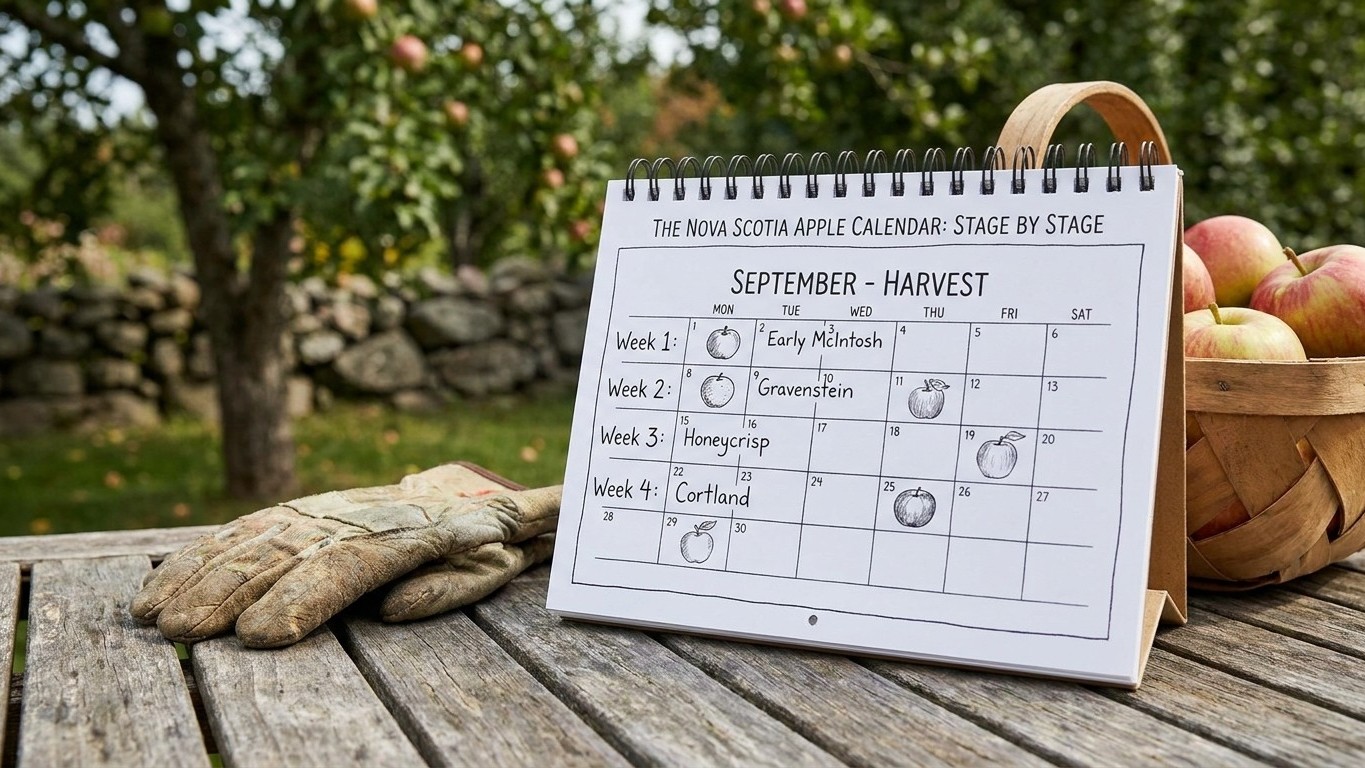
The Nova Scotia apple calendar runs from dormancy through green tip, pink, bloom, petal fall, fruit set, and harvest, each stage triggered by the tree’s own accumulated warmth rather than a fixed month. Environment and Climate Change Canada’s 1981-2010 normals put the mean last spring frost at Halifax Stanfield International Airport on May 7 and the mean first fall frost on October 18. Both figures are means, not cutoffs: in roughly half the years on record, the real frost fell later than that, so treat May 7 as the middle of a risk window, never a date you can plant past safely.
What the calendar actually does in a given year depends on three things: the cultivar’s own bloom timing and chill needs, the site’s exposure to pooling cold air, and how far that site sits from the Atlantic’s moderating influence. A tree on a low, sheltered spot can bloom into danger on a date when a tree a short distance up a nearby slope has already cleared it. Winter cold, not spring frost, is the other filter that decides whether a cultivar belongs here at all: Halifax’s coldest month averages a nightly minimum of -10.4 °C (ECCC, 1981-2010 normals), which most apple cultivars sold in the province tolerate without dieback, though a cultivar bred for a milder climate is a different question. Sorting out that cultivar choice, and matching it to the site, is worth doing before the calendar work starts, a step Growing Apples in Nova Scotia covers in more depth.
Working through it

The season breaks into seven stages, and the stage the tree is actually showing, not the week of the year, is what should decide the next job.
Dormancy

From mid-autumn through the depths of winter the tree sits still, bark grey-brown, buds tight and no bigger than a grain of rice. This is when the region’s winter cold does its work: a coldest-month average nightly minimum of -10.4 °C at Halifax (ECCC, 1981-2010 normals) is cold enough to satisfy the chill requirement of nearly every apple cultivar sold for the province. Prune now, while the tree is bare and cuts close slowly, and hold off on any nitrogen feed until real growth starts.
Green tip

The first flecks of green push through the bud scales as days lengthen, usually weeks ahead of the ECCC mean last frost of May 7 at Halifax Stanfield. The tissue exposed is minimal at this point, so the tree can shrug off a hard freeze it could not survive later. This is the point to apply a dormant oil spray for scale and mite eggs, before the canopy opens enough to trap spray against tender leaf.
Pink

Blossom clusters swell and color rose-pink before the petals separate, typically in the same weeks the mean frost date falls. This stage is far more frost-tender than green tip: a freeze that would barely mark a dormant bud can blacken an entire pink cluster. Because May 7 is a mean and not a boundary, expect the pink stage to run into frost risk in roughly half of all years, and watch the forecast rather than the calendar.
Bloom

Open white flowers, pink at the base, mark the most frost-sensitive stage of the whole season and also the stage that sets the year’s crop. Bees need calm, mild days to work the blossom, so cold, wet weather around bloom costs fruit twice: fewer flowers survive the cold, and fewer of the survivors get pollinated. A home orchard’s practical defense against a late frost during bloom is choosing a cultivar that flowers a few days later than the earliest options, an angle covered on The Best Apple Varieties for Nova Scotia.
Petal fall

Petals brown and drop, leaving a small green fruitlet at the base of each flower. Frost tolerance improves slightly at this stage but is still far below what a dormant bud can take. This is the practical window for the first fungicide cover spray against apple scab, since the flower parts that carry disease spores are now gone.
Fruit set

By early summer the fruitlets that survived pollination swell to pea size, and the tree drops a share of them on its own in the “June drop.” Thin what remains to one fruit per cluster now, spaced by hand, to build size and to stop the tree from biennial bearing the following year. Frost is no longer a working risk by this stage.
Harvest
Fruit color and firmness, not a date, decide when to pick, and different cultivars on the same tree row finish weeks apart. The ECCC mean first fall frost at Halifax Stanfield falls on October 18, and a light frost does little harm to fruit still hanging on late-season trees, though wood still soft with late growth is a separate risk covered below. Get the crop in ahead of a hard freeze, and store only fruit that is sound, since one bruised apple speeds the rot of its neighbors in storage.
What changes across Nova Scotia
The Halifax Stanfield figures above are a starting point, not a provincial average. Nova Scotia’s growing conditions shift with elevation, distance from the coast, and whether a given site drains cold air or traps it.
The Annapolis Valley, the province’s main apple-growing region, sits inland between two ridges that block much of the direct Atlantic wind, which lets it run warmer summer days than the coast. The same ridges also trap cold air on clear nights, so valley-bottom orchards there can see a harder spring frost than an orchard on the surrounding mid-slope even a short distance away, which is why growers there favor planting on the slope rather than the flat.
Coastal districts along the South Shore and the Atlantic side of the Eastern Shore get the opposite trade. The ocean moderates both extremes, so winter lows rarely reach the depths an inland valley sees, but that same moderation delays spring warm-up and keeps bloom running later, with more fog and slower ripening through summer.
Inland and upland areas away from Halifax’s own harbor, and higher ground toward the Cape Breton highlands, run colder in winter and later in spring than the Halifax Stanfield normals describe. A grower in one of those spots should expect green tip, pink, and bloom to lag the Halifax dates by days to weeks depending on elevation, and should read the tree’s own bud stage rather than assume the Halifax figures apply directly.
| Region | Main influence | Typical shift vs. Halifax Stanfield normals | Main risk |
|---|---|---|---|
| Annapolis Valley, valley bottom | Ridges block wind, trap cold air at night | Warmer summer days, but harder frost on low ground | Spring frost pooling on the flats |
| Annapolis Valley, mid-slope | Same ridges, but air drains downhill | Close to the Halifax normals | Lower frost risk than the valley floor |
| South Shore / Atlantic coast | Ocean moderation | Milder winter lows, later spring bloom, cooler summer | Fog and slow ripening |
| Inland uplands / Cape Breton highlands | Elevation, distance from coast | Colder winter, later spring, earlier fall frost | Short effective season |
The mistakes this climate punishes
Most crop losses in this climate trace back to a handful of choices that read fine on paper and fail at a specific stage, not as a vague bad year.
- Choosing an early-blooming cultivar on a low or sheltered site prone to frost pooling.
- Trusting the average winter minimum to rule out a marginal-hardiness cultivar.
- Feeding nitrogen into midsummer or later instead of stopping by early summer.
- Skipping the dormant prune and letting the canopy stay dense into bloom.
Why each one bites
An early bloomer flowers close to the calendar’s most frost-tender stage, right around the ECCC mean last frost date of May 7 at Halifax Stanfield. Because that figure is a mean and not a cutoff, a grower who plants for an average year gets caught in the years frost runs later, and the damage shows as blackened blossom clusters with no fruit to follow, not as a damaged tree.
Halifax’s coldest month averages a nightly minimum of -10.4 °C (ECCC, 1981-2010 normals), but an average month still contains colder nights than its own mean, and a single hard snap in a severe winter can kill wood on a cultivar chosen for a milder climate. That damage shows the following spring as dead branch tips or a tree that leafs out on only part of its canopy.
Late nitrogen keeps shoots growing soft and unhardened into autumn, and that soft growth is what a frost near the ECCC mean first fall date of October 18 damages first, well before it touches mature wood. Stop feeding by mid-summer so new growth has time to harden before the season’s first cold nights.
Checking this against your county
The Halifax Stanfield figures above are the only province-wide frost normals cited here, and they will run early for the Annapolis Valley floor and late for the uplands. For a planting or spray calendar tuned to your own county, the Nova Scotia Department of Agriculture’s extension service is the source to check, since it tracks local conditions and pest and disease timing that a provincial average cannot capture. Call before committing to a spray date or a bloom-sensitive cultivar, particularly if your site sits in a valley bottom or well above the Annapolis Valley floor, where the gap from the Halifax normals runs largest.
Common questions
Can I still grow apples if my property is well inland or up in elevation?
Yes, but the calendar above will run later than the Halifax Stanfield normals suggest, and cultivar choice matters more than it does near the coast. Pick a variety proven hardy for a shorter, cooler season, a choice The Best Apple Varieties for Nova Scotia walks through, and expect bloom to lag the May 7 mean by days to weeks depending on how far inland or how high up you sit.
How do I tell what stage my tree is at without checking a calendar?
Look at the buds themselves rather than the date. Tight grey-brown buds with no color mean dormancy, a fleck of green at the tip means green tip, a swollen rose-colored cluster before the petals separate means pink, and open white flowers mean full bloom. The stage read off the tree is always more reliable than a date carried over from last year.
Will one light frost after petal fall wipe out the crop?
Usually not the whole crop. Fruitlets gain some frost tolerance once the petals drop, and a light frost typically damages only the most exposed clusters rather than every flower on the tree, so a partial crop is the more likely outcome than a total loss.
My tree bloomed heavily but set almost no fruit. What went wrong?
Cold, wet, or windy weather during bloom keeps bees from working the blossom, and without pollination a heavy bloom still sets little fruit. Check also whether the tree has a compatible pollenizer nearby, since many apple cultivars need a different variety blooming at the same time in order to set a crop at all.