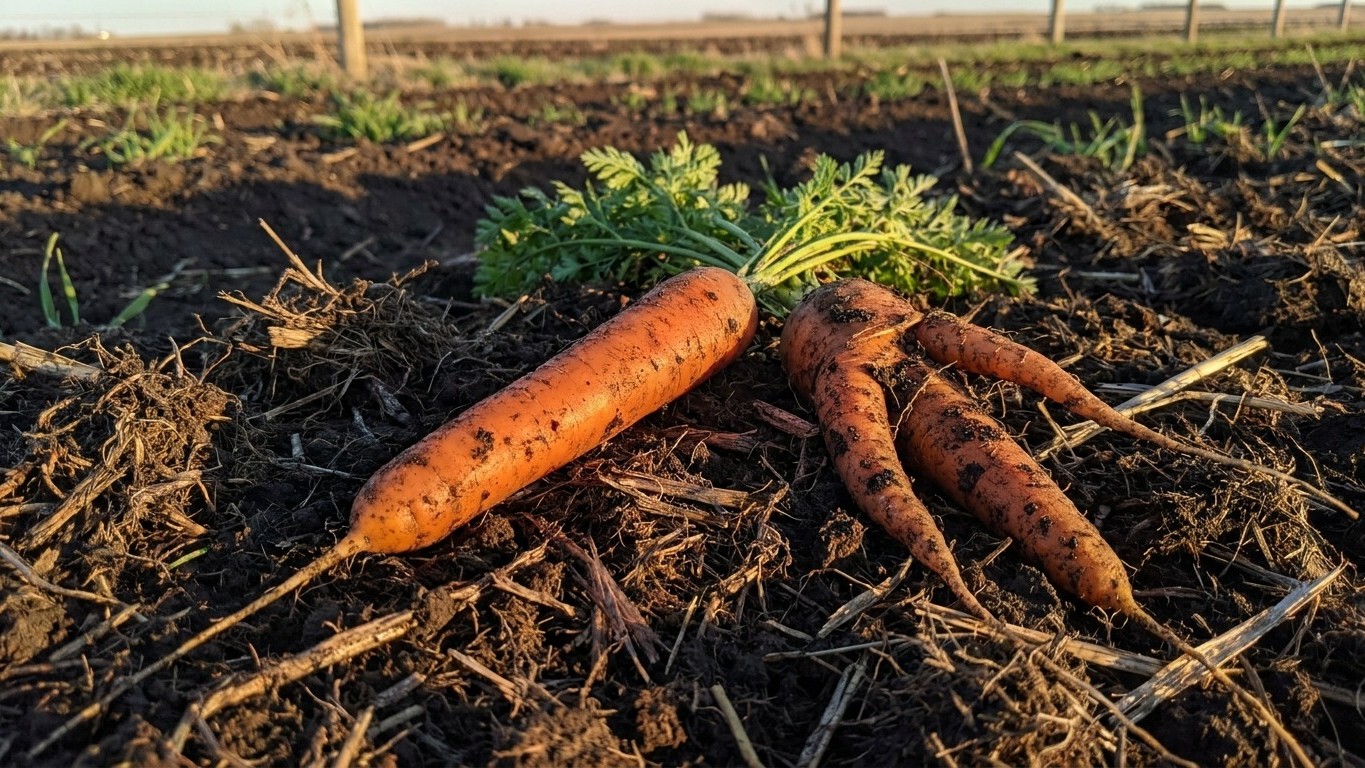

Carrots are sown where they grow, so the clock starts the day the seed goes in: pull them 70 to 100 days after seeding, depending on the type on your packet. Clemson Cooperative Extension puts the early end at “about 65 to 75 days after planting.” Once they’re out, cut the tops off and hold the roots at 33 °F with high humidity. Nova Scotia’s ground adds a wrinkle, because what the roots meet underground decides whether they come out straight.
The short answer
What the province’s ground is made of
The most common surface soil in Nova Scotia is a Podzol, the acid, leached soil that forms under conifers, where rain has washed the bases out of the topsoil. In Agriculture and Agri-Food Canada’s Canadian Soil Information Service data, Podzols cover 53 percent of the mapped surface, with Gleysolic soils next. Across 472 mapped surface horizons, the median texture is loam to silt: 52 percent sand, 10 percent clay and 38 percent silt. Organic matter is about 2.1 percent, the median surface pH is about 5.2 (strongly acid), and the drainage class is imperfectly drained.
Canada has no official provincial soil series the way a US state does, so there is no single series name to give you. What you have above is the dominant profile of the province: the commonest soil order and the median of its measurements. Nova Scotia spans hundreds of soils, which makes this a starting point, not a diagnosis. The survey covers agricultural land, and river bottoms, wet ground, and any lot a builder has scraped or filled can look nothing like it. That 5.2 is the province’s median, not your pH.
Will a carrot fork in it?
Utah State University Extension describes the carrot’s ideal as deep, sandy, well-drained soil rich in organic matter, and says heavy or rocky soil makes the root fork. Laid against that, the median Nova Scotia profile is better than its reputation suggests. Ten percent clay is not heavy, and more than half the mineral content is sand. On texture alone, a typical patch won’t force a carrot into a pitchfork shape.
Two things pull the other way. Imperfect drainage means water lingers longer than a carrot likes, and 2.1 percent organic matter is modest next to the “rich in organic matter” the crop wants. Stones, which this median can’t show you, are the other forking culprit.
So the practical answer is this. In ordinary loam, work in plenty of compost and double dig, as Utah State advises for heavy soil. Where the ground stays wet or turns out stony or clayey, build a raised bed and fill it with loose, compost-rich soil. A different variety won’t fix a drainage or compaction problem. For more on how the ground shapes the roots, see Will Carrots Fork in Nova Scotia Soil?, and for the bigger picture, Growing Carrots in Nova Scotia.
The test that settles it in your own garden
The province’s median tells you what the region’s ground tends to do. It can’t tell you what is under your hose. An afternoon with a spade settles it, and none of it needs equipment.
Four checks, in order
- Dig a hole at least as deep as the carrots you hope to grow are long. Look at the wall of the hole. Note where the dark topsoil ends, whether a pale, hard or cemented layer sits beneath it, and how many stones show in the face.
- Go through the soil you removed. Crumble it through your fingers and set aside every stone and hard lump. A growing root that meets one has to bend or split around it, and that is where forks begin.
- Feel the texture. Squeeze a moist handful and rub it between your fingers. Gritty and falling apart means sand. Smooth and silky, like flour, means silt. Sticky, holding together and pressing into a long ribbon means clay.
- Watch the water. Fill the empty hole with water and let it sink in, then fill it again and watch. Water that drops steadily means the ground drains. Water that sits and shines means a hard layer or wet ground below. Run this in spring, when you’d actually be sowing, because wet-season drainage is the one your carrots will live with.
Reading what you found
Dark soil to the bottom of the hole, few stones and water that drains is good news. Add compost, loosen the bed deeply and sow.
A hard layer, or lots of stones, calls for double digging, which means loosening the lower layer without burying the topsoil. If the ribbon was long and sticky, or the water sat, a raised bed is the faster fix. Drainage problems don’t improve much by adding sand to clay, but a bed built up above the wet ground sidesteps them.
The hole won’t give you your pH or your exact organic matter. A soil test will, and it replaces the 5.2 and 2.1 percent above with your own numbers. The sources behind this page give no target pH for carrots, so I won’t invent one. Let the lab report guide any amendment.
What goes wrong here
In the ground
- Forked, stubby or twisted roots. Heavy, compacted or stony soil is the cause. The remedy is plenty of compost, double digging, every stone picked out, or a raised bed where the ground is hopeless. Ordinary seed won’t behave differently in the same bad bed.
- Waterlogged rows. Imperfect drainage is the median here, and Gleysolic soils, the province’s second most common, form where ground is saturated. Roots sitting in wet soil stall or rot. Raise the bed, and don’t sow into ground that is still squelching in spring.
- Poor germination in a hot spell. Carrots are sown in place, with no transplant to fall back on, so a patchy row is a patchy crop. Carrot seed is slow to sprout, and a surface that dries or crusts over stops it altogether. Keep the seed row evenly moist, cover it lightly with a board or a thin mulch until sprouts show, and re-sow gaps promptly.
- Splitting from uneven water. A long dry stretch followed by a soaking makes the root swell faster than its skin can stretch, and it cracks. Water on a steady schedule and mulch to even out moisture. The compost you dug in earlier helps here too, because organic matter holds water between rains.
- Damage blamed on soil that is really an insect. Tunnels and scarred roots often come from pests, not texture. What Eats Carrot in Nova Scotia, and When covers how to tell the difference.
- Pulling by guesswork. Because the 70 to 100 days run from seeding, write the sowing date on a label at the end of the row. Start checking when the early end of that range arrives, and pull a test root before lifting the lot.
After the harvest
- Tops left on. The leaves keep drawing moisture out of the root, which is why bunched carrots, tops attached, keep only about 10 to 14 days, while trimmed ones keep for months. Cut the tops off as soon as the carrots are out of the ground.
- Storing them too warm. Clemson’s advice is to store carrots at 33 °F and high humidity to prevent wilting. That is just above freezing, and nothing like a typical basement or cellar in early fall. At 50 °F a carrot sprouts and goes soft in a fraction of the time.
- Storing them dry. Low humidity wilts the roots even at the right temperature. The target is cold and humid together, so don’t leave them open to dry air.
Common questions
How do I know when carrots are ready to pull?
Count from the day you seeded. Most carrots are ready between 70 and 100 days later, and your seed packet narrows that range for your type. Clemson Extension puts harvest at about 65 to 75 days after planting for its crop. Check the row around the early end of your range, brush soil from a shoulder, and pull one test carrot to see whether it has sized up.
Can I leave carrots in the ground?
They will sit in the ground for a while once sized, but this page carries no frost date for Nova Scotia, so I can’t tell you how long. Watch your local forecast and lift the crop before the soil freezes solid.
Does Nova Scotia soil mean I need a raised bed?
Not automatically. The province’s median profile is loam to silt with only 10 percent clay, so many gardens can get by with compost and double digging. Choose a raised bed if your test hole holds water, shows a hard layer, or turns up clay or stones throughout.
How do I keep carrots after pulling them?
Cut the tops off first, then store the roots at 33 °F in high humidity. Leave the tops on and the leaves pull moisture out of the roots, so bunched carrots last only about 10 to 14 days. Trimmed roots can last for months if the cold and humidity hold.