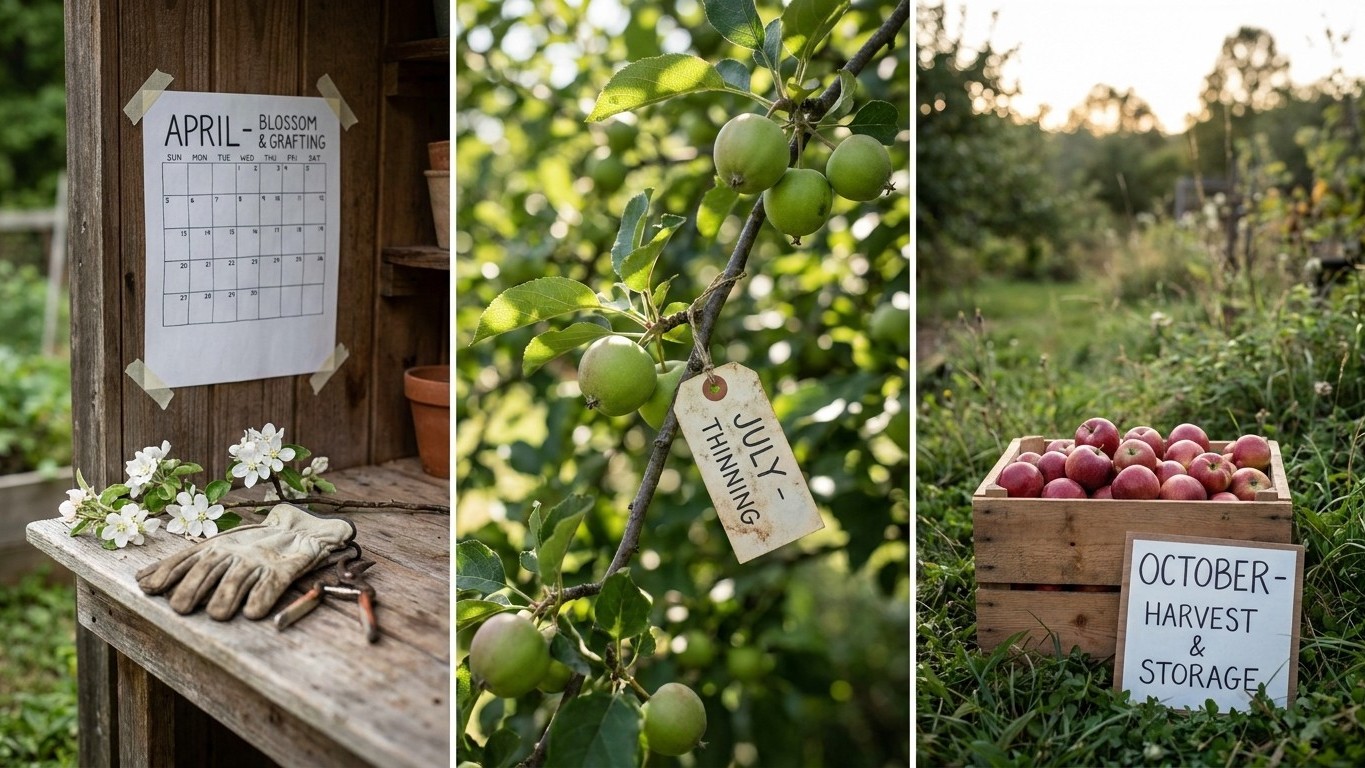

West Virginia’s apple calendar runs on frost, not on the month printed on a wall calendar. At the Charleston reference station, NOAA’s 1991-2020 climate normals put the last spring freeze between April 9 and April 23, and the first fall freeze between October 18 and November 1. Everything an apple tree does between those two windows, from green tip to picking, has to fit inside them. Check your tree’s bud stage against the April frost window before you decide a bloom is safe, not the date on the calendar.
The short answer for West Virginia
Frost, not the date on your wall calendar, is what decides how West Virginia’s apple season runs, and the tree tells you where you stand better than a chart does. In Charleston, the last spring freeze typically falls between April 9 and April 23 — earlier if you’re near the Ohio River or the Eastern Panhandle’s orchard valleys, later if you’re up in the mountains to the east. So before you trust a warm stretch in April, go look at your buds: if they’re still tight or just showing green, you have room; if they’re pink or open, check that date against your local frost window before you relax.
What that answer depends on is elevation and which side of the state a tree is standing on. Charleston sits in a river valley at moderate elevation, and its frost dates run later in spring and earlier in fall than the mountainous counties to the east, and earlier in spring and later in fall than the milder lowlands closer to the Ohio River and the Eastern Panhandle’s orchard valleys. The coldest month at Charleston averages a daily minimum of 26.3°F, per NOAA’s 1991-2020 normals, which sits comfortably within the winter hardiness of every standard apple cultivar sold in the state. Killing cold is not the usual risk here. Frost arriving at the wrong bud stage is.
That distinction between hardiness and timing is what the rest of this calendar is built on. A tree can sail through a West Virginia winter without damage and still lose its entire crop to a freeze that lands on open blossoms weeks after the average last-frost date, because “average” describes a 30 to 70 percent probability band, not a promise.
Working through it

An apple tree’s year is a sequence of stages, and each one carries a different frost tolerance and a different job for the grower. Reading the stage, not the calendar, is what keeps a crop alive through a variable spring.
Dormancy

From leaf drop in fall through the depth of winter, the tree has no exposed green tissue and can tolerate cold well beyond anything West Virginia’s winters typically deliver. This is the window for structural pruning, dormant oil applications for scale and mite eggs, and any soil work. Nothing here is vulnerable to frost, because there is nothing tender exposed to it.
Green tip

Buds swell and split to show the first sliver of green leaf tissue. This is the first stage with any exposed growth, and it tolerates a hard freeze better than any stage that follows it, though a severe one can still burn the tips. Green tip is triggered by a run of warm days, not a date, which is why it can arrive on a similar day in a mild spring even before the April 9 to April 23 last-frost window (NOAA, Charleston) has closed.
Pink

Blossom color shows clearly through the still-closed bud. This is the last practical point for a delayed-dormant spray, and it is also where frost sensitivity starts climbing sharply. If a grower has not already chosen varieties suited to this timing, pink is the last stage at which that choice still matters. Reviewing The Best Apple Varieties for West Virginia before pink shows on the buds is more useful than reviewing it after.
Bloom

Open flowers are the single most frost-sensitive stage a tree passes through all year. A freeze that hits open blossoms, especially one that lands squarely inside the April 9 to April 23 window NOAA’s Charleston normals describe, can cut a crop to nothing even on an otherwise healthy tree. Bloom is also when pollinators need to be active, so cold, wet, windless days during this stage cost fruit set even without a hard freeze.
Petal fall

Petals brown and drop, and the fruitlet begins forming at the base of each spent blossom. Fire blight risk is highest here in warm, wet weather, since the tissue is soft and freshly exposed. Thinning sprays, where used, are timed to this stage rather than to bloom itself.
Fruit set and June drop

The tree naturally sheds a portion of its young fruit a few weeks after bloom. Hand-thinning the remainder to one apple per cluster, spaced along the branch, is what produces full-size fruit instead of a heavy crop of small ones.
Harvest
Ripeness is read from the fruit, by ground color, seed color, and ease of separation from the spur, not from a date on a calendar. The relevant frost constraint at this end of the season is the first fall freeze, which NOAA’s Charleston normals place between October 18 and November 1. Most standard cultivars are picked well before that window opens, but a late-maturing variety left on the tree into that stretch is gambling with a freeze that can soften and split the fruit overnight. Anyone still deciding what to plant, rather than what to pick, is better served starting from Growing Apples in West Virginia before working forward into this calendar.
What changes across West Virginia
A state this mountainous does not have one apple calendar, it has several, and elevation is the biggest reason. Higher ground in the eastern highlands, the Allegheny counties around Pocahontas, Randolph, and Tucker, cools faster in fall and holds cold longer in spring than the Charleston valley the NOAA figures above are measured at. NOAA’s own caution on the Charleston normals notes that higher elevations across the state freeze noticeably earlier in fall than the river-valley station the data comes from, and the same logic runs in reverse each spring.
The Eastern Panhandle, around Berkeley and Jefferson counties, sits at generally lower elevation and has long been apple-growing country in the state for that reason. It tends to run milder and to hold its frost-free stretch a bit longer than the mountain interior, though no station-level NOAA figure for that specific area is given here, so treat it as a general tendency rather than a fixed date. The lower reaches of the Ohio River valley run a similar pattern for the same reason, less elevation, more retained warmth.
Valley bottoms anywhere in the state, regardless of region, tend to pool cold air on clear, calm nights, which is why an orchard on a slope often escapes a frost that hits a planting in the hollow below it by several degrees. This is a site effect layered on top of the regional one, and it matters most at bloom, when a few degrees decide whether a crop survives.
| Area | Frost timing relative to Charleston | What drives it |
|---|---|---|
| Charleston river valley (NOAA reference station) | Baseline: last frost April 9-23, first fall frost Oct 18-Nov 1 | Moderate elevation, valley setting |
| Allegheny highlands (Pocahontas, Randolph, Tucker counties) | Generally earlier in fall, later in spring | Higher elevation |
| Eastern Panhandle orchard valleys (Berkeley, Jefferson counties) | Generally milder, longer frost-free stretch | Lower elevation |
The mistakes this climate punishes
Planting an early bloomer where cold air pools
An early-blooming cultivar set in a valley bottom or a low frost pocket is the single most common way a West Virginia grower loses a crop. The tree isn’t damaged by winter, it blooms into a frost that a slope fifty feet higher would have missed. This shows up as blackened blossom centers and a near-total absence of fruit set the following month, on a tree that otherwise looks healthy.
Trusting a mild winter to mean an early, safe spring
A warm February or March can push buds toward green tip and pink well ahead of a typical year, which feels like a head start but actually extends the number of days the tree spends exposed before NOAA’s April 9 to April 23 Charleston frost window has closed. The mistake shows up as frost damage on a bloom that a grower assumed was safely late.
Feeding nitrogen too late in the season
A dose of nitrogen fertilizer applied in mid to late summer keeps the tree pushing soft new growth right up to fall, and that soft tissue is exactly what gets hurt first when the first freeze arrives, per NOAA’s Charleston normals, between October 18 and November 1. The damage shows up as blackened, wilted shoot tips within days of the first hard freeze, on wood that would have hardened off fine if feeding had stopped earlier in the growing season.
Picking a very low-chill variety for the wrong reason
West Virginia’s winters deliver plenty of chilling hours in an ordinary year, so chill requirement is rarely the limiting factor here the way it is farther south. The mistake is choosing a variety for its chill tolerance without checking its bloom timing against local frost, since a variety bred to break dormancy early in a mild climate will do exactly that here too, straight into whatever frost risk remains on the calendar.
Checking this against your county
Every figure above is measured at or near Charleston, and a grower an hour in any direction, especially uphill, should expect the real dates to differ by days to weeks. WVU Extension is the resource built to answer that question at the county level, with agents who know the local frost pattern, not just the station average.
Before committing a bloom date, a spray schedule, or a harvest window to memory, check it against WVU Extension for the specific county the orchard sits in. That single check is worth more than any date printed here, because it accounts for the elevation and site effects a statewide figure cannot.
Common questions
Is West Virginia too cold to grow apples?
No. NOAA’s 1991-2020 normals put Charleston’s coldest month average minimum at 26.3°F, which is well within the winter hardiness of standard apple cultivars. The real risk in this state is frost timing at bloom, not winter cold killing the tree.
How do I know if my tree bloomed too early?
Compare the date your blossoms opened to the last-frost window for your area, and if it’s inside or close to the early edge of that window, check the blossom centers a day or two after any freeze. A frost-killed blossom shows a blackened or brown center where a healthy one stays pale.
Do I need to spray at every stage listed here?
No, spray needs depend on what pests and diseases are actually present in a given orchard, not on the calendar stage alone. Pink and petal fall are the two stages most commonly tied to a spray decision, but a county extension agent can say what’s actually worth spraying for in a specific area.
Why did my tree bloom weeks before my neighbor’s, same variety?
Site differences, especially elevation and whether cold air pools on the property, can shift bloom timing by a couple of weeks even between nearby trees of the same cultivar. A tree in a low, sheltered hollow will often run warmer and bloom earlier than one on an open slope nearby, which changes its frost exposure even though the variety and the regional climate are identical.