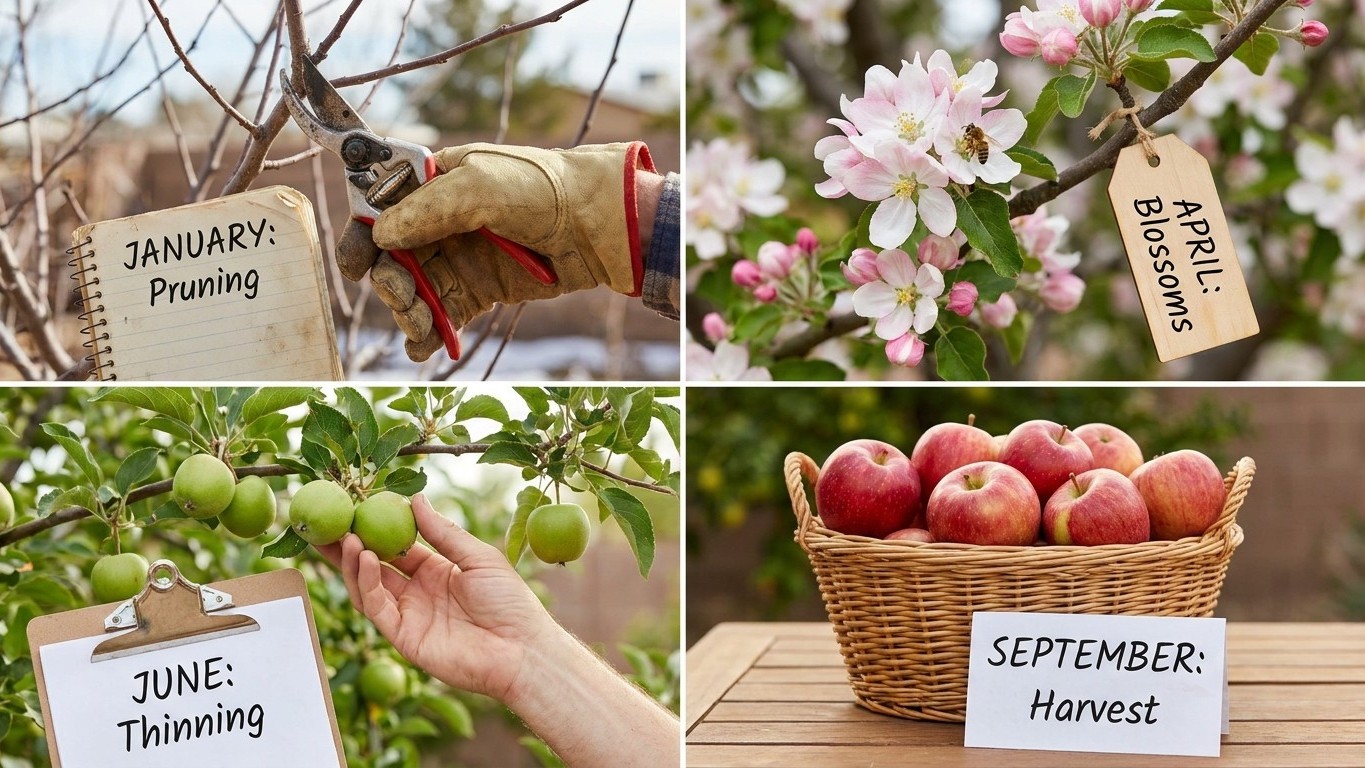

Phoenix apple trees don’t run on a frost date, because there almost isn’t one. What sets your tree’s whole year is winter chill and how fast summer heat arrives, and both of those are already written into the cultivar you planted. So before you circle a month on any calendar, go check what chill hours that tree needs and compare it to what Phoenix nights actually give it, an average low of 44.8°F on the coldest nights. Match those two numbers, and the rest, budding, bloom, harvest, plays out on its own schedule underneath your tree, not on a wall.
The short answer for Arizona
What decides the calendar
In the low desert around Phoenix, an apple tree’s year is decided by chill hours in winter and heat in early summer, not by a frost date. NOAA’s 1991-2020 climate normals put the average nightly minimum for Phoenix’s coldest month at 44.8°F, which is mild. Most apple cultivars need long stretches of nights well below that to break dormancy evenly, so a tree planted here has to be a genuinely low-chill selection or it will leaf out late, bloom thin, and set little fruit.
Frost still happens on rare occasion. NOAA’s climate normals and daily records from station USW00023183 show a cold snap reaching 32°F in 6 of the last 30 winters, arriving somewhere between late December and mid-January. That isn’t frequent or reliable enough to build a planting calendar around, and it’s too late in the season to affect bloom, which for low-chill apples in the desert opens afterward, in late winter.
This calendar also depends on how quickly heat arrives in early summer, since Arizona’s growing season doesn’t end with a freeze. It ends with weeks of daytime highs that stall a tree’s ability to finish and hold fruit, so harvest timing for a desert apple is really about beating that heat rather than dodging cold.
So the short answer: choose a cultivar for the chill your winter actually delivers, then let that cultivar’s own stages, not a date on the wall, tell you when to act. The answer changes completely at elevation, since places like Flagstaff sit in a different climate with a real winter freeze, and the whole calendar below shifts with it.
Working through it

An apple tree’s calendar is really seven stages, and in the desert each one is triggered by chill and warmth rather than by frost thawing out. Here is what each stage looks like and what decides when it starts.
Dormancy through bloom
Dormancy runs through the coldest stretch of winter, when the tree needs consecutive cool nights to satisfy its chill requirement. In Phoenix, NOAA’s 1991-2020 normals put the coldest month’s average nightly minimum at 44.8°F, which is borderline for chill accumulation even for a cultivar bred for low chill. Trees that don’t get enough hours below that threshold come out of dormancy unevenly the following spring.
Green tip is the first visible sign that dormancy is ending, when the bud scales split and a sliver of green leaf tissue shows. In the low desert this can arrive earlier than a grower expects, because there’s no lasting cold to hold it back once chill is satisfied and days start warming. Watching the tree itself, rather than a date, matters here since green tip on one tree can run two or three weeks ahead of a tree a few miles away, depending on microclimate and cultivar.
Pink stage follows, when the flower buds show color before the petals separate. Because Phoenix’s frost-free season runs 365 days most years, according to NOAA, pink stage here isn’t the danger point it is in a climate with a real spring freeze. The bigger risk runs the other way: pink and bloom arriving so early, in a mild winter, that pollinators aren’t yet active in numbers.
Bloom is the pollination window, and it needs bees moving. A cultivar chosen for the desert, of the kind discussed in The Best Apple Varieties for Arizona, typically blooms in late winter here, well ahead of where a cold-climate apple would bloom. Because that rare 32°F cold snap, when it happens, tends to land between late December and mid-January according to NOAA’s daily records, it’s usually over before bloom opens, so it rarely touches open flowers directly. A grower in a colder pocket of the state should still confirm local timing before assuming the same.
Fruit set through harvest
Petal fall marks the point where pollination has either taken or it hasn’t. Petals drop and the small green fruit begins to swell, and this is the moment to judge whether chill was adequate, since a tree that broke dormancy unevenly will show it here as patchy, scattered set rather than a full flush.
Fruit set is where a poorly chilled tree loses its crop. Weak or delayed bloom from insufficient winter chill often produces flowers that open out of sync with each other, so pollination is spotty and many blossoms drop without setting fruit at all.
Harvest for the low-chill cultivars that actually work in the desert lands in late spring to early summer, well before the hottest stretch of the year. That timing isn’t incidental. A low-chill apple is bred to finish before the season’s real limiting factor, sustained heat, degrades flavor and texture past their best.
What changes across Arizona
Low desert, high country, and the space between
Every figure above is measured at or near Phoenix, and Phoenix isn’t Arizona’s only apple climate. Elevation is the biggest variable in the state, and it changes both how much chill a tree gets and whether frost is a real threat at all.
The low desert, Phoenix, Tucson, and similar elevations, runs mild winters that barely deliver enough chill for even a low-chill cultivar, and a freeze is rare enough that NOAA’s normals list the frost-free season there at 365 days. The high country around Flagstaff and similar elevations sits in a genuinely different climate, with a real winter freeze most years. That means far more reliable chill accumulation, which opens the door to higher-chill cultivars that would never flower properly in Phoenix, but it also means a real spring frost risk that a low-desert grower never has to think about.
In between sit the transition zones, places like the Verde Valley and other mid-elevation pockets, where cold pools in low ground on clear winter nights even when the surrounding hills stay milder. A valley floor a few hundred feet lower than the land around it can hold a frost pocket long after nearby fields have warmed, so two orchards a short drive apart can end up on different calendars entirely.
| Region | Winter character | Frost risk | Best-suited chill class |
|---|---|---|---|
| Low desert (Phoenix, Tucson) | Mild nights, coldest month averages 44.8°F minimum (NOAA) | Rare; frost-free most years per NOAA | Low-chill only |
| High country (Flagstaff and similar elevation) | Genuine winter cold | Regular hard freeze | Moderate to high chill |
| Transition zones (e.g. Verde Valley) | Variable, cold air pools in low ground | Localized frost pockets | Site-dependent, check locally |
None of this means an apple tree can’t be grown outside the low desert or the high country. It means the cultivar and the calendar both have to match the specific elevation, and a grower moving even twenty miles from Phoenix into higher ground should confirm local conditions rather than assume the Phoenix figures apply.
The mistakes this climate punishes
Where each mistake shows up first
The biggest one is planting a high-chill cultivar in the low desert. It survives the winter fine, since Phoenix’s mild lows won’t kill it, but it never accumulates the chill hours it was bred for, so it breaks dormancy late, unevenly, and thin. This shows up in year one, right at bloom, as a tree with far fewer flowers than its label promised and a scattering of undersized fruit by early summer.
The opposite mistake shows up in the high country. A very low-chill cultivar planted where winters run genuinely cold can bloom too early for its own good, opening flowers into a stretch of the season where a hard freeze is still a real possibility. That risk belongs to Flagstaff-elevation growers, not to the low desert, where the rare 32°F cold snap NOAA records almost always lands before bloom, not during it.
Feeding too late in the season punishes both regions, but differently. In the low desert, late nitrogen pushes soft new growth right into the worst of summer heat, exactly when the tree should be finishing fruit rather than building leaves. In the high country, that same late feeding pushes soft growth into the season’s first hard freeze, and it’s that new growth that dies back first.
A few other errors are easy to miss until harvest:
- Watering on a fixed schedule through dormancy, which can waterlog roots when the tree isn’t using much moisture.
- Assuming the calendar runs by month rather than by stage, and pruning or spraying weeks off from when the tree actually needs it.
- Leaving low-chill fruit on the tree past its ripening window, since desert heat degrades flavor and texture fast once harvest stage passes.
Each of these costs a season, not a tree, but a repeated mistake, feeding late every single year, for instance, will eventually weaken the tree enough to cut yield permanently.
Checking this against your county
Every figure here comes from Phoenix, and the rest of the state runs on its own numbers. Before committing to a calendar, check your county’s chill accumulation and frost history with the University of Arizona Cooperative Extension, extension.arizona.edu, which maintains offices by county and can point you to whatever weather station data applies to your elevation.
This matters most for anyone outside the low desert or the high country proper, since the transition zones in between don’t have one clean answer. If you’re still deciding what to plant in the first place, start with Growing Apples in Arizona for the groundwork before working out your own stage-by-stage timing.
Common questions
Can I grow apples in Phoenix at all?
Yes, but only with a genuinely low-chill cultivar, since Phoenix winters rarely deliver enough cold to satisfy anything else. Expect a shorter, earlier season than an apple tree would have anywhere colder.
Do I need to worry about frost killing my apple blossoms in Phoenix?
Rarely. NOAA’s records show Phoenix reaching 32°F in only 6 of the last 30 winters, and that cold snap tends to land between late December and mid-January, before bloom opens. It’s still worth checking a forecast in that window if your tree is running early for its stage.
Why did my apple tree bloom but set almost no fruit?
The most common cause in this climate is insufficient winter chill, which makes bloom open unevenly and pollination spotty. It can also mean too few pollinators were active during the short bloom window, or that a hot spell hit right at petal fall and dried out the flowers before they could set.
When should I prune my apple tree in Arizona?
Prune during dormancy, before green tip appears, rather than on a fixed date, since dormancy timing shifts with how mild or cool the winter runs. Check the buds themselves each year instead of marking a calendar date and pruning by that alone.