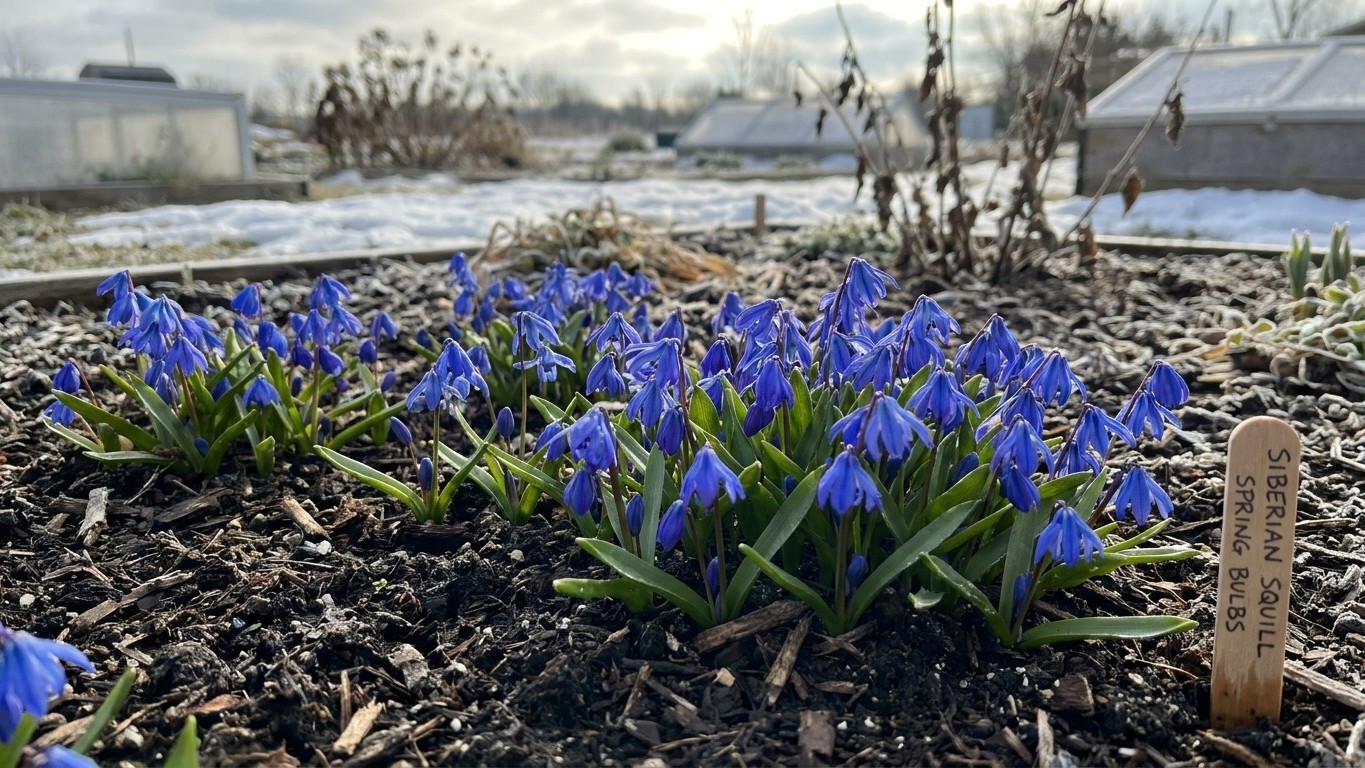

Siberian squill needs 12 to 15 weeks below 45°F to flower at all, and it’s hardy down through USDA zone 2, which makes it the toughest spring bulb sold in this country. Plant it 3 inches deep and 3 inches apart, and once it settles in, it tends to stay for good.
What Siberian Squill actually is

Before anything else, two numbers matter more than color or bloom shape. Siberian squill is hardy across USDA zones 2-8, a range that covers nearly every climate in the continental United States and reaches into conditions few other spring bulbs tolerate. And it needs 12 to 15 weeks below 45°F to produce a flower, according to the Flower Bulb Research Program at Cornell University’s Department of Horticulture. That cold requirement isn’t a rough guideline. Fall short of it and the bulb often still sends up leaves, just no flower, or a bloom stalk too short to notice above the foliage. A bulb that lands just under the threshold usually doesn’t fail outright either. It flowers thin, sparse, unconvincing. Anyone gardening near the edge of that 12-to-15-week window should expect an uneven show rather than a total blank.
Botanically, this is a member of the scilla group, and its color runs a single note: blue. Not blue-purple, not blue-tinted white. Blue, in small nodding clusters that open in early spring, ahead of tulips and around the same window as the earliest crocuses, though it typically trails snowdrops by a couple of weeks.
A habit worth knowing before you plant
Two quirks catch first-time growers off guard. The foliage often starts dying back while the flower is still fully open, so the plant can look half-finished at its peak, which is normal and not a sign of stress. And in a lot of climates the leaves emerge in autumn, sit through winter under snow, then resume growth in spring rather than starting fresh. Neither behavior signals a problem. It’s simply how this bulb runs its calendar.
How deep and how far apart
The numbers are fixed, not a range to eyeball:
- Depth: 3 inches. This isn’t arbitrary. Three inches of soil buffers the bulb against freeze-thaw cycles, which is what pushes shallow-planted bulbs up and out of the ground over a few winters. Plant shallower and you’ll likely find bulbs sitting on the surface by year three.
- Spacing: 3 inches apart. This distance is what turns a planting into a solid blue drift rather than a scatter of isolated dots. Squill reads best in mass, so tight spacing within that 3-inch figure is doing real visual work, not just filling space.
Orientation matters less than people assume, but there’s still a right way up. The pointed end faces skyward; the flatter, sometimes slightly concave end (where old roots were attached) goes down. When a bulb is round enough that the ends genuinely can’t be told apart, plant it on its side. The shoot will find its way up regardless, so this isn’t a case where guessing wrong ruins the planting.
One step gets skipped more often than it should: if the bulbs arrived dry and papery rather than firm, soak them overnight before planting. That single step is often the difference between a bulb that establishes root growth right away and one that sits dormant, dehydrated, and eventually rots instead of sprouting. It costs nothing and takes one evening, so there’s little reason to skip it.
Will it come back next year
This is where a lot of spring bulbs disappoint buyers who assumed “perennial” meant “permanent.” Siberian squill isn’t one of the disappointing ones. It’s a bulb that returns reliably and, left alone, spreads on its own, sometimes aggressively enough to show up scattered through a lawn a few seasons later. Whether that’s a selling point or a nuisance depends entirely on the gardener; plenty of people plant it specifically because it naturalizes into turf, and plenty of others regret it once it’s spreading past the bed they intended.
The mechanism behind that reliability is straightforward biology, not marketing language. After the flower fades, the leaves keep photosynthesizing, and that process is what rebuilds the bulb’s stored energy for next year’s flower. The bulb is, essentially, recharging itself underground through its own foliage. Cut those leaves back while they’re still green, mow over them, or braid and tie them for tidiness, and the plant loses the fuel it needs to bloom the following spring. This is by far the most common reason an established squill planting suddenly stops flowering: not disease, not soil, not weather, but leaves removed too soon.
The fix is patience. Let the foliage yellow and go limp on its own before cutting it back or mowing over it. It’s not a long wait, usually a matter of weeks after bloom, and it’s the entire difference between a planting that persists for decades and one that quietly declines after two or three years.
What eats it, and what leaves it alone
Rodents generally leave Siberian squill alone, which sets it apart from bulbs like tulips that squirrels and voles treat as a buffet. The bulb’s chemistry is the likely reason: scilla species carry compounds that make them unpalatable to most digging mammals, the same general category of defense that protects daffodils. That’s a practical advantage for anyone who’s lost a full bed of tulip bulbs to squirrels in a single fall and doesn’t want a repeat.
Where problems do show up, it’s usually not the bulb itself but the timing right after planting, when freshly disturbed soil can attract digging animals investigating the loose dirt out of curiosity rather than appetite. If that’s happened before in a given yard, a simple layer of wire mesh laid over the planting area until the ground freezes solid is the measure that actually works, far more reliably than sprays or granular repellents that wash out or lose potency. Once the ground is frozen, the disturbance risk passes and the mesh can come off for the season.