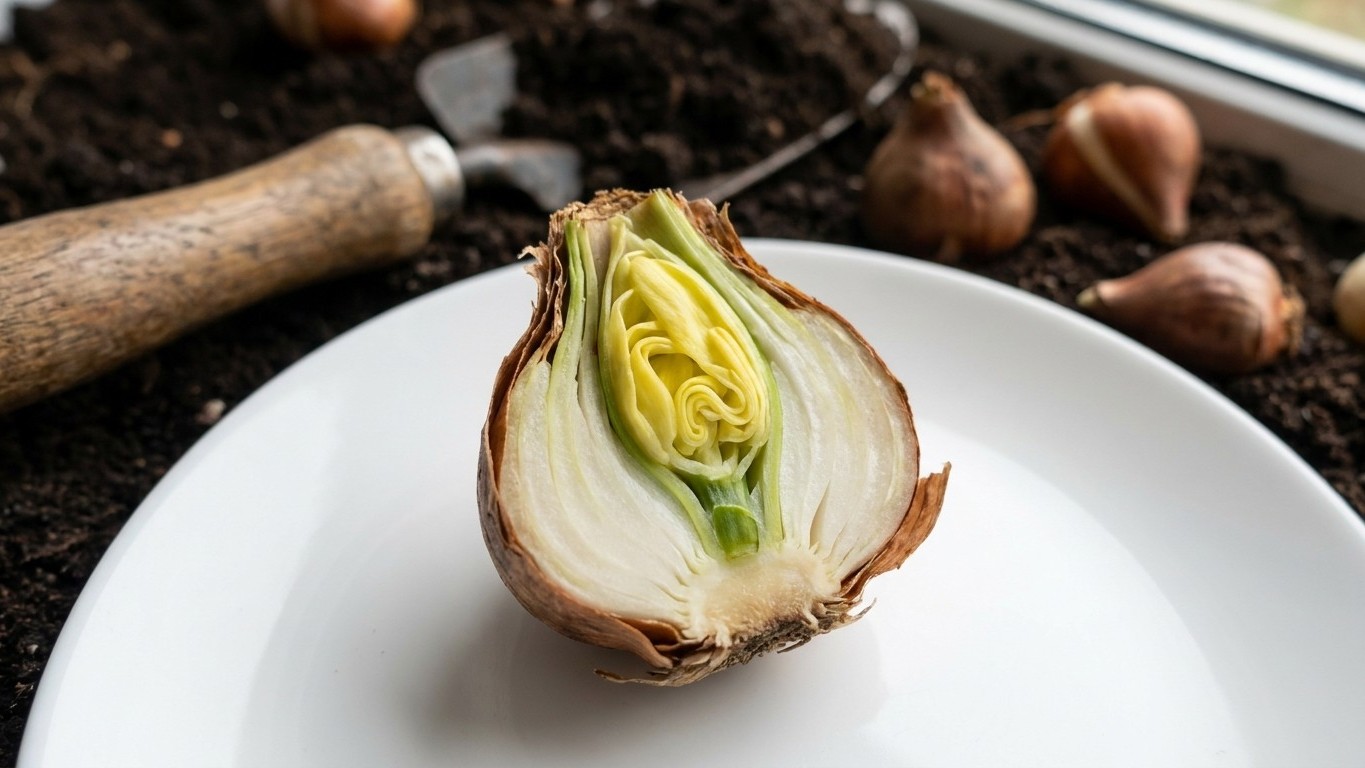

A spring bulb bought this fall is already a finished plant. The flower for next April is fully formed inside it right now, packed and waiting. What decides whether that flower ever opens has almost nothing to do with soil fertility and everything to do with cold, timing, and which species you chose in the first place.
The one thing that decides everything

Cut open a daffodil or tulip bulb in September and you’ll find something surprising: a miniature flower, stem and all, curled up inside the papery layers. Bulb growers spent the previous growing season building that structure underground, then harvested it at rest. The gardener isn’t growing a flower from scratch. The gardener is storing and triggering one that already exists.
The trigger is cold. Most spring-flowering bulbs, tulips, daffodils, Hyacinth: How Much Cold It Needs and How Long It Lasts, most crocus, need somewhere between twelve and fourteen weeks at temperatures below about 45°F to complete a hormonal process called vernalization, a requirement explained in more detail in Why Spring Bulbs Need Thirteen Weeks of Cold. Skip that chilling period and the bulb either refuses to bloom or throws up a stunted, twisted flower stalk that never opens properly, and the amount of cold required varies enough by species that it’s worth checking Which Spring Bulbs Survive Your Winter — and Which Never Get Enough Cold before assuming any given bulb will thrive in your climate. This is why bulbs planted directly into ground that’s already frozen solid, or bulbs left in a warm garage all winter, disappoint gardeners every single year. The plant was never given its cold.
Soil nutrition matters far less than most planting instructions suggest. A bulb planted in mediocre soil with adequate cold will usually still flower, because the food reserves for that first bloom are already packed inside the bulb tissue. What the gardener actually supplies, in order of importance, is cold exposure, then When to Plant Spring Bulbs so there’s enough time before hard freeze for roots to establish, then reasonable drainage so the bulb doesn’t rot. Fertilizer comes in a distant fourth place, useful mainly for feeding next year’s flower, not this one, which is also why knowing What to Do With Bulb Foliage After Blooming matters so much for that future bloom.
That ordering also shapes the order in which different species actually flower once spring arrives, laid out in Spring Bulbs in Order of Bloom. Planting date matters because it controls how much root time a bulb gets before winter locks the ground. Species choice matters because some bulbs rebuild their internal flower every year under typical garden conditions and some don’t, a distinction easily seen in a reliable naturalizer like Siberian Squill, which reflowers and spreads with almost no fuss year after year, visible again in a diminutive, early-blooming bulb like the Reticulated Iris, echoed once more in the tidy, early carpet of blue produced by Striped Squill, and also visible in a woodland naturalizer like the Spanish Bluebell, a species with its own quirks around chilling requirements and bloom longevity, as detailed in Tulip: How Much Cold It Needs and How Long It Lasts, and further explored in Crocus: How Much Cold It Needs and How Long It Lasts, again in the case of a native prairie bulb covered in Camassia: How Much Cold It Needs and How Long It Lasts, and once more in a delicate early riser like Grecian Windflower, in the earliest of the true bulbs to bloom, whose own chilling math is broken down in Snowdrop: How Much Cold It Needs and How Long It Lasts, and in the earliest of the early bloomers, the tiny tuberous Winter Aconite, in the clump-forming habits of Grape Hyacinth, and similarly in the case of an early, cold-hardy bloomer like Glory-of-the-Snow, in the very different chilling behavior explained in Dutch Iris: How Much Cold It Needs and How Long It Lasts, in the classic garden favorite discussed in Daffodil: How Much Cold It Needs and How Long It Lasts, as well as in a tall, statuesque bulb whose own chilling and rebloom habits are explored in Crown Imperial, and in a summer-blooming bulb built along different rules altogether, the Asiatic Lily, and once more with the striking globe-shaped flower heads of Ornamental Allium. Depth matters because it’s the buffer between the bulb and a freeze-thaw cycle that can heave it right out of the ground. None of it is really about feeding the plant. All of it is about giving a pre-built flower the specific conditions it needs to open on schedule.
When to plant, and why the window is narrow
The rule of thumb nurseries use is roughly six weeks before the ground freezes solid in your area. Not six weeks before the first frost, which kills tender annuals and matters not at all to a bulb sitting several inches underground, but six weeks before the soil itself stops being workable. That window is narrower than most first-time bulb buyers expect, and it moves by more than a month depending on where in the country you garden. A gardener in Minnesota is often finished planting before someone in North Carolina has even bought their bulbs. Rather than guess at a single date here, check the planting calendar for your specific zone, since frost timing varies enough by region that a national date range would mislead as many readers as it helped.
Planted too early
Getting bulbs in the ground while soil is still warm from summer feels productive, but it backfires. Warm soil tells the bulb to start growing immediately, and top growth that emerges in October or early November has no chance of surviving a hard freeze. The leaf tips blacken, the growing point can be damaged, and the bulb enters winter weaker than if it had never been planted at all. This is the most common mistake among gardeners buying bulbs the moment they hit store shelves in late summer, well before planting season has actually arrived.
Planted too late
The opposite failure is quieter but just as costly. A bulb planted into cold, nearly frozen soil doesn’t have time to grow the root system it needs before winter locks everything in place. Bulbs are living tissue, not inert objects, and they lose moisture in storage even in a cool garage or refrigerator crisper drawer. A bulb that goes into frozen or near-frozen ground often survives, but blooms weak, short, or not at all the following spring, because it spent the winter trying to establish roots instead of resting properly. Gardeners who find unplanted bulbs in a bag come January are usually better off composting them than forcing them into frozen ground.
Which ones come back, and which do not
This is the distinction that costs home gardeners the most money over time, and it’s rarely explained clearly on the bulb packaging itself. Some spring bulbs are true perennials in the garden sense: plant them once and, given reasonable conditions, they multiply and return for a decade or more. Others are perennial only in botanical classification. In practical garden terms, in most American climates, they behave like an expensive annual that happens to be sold in a bag marked “perennial.”
The difference comes down to how each species rebuilds its flower bud. Daffodils, crocus, squill (scilla) and alliums are efficient at converting a full season of leaf growth into a fresh flower bud for the following year, and many of them also produce small offset bulbs that spread the planting outward over time. That’s why an old farmhouse daffodil patch can still bloom heavily forty years after anyone planted it. Most modern tulip hybrids, particularly the large-flowered Darwin and Triumph types bred for maximum bloom size and color saturation, put so much energy into that first spectacular flower that they rarely have enough left to rebuild a full-size bud for a second or third year. Bloom size shrinks noticeably by year two or three, and many hybrid tulip plantings thin out to almost nothing by year four.
- Daffodils (Narcissus): reliably naturalize, multiply by offset bulbs, deer and rodents generally avoid them
- Crocus: spreads readily in lawns and beds, one of the earliest bloomers, tolerant of a wide range of soils
- Squill (Scilla): aggressive naturalizer in the right conditions, sometimes considered invasive in parts of the Northeast
- Allium (ornamental onion): long-lived, rodent-resistant, bloom size stays consistent for many years
Against that, most modern tulip hybrids fade fast enough that experienced gardeners often plant them the way they’d plant annual flowers, replacing a meaningful share of the bed every year or two rather than expecting a permanent display.
- Darwin hybrid and Triumph tulips: largest flowers, fastest decline, often noticeably smaller blooms by year three
- Double and parrot tulips: showy but among the least reliable for return bloom in most climates
- Hyacinths: can return for several years but flower spikes shrink noticeably each season
There’s one habit that protects whatever return bloom a bulb is capable of, and it’s the single most common way gardeners accidentally sabotage next year’s flowers: cutting back or braiding the foliage as soon as the petals drop. That foliage is doing the actual work of photosynthesis that builds next year’s flower bud inside the bulb underground. Leave it standing, even as it flops over and looks untidy, until it yellows and pulls away easily by hand, usually six to eight weeks after bloom. Cut it early and you’ve effectively converted even a good naturalizer into an annual.
Depth, spacing and what digs them up
The working rule most bulb growers and extension offices give is straightforward: plant at roughly three times the height of the bulb itself, measured from the base of the hole to the soil surface. A 2-inch daffodil bulb goes about 6 inches deep; a smaller 1-inch crocus bulb needs only about 3 inches. That depth isn’t arbitrary. It’s the buffer zone that keeps the bulb below the layer of soil that repeatedly freezes and thaws through the winter, since repeated freeze-thaw cycles can physically push a shallow bulb upward out of the ground, a process called frost heave. A bulb that heaves to the surface loses its insulation, dries out, and rarely survives to flower.
Spacing matters less for survival than for how the display looks, but a reasonable rule is to leave a gap equal to about two to three bulb widths between plantings, tighter for small bulbs like crocus that look best in dense drifts, wider for larger daffodil and allium bulbs that will multiply and need room to spread over several seasons.
The other threat comes from underground, and it’s selective in a way that surprises a lot of gardeners: squirrels, chipmunks and voles dig up and eat tulip and crocus bulbs with real enthusiasm, but they leave daffodil and allium bulbs alone almost entirely. That’s not random taste. Daffodils and alliums contain naturally occurring compounds, including alkaloids in daffodils and sulfur compounds in alliums, that are mildly toxic and taste bitter to rodents. Tulips and crocus contain no comparable defense chemistry, which makes them an easy, palatable snack.
Of the countermeasures gardeners try, one has a real track record and one mostly doesn’t. Laying a piece of galvanized wire mesh directly over a newly planted bed, then removing it once the ground freezes hard, physically blocks digging during the exact weeks when rodents are most active and the scent of freshly disturbed soil is strongest. Repellent sprays marketed for bulb protection, by contrast, wash off with the first rain or watering and need reapplying so often that most gardeners give up on them within a season. If tulips or crocus keep disappearing every fall in a particular bed, mesh over the planting is the fix worth trying before anything else.