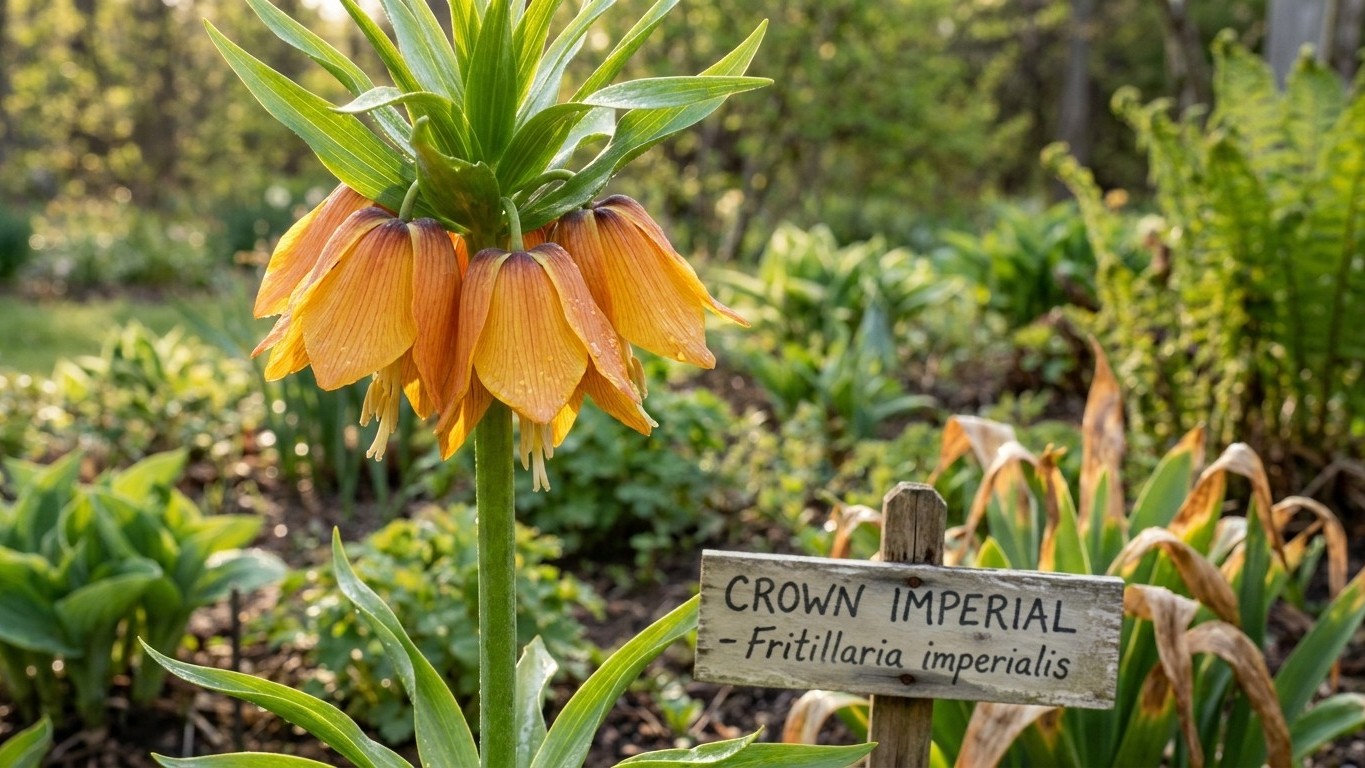

Crown Imperial needs 12-14 weeks of temperatures below 45F to bloom, and it only thrives in USDA zones 5-8. Skip either condition and you get leaves with no flower, or a stunted stem hiding in the foliage. Here’s what that means for planting, spacing, and whether this bulb sticks around.
What Crown Imperial actually is

Two numbers matter before you buy a single bulb. The hardiness range is USDA zones 5-8, and the cold requirement is 12-14 weeks below 45F, according to Cornell University, Department of Horticulture : Flower Bulb Research Program. That second figure is the one that decides whether you get flowers at all. Fall short of it and the bulb still sends up leaves, but the flower stalk either never forms or comes up too short to clear the foliage. A bulb that lands just under the 12-week mark doesn’t necessarily fail outright, but you’re in the uncertain band: expect a thinner, shorter bloom rather than a guaranteed no-show.
Crown Imperial belongs to the fritillaria group, and it flowers in mid spring, arriving after the earliest bulbs but ahead of the late-season tulips. Colors run to orange and yellow, a warmer palette than the blues and pinks that dominate the same weeks in most beds.
One habit is worth flagging early rather than discovering by accident. The foliage tends to die back while the flower is still open, so the plant can look like it’s failing right at its peak. That’s normal for this bulb, not a sign of disease or poor planting. It’s a quirk that trips up a lot of first-time growers who assume yellowing leaves mean something’s gone wrong underground.
How deep and how far apart
Depth and spacing aren’t suggestions here, they’re the two decisions that determine whether the bulb survives winter and whether the bed looks intentional or scattered. Planting deep enough buffers the bulb against freeze-thaw cycles and keeps it from heaving out of the soil during a hard winter. Spacing decides whether you get a drift that reads as one shape from a distance, or a row of dots that looks like an afterthought.
- Depth: 8 inches
- Spacing: 12 inches apart
The bulb itself gives you a shape clue, but not a foolproof one. Crown Imperial should go in tipped slightly on its side rather than sitting flat, because the crown of the bulb is hollow and standing it upright lets water collect there and rot it out over winter. If the bulb’s orientation isn’t obvious from looking at it, tipping it on its side is the safer default regardless.
Dry tubers should soak overnight before they go in the ground. This step gets skipped more often than it should, and it’s the difference between a bulb that establishes root growth before the ground freezes and one that sits dormant and rots come spring. An overnight soak rehydrates tissue that’s often shipped bone-dry, giving the bulb a head start on root formation right after planting.
Getting the timing right
Depth and spacing only do their job if the bulb goes in early enough to root before the ground locks up. Combined with the 12-14 week cold requirement, that means planting needs to happen well before the first hard freeze in your area, not after it. A bulb planted late may still meet its chilling hours technically, but it won’t have had time to establish roots first, and that weakens the whole first season.
Will it come back next year
This is the honest question, and the answer for Crown Imperial is mostly good news, with one condition attached. As a fritillaria, it’s built to return and, given the right conditions, to multiply over the years rather than fade out after a season or two like some bulbs sold as perennials but behaving more like annuals.
The condition is foliage management, and it’s non-negotiable. After the flower fades, the leaves need to be left alone until they yellow completely on their own. That yellowing period is when the bulb is actually building next year’s flower inside itself, storing the energy it will draw on the following spring. Cutting the leaves back while they’re still green, even if they look untidy or the bed seems ready for cleanup, is the single most common reason a Crown Imperial planting stops flowering after its first strong year.
Gardeners who tidy aggressively in early summer are often the ones who report a bulb that “didn’t come back.” In most cases it did come back, it just didn’t have the stored energy to flower because the leaves were removed too soon. Left to finish their natural cycle, the leaves eventually collapse on their own, usually by early summer, and that’s the signal that it’s safe to clear them away.
Combined with the right hardiness zone and enough winter chill, a Crown Imperial bulb that’s allowed to finish its foliage cycle each year is genuinely a long-term planting, not a one-season purchase.
What eats it, and what leaves it alone
Rodents are the main concern with most spring bulbs, but Crown Imperial has a built-in defense that a lot of other bulbs lack. It smells strongly of fox, and that scent is reported to deter the squirrels and voles that otherwise treat a bulb bed like a buffet. It’s not a guarantee, but it’s a real advantage over bulbs like tulips, which rodents actively seek out.
Where the smell doesn’t fully do the job, or where a particularly determined animal population is already established in the yard, wire mesh laid over the planting bed until the ground freezes is the measure that actually works. It’s not glamorous, and it’s not something sold at checkout alongside the bulbs, but it physically blocks digging during the exact window when a newly planted bulb is most vulnerable, before it’s rooted in and before the ground itself becomes too hard to dig through.
Once the ground freezes solid, the mesh can come off. The bulb is no longer an easy target, and by spring, that fox-like scent is doing most of the ongoing work of keeping animals away from the emerging shoots.