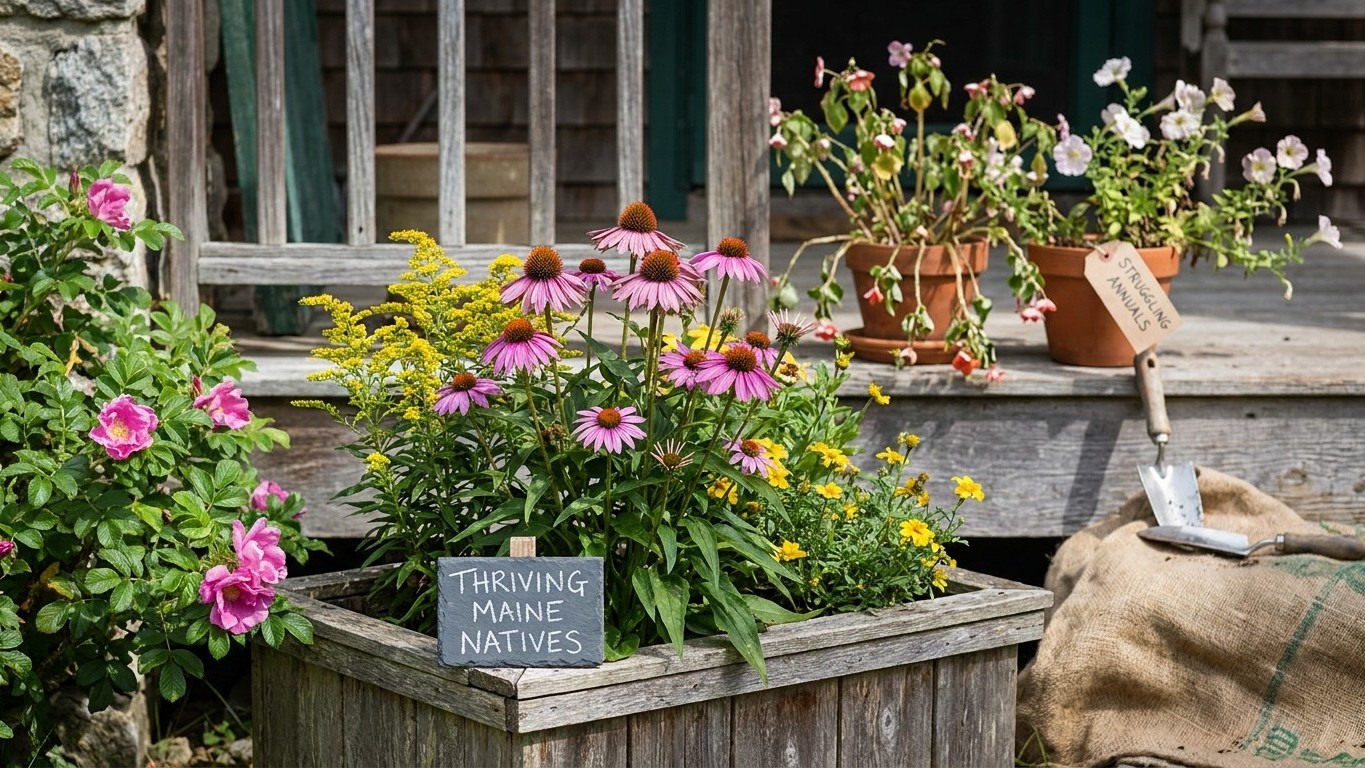

Flowers that actually thrive in Maine are the ones built for a short, cool growing season and a genuinely cold winter: peonies, daylilies, garden phlox, coneflower, and lupine all handle what Maine’s USDA zones 3b to 6a bring, per the USDA Plant Hardiness Zone Map’s 2023 update. Portland’s coldest month averages a nightly low of 15.6°F, according to NOAA NCEI’s 1991-2020 climate normals, and summer heat stays mild, with only 3.8 days a year reaching 90°F. Check your specific USDA zone before buying anything at a nursery, since Maine spans several zones between the coast and the north woods.
What thrives in Maine

Winter hardiness is the filter that matters most here. Maine’s USDA zones run from 3b up to 6a, per the USDA Plant Hardiness Zone Map’s 2023 update, and Portland sits near the mild end of that range while inland valleys and the north drop several zones colder. NOAA NCEI’s 1991-2020 climate normals put Portland’s coldest month at a mean nightly low of 15.6°F, and that figure, not a single record cold snap, is what actually decides whether a perennial’s roots make it through winter. A plant tagged hardy to zone 6 will likely fail anywhere colder than that, so read the tag against your own zone rather than the state average. Gardeners working through zone questions across the region can find more detail in our Maine guides, since soil, elevation and coastal exposure all shift the picture county to county.
Heat load and what it rules out
Maine’s summers are short and rarely hot. Portland averages just 3.8 days a year at or above 90°F, NOAA NCEI’s normals show, which means plants that need sustained heat to flower well, tropical hibiscus, lantana, and most cannas among them, tend to sulk here even in a good year. Gardeners further south dealing with the opposite problem, too much heat rather than too little, will find a different set of struggles covered in Flowers That Actually Thrive in Mississippi, and the Ones That Struggle. Maine’s short bright summer instead favors cool-season bloomers: peonies, bearded and Siberian iris, garden phlox, and daylilies all reach full flower without needing weeks of heat first.
Drought tolerance matters less overall than cold hardiness, but it decides plant choice on the sandy, fast-draining soils common along the coast. Sedum, yarrow, and lupine handle those conditions once established without regular watering, while low, damp spots favor moisture-loving perennials like astilbe and Siberian iris instead. Match the plant to your actual soil moisture, not a generic drought-tolerance list, since Maine’s soils vary enormously between a rocky coastal ledge and a low inland field.
Native plants worth the space
Plants native to the wider Northeast region have already spent thousands of years sorting out which root systems survive a Maine winter and which don’t, so they need far less coddling once they’re in the ground. Established natives rarely need supplemental water or fertilizer past their first year or two, because their root systems are built for the region’s freeze-thaw cycles and its natural rainfall pattern rather than a nursery pot’s steady drip irrigation. That’s the practical payoff: less hose time, less feeding, and fewer losses over winter.
Species worth planting
Several perennials native to the broader Northeast do well in Maine gardens and carry real pollinator value:
- Butterfly weed and swamp milkweed (Asclepias tuberosa and A. incarnata) – the only host plants monarch caterpillars can eat
- New England aster (Symphyotrichum novae-angliae) – late-season nectar right before frost
- Black-eyed Susan (Rudbeckia hirta) – long bloom window, tolerates poor soil
- Wild bergamot (Monarda fistulosa) – draws native bees and hummingbirds
- Cardinal flower (Lobelia cardinalis) – a hummingbird magnet for damp spots
- Blue flag iris (Iris versicolor) – suited to wet edges and rain gardens
These aren’t ornamental filler. Native flowers support the specific insects that evolved alongside them, in a way that many imported ornamentals simply can’t, because the timing of bloom, the shape of the flower, and the chemistry of the nectar all line up with what local bees, moths, and butterflies already look for. A border built around even a handful of these species does more for a local food web than a bed of hybrid annuals ever will, without asking for more maintenance in return.
Perennials that come back

At Maine’s hardiness levels, several garden staples return reliably year after year with no special winter protection: peonies, daylilies, hostas, garden phlox, Siberian iris, sedum, and coneflower (Echinacea purpurea, generally hardy to zone 3) all overwinter fine across most of the state. Black-eyed Susan behaves as a short-lived perennial here, often reseeding itself enough that it reads as permanent even when individual plants don’t last more than a few years.
What gets grown as an annual instead
Some well-known “perennials” are only perennial where winters stay much milder than Maine’s. Dahlias, hardy roughly to zone 8, get dug up and stored indoors over winter here rather than left in the ground. Gladiolus corms get the same treatment. Certain salvias and most lantana, perennial in the Deep South, simply get replanted each spring as annuals because there’s no realistic way to overwinter them outdoors this far north.
Read the hardiness zone on the plant tag against your own zone, not the state’s warmest pocket, before assuming something will survive winter. A tag reading “zone 5” is a real risk in a zone 3b or 4a location even if a nursery two towns over, sitting in a milder microclimate, sells the same plant with no trouble at all.
| Plant | Behavior in Maine | Winter treatment needed |
|---|---|---|
| Peony | Reliable perennial | None |
| Daylily | Reliable perennial | None |
| Coneflower | Reliable perennial (to zone 3) | None |
| Dahlia | Grown as an annual | Lift tubers, store indoors |
| Gladiolus | Grown as an annual | Lift corms, store indoors |
Putting a border together
Layer a Maine border by height the same way you would anywhere: taller plants like phlox, delphinium, and coneflower go at the back or center of an island bed, mid-height perennials such as daylilies and Siberian iris fill the middle, and low growers like sedum and creeping thyme edge the front. Leave real gaps at planting time rather than spacing everything tight, since perennials in Maine’s short season still bulk up considerably by their second or third year, and a border planted too dense now becomes a crowded, mildew-prone mess in three seasons.
Bloom succession and repeated color
With last spring frost at Portland falling somewhere between April 22 and May 1 and first fall frost between October 9 and October 21, per NOAA NCEI’s 1991-2020 normals, the usable outdoor season runs roughly five months along the coast, and shorter inland. Plan bloom succession across that window rather than betting on one big flush: peonies and iris open early in the season, phlox and coneflower carry the middle, and asters and sedum close it out near frost. Repeating the same two or three colors through each bloom period, rather than scattering a different color for every plant, is what makes a border read as designed instead of accidental.
Gardeners in southern New England work with a milder version of this same calendar, and the tradeoffs there are covered in Flowers That Actually Thrive in Massachusetts, and the Ones That Struggle, useful reading if you’re comparing what a slightly longer season buys you.
Local help
The University of Maine Cooperative Extension runs the state’s Master Gardener Volunteer program and publishes plant lists suited to specific counties and hardiness zones, which is a better source than a national catalog when you’re choosing between varieties. Check their site before planting anything you’re unsure about, especially near the edge of your zone. Find their programs and regional contacts at extension.umaine.edu.
Common questions
Can I grow hydrangeas in Maine?
Some kinds, yes. Panicle hydrangeas and smooth hydrangeas are generally hardy through Maine’s zone range, but bigleaf hydrangeas, the ones with the big blue or pink mophead blooms, often fail to flower here because their buds set on old wood that Maine’s winter kills back. Check the specific species on the tag, not just the word “hydrangea.”
Why did my lavender die over winter?
Most likely a hardiness mismatch, wet feet, or both. Common English lavender is only reliably hardy to about zone 5, which puts it at risk anywhere colder in Maine, and lavender in general hates sitting in wet soil over winter far more than it minds the cold itself. Raised beds or very sharp drainage improve its odds considerably.
Do I need to deadhead perennials to get more blooms?
For many perennials, yes, deadheading spent flowers pushes the plant to produce another round rather than setting seed. Coneflower, phlox, and daylilies all respond well to it. Peonies and iris are exceptions, since they bloom once per season regardless of deadheading, though removing spent flowers still tidies the plant and can reduce disease risk.
Is it too late to plant perennials if I missed spring?
No. Fall planting, roughly six to eight weeks before the ground freezes, works well for most perennials and lets roots establish before winter without the stress of summer heat. Given Portland’s first fall frost falling between October 9 and October 21 per NOAA NCEI’s normals, aim to get perennials in the ground well before that window closes, earlier if you’re inland or north.
Related guides
- Flowers That Actually Thrive in New Hampshire, and the Ones That Struggle
- Flowers That Actually Thrive in Massachusetts, and the Ones That Struggle