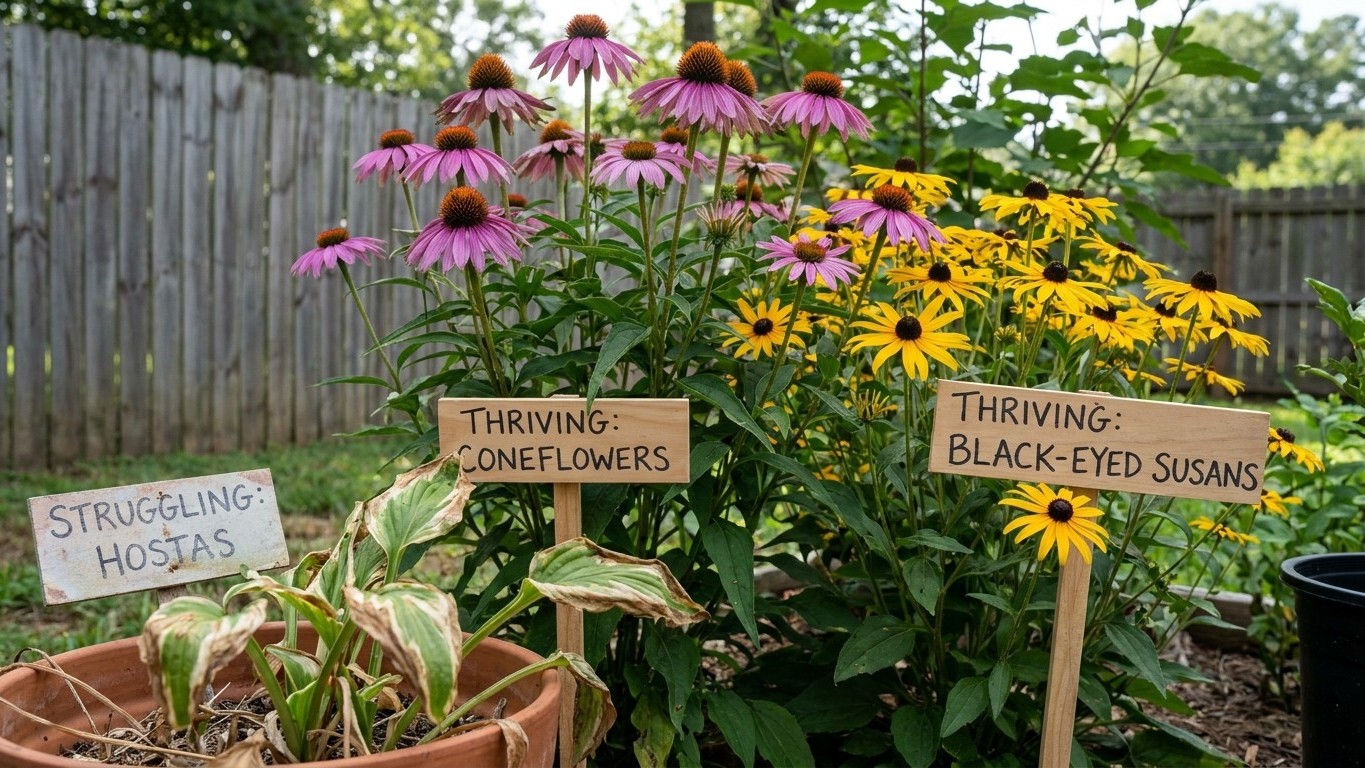

Mississippi doesn’t kill flowers with cold — it kills them with July. The plants that die in your bed aren’t weak, they’re just built for a Midwest winter and a mild summer, and Mississippi gives them neither. So skip the tray that looked good on the seed rack and check what your bed actually deals with day to day: full sun, standing water after a storm, clay that stays wet for a week. That’s the real filter here, not the zone number on the tag, because in this state heat and humidity decide everything winter cold used to decide somewhere else.
What thrives in Mississippi

The traits that matter most in a Mississippi bed are almost the reverse of what a Midwestern or New England gardener screens for. Cold hardiness barely factors in across most of the state, since NOAA’s Jackson normals show winter lows staying well above freezing on an average day even in the coldest month. What actually separates a flower that sails through July from one that collapses is tolerance for combined heat and humidity, plus enough drought resistance to shrug off the stretches between summer rains.
The plant families that carry those traits
A handful of plant families show up again and again in successful Mississippi borders. The mint family, Lamiaceae, gives you salvias and Russian sage, plants with the kind of tough, aromatic foliage that resists the fungal problems humidity invites. The mallow family, Malvaceae, gives you hardy hibiscus and rose mallow, both of which actually prefer wet feet and full sun and treat a Mississippi summer as home turf rather than a hardship. The aster family, Asteraceae, covers coneflower, black-eyed Susan and zinnia, all of which tolerate heat, poor soil and irregular water once established. Verbena and lantana, in the verbena family, do the same job at a lower, spreading height.
What struggles is the opposite profile: plants bred for cool, dry summers and long, hard winters. Delphiniums, lupines and most alpine-type perennials rot in humid heat before they ever get to bloom a second time. Powdery mildew and root rot are the two failures to watch for, and both trace back to the same cause: a plant that was never suited to this much heat and moisture in the first place, regardless of how it performs on a seed rack photograph from a cooler region.
Soil drainage matters as much as species choice. Mississippi’s clay-heavy soils in much of the state hold water long after a summer thunderstorm, and a flower that would tolerate drought in sandy soil can still rot in wet clay. Raised beds or amended planting holes solve more heat-and-humidity problems than switching cultivars ever will.
Native plants worth the space
Native and regionally adapted flowers earn their keep by needing less from you once they’re in the ground. A plant that evolved alongside Mississippi’s summer heat and clay soils does not need the same babying a nursery-bred hybrid does, and that shows up directly in your water bill and your weekend schedule. Established natives typically need supplemental watering only in extended dry spells, not on the weekly schedule a shallow-rooted annual demands.
What to plant
Purple coneflower (Echinacea purpurea), native across the wider Southeast, tolerates poor soil, full sun and drought once its roots are down, and its seed heads feed goldfinches through fall and winter if you leave them standing. Black-eyed Susan (Rudbeckia hirta) does the same job with a longer bloom window and self-seeds readily, so one packet can fill a bed over a couple of seasons. Swamp sunflower (Helianthus angustifolius), native to wet meadows and ditches across the Gulf South, handles the low, poorly drained spots in a yard that kill almost everything else and throws up bright yellow blooms right as most other perennials are finishing for the year.
Bee balm (Monarda didyma and Monarda fistulosa), native across much of the eastern United States, draws hummingbirds as reliably as any flower you can plant, and its square stems and minty scent mark it as a member of the same mint family that gives the region its toughest ornamentals. Louisiana phlox and native milkweed species (Asclepias tuberosa and Asclepias incarnata) round out a pollinator planting, with the milkweeds doing double duty as the required host plant for monarch caterpillars on their fall migration through the Gulf region.
None of this is unique to Mississippi. Gardeners a few states over face a similar calculation with a different plant list, and the same logic about matching regional natives to regional stress shows up in our guide to flowers that actually thrive in North Carolina, and the ones that struggle, where humidity plays a similar role but the winter cold cuts off a slightly different set of options.
Perennials that come back

At USDA zones 7b to 9a, a real perennial should survive winter without protection in most years, though a colder pocket in the northern hill country of the state will lose more than a warmer spot near the coast. Daylilies, garden phlox, coneflower, black-eyed Susan, and most salvias come back reliably across this range, dying back to the crown in winter and resprouting once soil warms in spring.
Reading a plant tag against your zone
A lot of disappointment in this state comes from trusting a plant tag’s hardiness zone without checking which end of the range it’s printed for. A tag that says “hardy to zone 8” means the plant needs zone 8 conditions or milder to survive winter outdoors, so it will likely die back to the ground or fail outright in the colder, northern parts of Mississippi’s 7b zone even though it thrives near the coast. Cross-check the tag against your own county’s typical winter lows before you plant it as a perennial rather than an annual.
Several flowers sold in every Mississippi garden center are technically tender perennials that simply cannot survive winter here and get treated as annuals instead. Lantana, pentas and mandevilla are all perennial in true tropical climates, but Mississippi’s winter lows are enough to kill the top growth and often the roots too, so most gardeners replant them each spring rather than gambling on overwintering. That’s a sharp contrast with a state like Connecticut, where the entire growing season runs shorter and cooler and a completely different set of plants gets the “grown as an annual here” treatment, as covered in our piece on flowers that actually thrive in Connecticut, and the ones that struggle.
| Perennial | Typical height | Bloom season | Water once established |
|---|---|---|---|
| Coneflower (Echinacea) | 2-3 ft | Early summer to fall | Low |
| Garden phlox | 2-4 ft | Mid to late summer | Moderate |
| Daylily | 1-3 ft | Late spring to midsummer | Low to moderate |
| Salvia (perennial types) | 1-3 ft | Late spring through frost | Low |
| Swamp sunflower | 4-6 ft | Early to mid fall | Moderate to high |
Putting a border together
A border that looks good all season is built in layers, not planted as a flat carpet of one height. Put the tallest plants, like swamp sunflower or tall garden phlox, at the back or center of an island bed, mid-height perennials such as coneflower and daylily in the middle band, and low spreaders like lantana or verbena along the front edge where they can spill over a walkway or bed border without hiding anything behind them.
Sequencing bloom and repeating color
Because Mississippi’s growing season runs long, from the last spring frost through well past the first fall frost at the Jackson reference station, a border planted with only one bloom season in mind spends most of the year looking finished rather than full. Stagger bloom times deliberately: something flowering in late spring, a different plant carrying midsummer when the heat is heaviest, and a fall bloomer like swamp sunflower or aster to close the season out.
Repeating the same color or plant at intervals along a border does more for how finished it looks than adding more different species ever will. Three clumps of the same salvia spaced along a thirty-foot bed read as intentional; three different unrelated flowers crowded into the same space read as clutter. Pick two or three anchor colors and repeat them.
- Leave real gaps at planting, since most perennials sold in gallon pots will double or triple their spread within two seasons
- Mulch the bare soil between young plants rather than crowding them tight to fill the look immediately
- Group plants with similar water needs together so you’re not overwatering the drought-tolerant ones to keep a thirstier neighbor alive
Local help
Mississippi State University’s Extension Service publishes plant lists and timing guidance tuned to the state’s different climate zones, and its Master Gardener program trains local volunteers who answer exactly these kinds of questions for free. Check the MSU Extension Service for county-level contacts before committing to a plant list built for a different part of the state, and browse our other Mississippi guides for more on timing and site prep.
Common questions
What flowers can I plant now in Mississippi?
It depends entirely on the month and your distance from the coast, since NOAA’s 1991-2020 normals put Jackson’s last spring frost between March 6 and March 22 and the first fall frost between November 7 and November 22, with rural and suburban gardens often running a week or two later in spring and earlier in fall. Check your local extension office rather than assume the Jackson dates apply directly to your county.
Do I need to deadhead perennials to keep them blooming?
Most of the reliable Mississippi perennials, including coneflower and salvia, bloom longer if you remove spent flowers regularly, though it’s not strictly required for survival. Skipping deadheading on coneflower does let seed heads form for goldfinches, so there’s a real tradeoff between tidiness and wildlife value.
Why do my lantana come back some years and not others?
Lantana is a tender perennial, not a true annual, so a mild winter can let the roots survive and resprout while a harder freeze kills them outright. That inconsistency is normal here rather than a sign you did something wrong, since Mississippi sits right at the edge of lantana’s reliable winter survival range depending on the specific winter and your local microclimate.
Can I grow the same flowers on the coast and in north Mississippi?
Some, but not all. USDA’s hardiness map spans zones 7b to 9a across the state, so a plant that overwinters reliably near the coast can die back or fail outright in the colder northern counties, and the reverse is rarely true since almost everything that tolerates the north’s colder winters also tolerates the milder coastal ones.
Related guides
- Flowers That Actually Thrive in Louisiana, and the Ones That Struggle
- Flowers That Actually Thrive in Arkansas, and the Ones That Struggle
- Flowers That Actually Thrive in North Carolina, and the Ones That Struggle