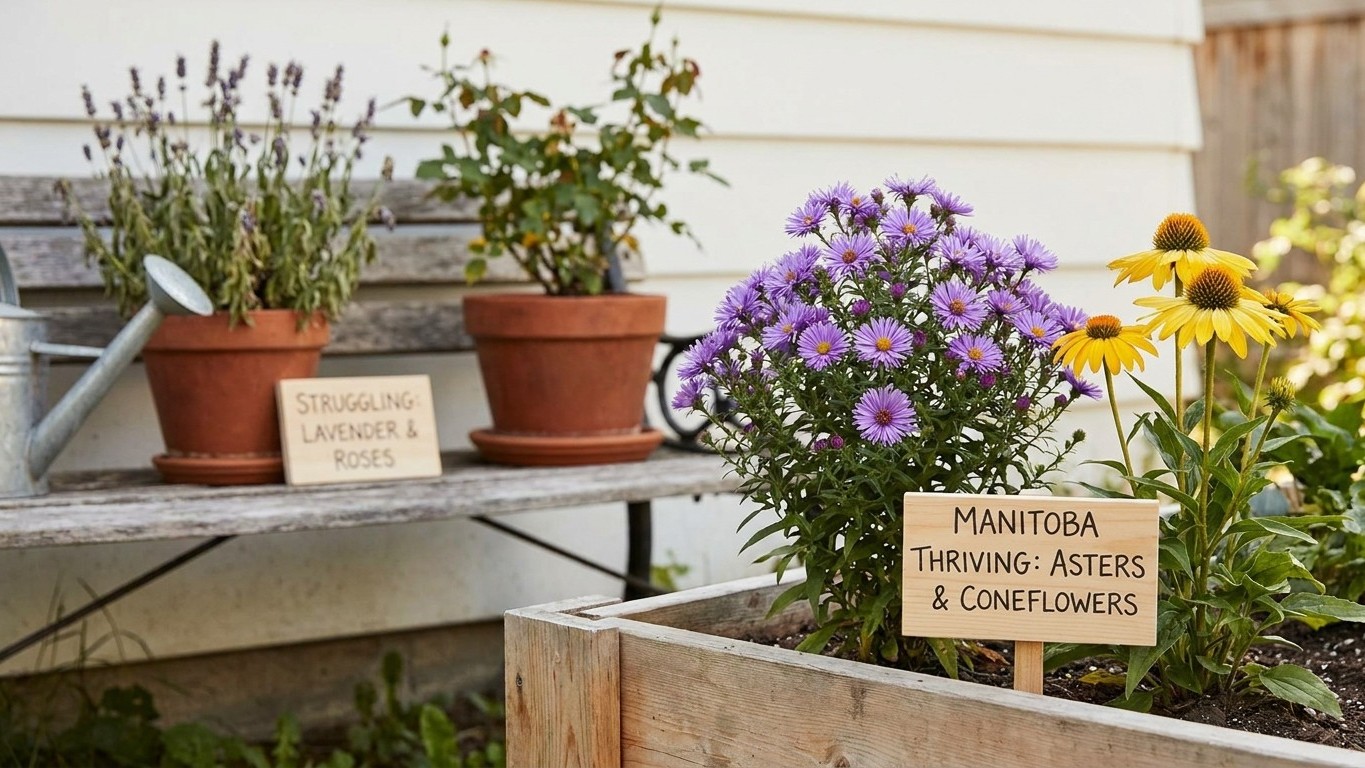

Manitoba borders that survive winter are built around peonies, Siberian iris, daylilies and rugosa roses, not around the hybrid tea roses and bigleaf hydrangeas stacked at the garden centre every May. Those cold-hardy perennials shrug off a Manitoba winter that finishes off anything rated for a milder zone. Check the hardiness zone printed on the plant tag before it goes in the cart, not after it’s dead the following April.
Putting a border together
Height and structure at the back, middle and front
A border reads as a mess when everything is the same height, so build it in three rough layers. At the back, put the tall, structural plants: delphinium hybrids running four to six feet, garden phlox (Phlox paniculata) at three to four feet, and a lilac or two if you have the depth for a shrub. Peonies sit a little shorter, at two to three feet, but their stems are stiff enough to hold that back-row position without staking. The middle layer carries the bulk of the summer show: coneflower (Echinacea purpurea), black-eyed Susan (Rudbeckia fulgida), bee balm (Monarda didyma) and daylilies (Hemerocallis), most of them in the two to three foot range. The front edge is for anything under a foot: creeping thyme, dianthus, and low sedums that soften the line between bed and lawn.
The mistake most new borders make is planting everything in a straight row by height, which looks like a staircase instead of a planting. Stagger the middle layer so a few taller clumps push forward and a few shorter ones tuck back, and the eye reads depth instead of rank order.
Bloom succession through the season
A border planted for one big June show is bare for the other five months. Spread the bloom out instead. Early bulbs and pasque flower open before most perennials have even leafed out. Peonies and Siberian iris carry early summer. Daylilies, phlox and echinacea take over for the midsummer stretch. Rudbeckia, aster and sedum ‘Autumn Joy’ close out the season into fall. Environment and Climate Change Canada’s 1981-2010 normals put the average last spring frost at Winnipeg Richardson Int’l A on May 23 and the average first fall frost on September 22, and both are mean dates, meaning frost arrives later than that roughly one year in two. Treat those dates as the middle of a window, not a guarantee, when you’re deciding how early to trust tender growth in spring or how long to expect bloom to hold in fall.
| Bloom window | Flower | Height | Note |
|---|---|---|---|
| Early spring | Species tulip, pasque flower | 6-12 in | Up before last frost most years |
| Early summer | Peony, Siberian iris | 2-3 ft | Reliable in zone 3b |
| Midsummer | Daylily, garden phlox, coneflower | 2-4 ft | Long bloom window, deadhead to extend it |
| Fall | Rudbeckia, aster, sedum | 1-3 ft | Carries colour to first frost |
Repeating colour instead of scattering it
One of each looks like a plant sale, not a border. Buy in threes or fives of a single cultivar and repeat that clump every few feet along the bed instead of scattering single plants of a dozen different things. Repetition is what makes a border read as designed rather than accidental, even when the plant list is short.
Leaving room now for size later
A peony division looks lonely its first year but will fill roughly a metre of space once established, and daylily clumps widen every season until you’re dividing them. Planting at mature spacing from day one leaves gaps for a summer or two, but planting tight means digging and moving things three years in when everything is crowded and root-bound. Mulch the gaps in the meantime rather than filling them with something you’ll have to rip out later.
- Check the mature spread on the tag, not just the pot size, before you decide spacing
- Leave at least the plant’s mature width between centres for anything you plan to keep more than two seasons
- Mulch bare soil between young plants instead of overplanting to hide it
What struggles here and why
Natural Resources Canada’s Plant Hardiness Site puts Winnipeg at zone 3b under the Canadian system, which is built from seven climate variables rather than the single winter-minimum figure the American zone map uses, so it isn’t directly comparable to a USDA zone. What that 3b rating means in practice is a genuinely cold winter: ECCC’s 1981-2010 normals put the mean daily minimum for the coldest month at Winnipeg at -21.4°C. That’s cold enough to kill hybrid tea roses and mophead hydrangea (Hydrangea macrophylla) outright most winters, since both bloom on wood that doesn’t survive that kind of cold without heavy protection. The same mophead hydrangeas that are far more forgiving in the milder, wetter climate covered in Flowers That Actually Thrive in New Brunswick, and the Ones That Struggle are a gamble here even against a south wall.
Tender bulbs are a separate problem. Dahlias and gladiolus grow well through a Manitoba summer, since the length of the frost-free season decides success here, not the count of scorching days: ECCC’s data for Winnipeg Richardson Int’l A shows only 4.54 days a year reaching 32°C, and 13.3 days above 30°C, figures that describe extreme heat, not the growing season itself. But neither dahlia nor gladiolus tubers survive a Manitoba winter in the ground. Lift them after the top growth blackens and before the ground freezes hard, well ahead of the September 22 average first frost at Winnipeg, and store them dry and cool indoors. Lavender is a similar case for a different reason: it isn’t the cold alone that kills it here so much as wet clay soil holding moisture against the crown under snow cover, the same rot problem it rarely faces in the dry summers described in Flowers That Actually Thrive in Colorado, and the Ones That Struggle.
Local help
A provincial hardiness zone only tells you so much. Soil, wind exposure and snow cover vary enough within Manitoba that the plant list for a Winnipeg backyard won’t match one on the open prairie further west. Manitoba Agriculture’s extension service keeps regional plant lists and is the place to check before you commit to something borderline for your specific site, and local Master Gardener volunteers run plant clinics and answer site-specific questions that a general guide like this one can’t. Start with Manitoba Agriculture, and for more on growing conditions elsewhere in the province, see our other Manitoba guides.
Common questions
Can I plant tulips and daffodils in Manitoba, or do they need to be dug up every year?
Most tulips and daffodils can stay in the ground here and will come back on their own, since they’re hardy well beyond what a Manitoba winter demands. The exception is anything sold as a tender or “tropical” bulb, which is a different category entirely and needs lifting like a dahlia.
Why did my peonies not bloom the first spring after planting?
Peonies often skip their first bloom while they establish roots, and a division planted too deep will sulk for a year or two longer than that. The eyes, the small pink buds on the root, should sit no more than an inch or two below the soil surface.
Is it worth trying roses at all, or should I skip them entirely?
Skip hybrid teas unless you’re willing to bury the graft union and mound soil over the base every fall. Rugosa roses and other own-root shrub roses are a far easier bet, since a hard winter kills the top growth without killing the plant.
Do I need to water a new border much, given how cold the winters are here?
Cold winters don’t mean wet summers, and a newly planted border still needs regular water through its first season regardless of what the coming winter looks like. Established perennials, once their roots are down, generally need far less supplemental water than the first year suggests.
Related guides
- Flowers That Actually Thrive in Saskatchewan, and the Ones That Struggle
- Flowers That Actually Thrive in Ontario, and the Ones That Struggle
- Flowers That Actually Thrive in New Brunswick, and the Ones That Struggle