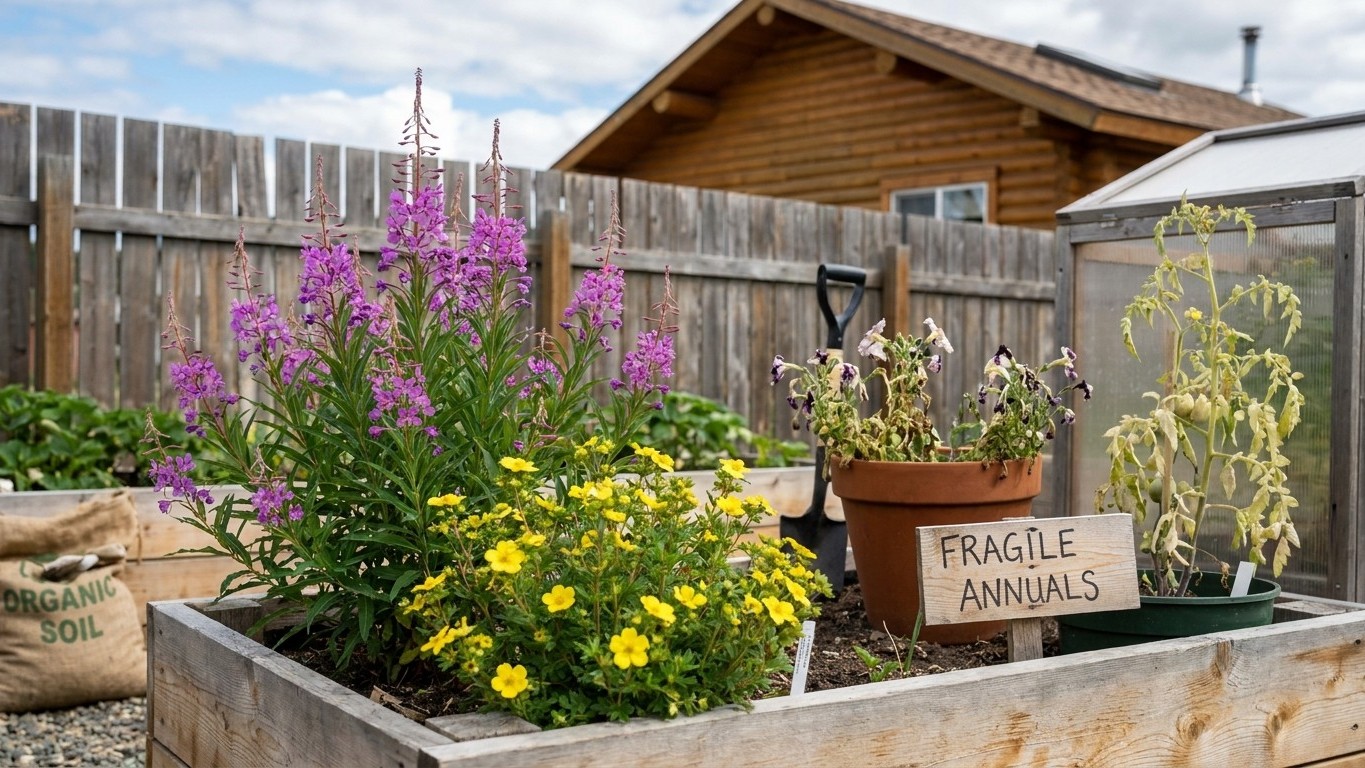

Plenty of flowers thrive in Yukon gardens, but the list looks different from what sells well in warmer provinces. Environment and Climate Change Canada’s 1981-2010 climate normals for the Whitehorse A station put the average last spring frost at June 5 and the average first fall frost at August 25, a frost-free stretch of roughly 81 days. Pick flowers for how fast they bloom and how much cold they tolerate, not for what looks good on a seed rack grown for a longer season.
Putting a border together

A Yukon border has to do its work fast. With an average frost-free window of about 81 days between the two ECCC mean dates above, there’s no room for a plant that needs a slow build-up of heat before it flowers. That doesn’t mean the border has to look thin or temporary. It means the planning has to be tighter: height, timing, and color all chosen with the short season in mind from the start.
Layering by height
Put the tallest plants at the back or center of the bed so nothing gets shaded out during the brief window it has to bloom. Delphinium elatum hybrids and garden lupines handle Yukon winters well once established, since both are bred from cold-region stock that copes with a mean coldest-month low around -19.2 °C, the figure ECCC’s 1981-2010 normals record for Whitehorse. Mid-height plants like calendula and snapdragons fill the middle layer. Calendula reaches bloom in about 50 to 55 days from seed on the packet, a figure counted from a warmer climate’s transplant date, so expect it to run a week or two longer here. Snapdragons list around 90 to 100 days to bloom from seed, which is tight against an 81-day season. Buy them as started transplants rather than direct-sowing if you want flowers before the season ends.
Front-of-border plants need to be quick and cold-tolerant since they’re the first thing frost touches in a cool snap. Sweet alyssum and dwarf marigolds in the ‘Bonanza’ series, listed at around 50 days to bloom, both work here. Leave the front row for plants that bloom fast and shrug off a light frost, because that’s the layer most likely to still be flowering after the average first fall frost date passes.
Succession of bloom across a short season
Southern gardeners plan for a long relay of bloom from spring through fall. In Whitehorse, the relay is compressed into a single push. Pansies and calendula tolerate a light frost, so they can go in the ground a little ahead of the average last frost date and keep blooming past the average first one in fall, stretching the display at both ends of that 81-day window. Everything in between, sweet peas, nasturtiums, snapdragons, goes in only once the frost risk has genuinely passed, and June 5 is a mean date, not a guarantee. In roughly half of all years the last frost falls later than that, so watch the forecast rather than the calendar.
Treat the frost dates as the midpoint of a risk window, not a safe start date, and hold back tender seedlings until the soil has actually warmed. Perennials do the heavier lifting for reliable bloom timing since they don’t have to germinate and mature from scratch every year.
Repeating color and leaving room to grow
Pick two or three colors and repeat them in small drifts of three to five plants rather than scattering one of everything through the bed. A repeated color reads as a design choice from a distance, while a mixed bag reads as clutter, and that matters more in a short bloom season where the border only gets a few weeks to make its impression. Space plants at the distance given on the seed packet even though a compressed season may keep them smaller than the catalog photo suggests. Crowding plants to compensate for a slower start usually backfires, since poor airflow around foliage invites the fungal problems that cool, damp Yukon summers can bring.
Flowers that struggle here
Some popular annuals simply don’t get enough heat to perform. ECCC’s Whitehorse normals record zero days a year reaching 90°F, which means the flowers that depend on sustained warmth to set buds are working against the climate all season. The table below compares a few of the plants that consistently thrive against ones that consistently disappoint, with catalog days-to-maturity figures shown against that 81-day frost-free average.
| Flower | Verdict in Yukon | Catalog days to bloom | Why |
|---|---|---|---|
| Calendula | Thrives | ~50-55 days | Tolerates light frost, fast enough to bloom well inside the season |
| Pansy | Thrives | ~90-100 days from seed, faster from transplant | Cold-hardy, blooms in cool temperatures most annuals can’t tolerate |
| Sweet pea | Thrives, with early start | ~60-70 days to first bloom | Cool-season vine, needs transplants or an early indoor start |
| Zinnia | Struggles | ~60-70 days | Needs sustained heat to size up; stays stunted with zero 90°F days on record |
| Dahlia | Struggles | Tubers, not seed-grown | Frost-tender tuber, must be dug and stored every fall given winter lows near -19.2 °C |
| Morning glory | Struggles | ~90-120 days | Needs warm soil to germinate and a long hot stretch to flower well |
Gardeners in a state like Alabama, where long hot summers are the norm, get strong results from zinnias and morning glory precisely because they have the heat that Yukon lacks. The reverse holds too: pansies and calendula that bloom for months in Whitehorse’s cool summer would fade fast under Alabama’s heat load. Kansas sits somewhere between the two, with a longer season than Yukon but real summer heat that lets dahlias and zinnias size up properly without the tuber-digging routine Yukon winters demand.
Local help
Master Gardener volunteers and garden clubs around Whitehorse and other Yukon communities are worth finding before you commit a season’s budget to seed, since they’ve usually already tested which cultivars hold up to a specific yard’s microclimate. For broader planting guidance, the federal Department of Agriculture’s site is the working reference to check, since the territorial department’s own pages weren’t reachable for verification at the time of writing. It’s also worth reading other Yukon guides on this site, since frost dates measured at Whitehorse can run weeks behind in higher or more northern parts of the territory, and a plant list built for one community won’t necessarily hold for another.
Common questions
Can I even grow annuals from seed outdoors in Yukon, or do I need transplants?
Direct-sowing works fine for fast, cold-tolerant annuals like calendula and alyssum, both listed at around 50 to 55 days to bloom. For anything closer to or past 70 days on the seed packet, start it indoors or buy transplants, because the roughly 81-day average frost-free window between ECCC’s June 5 and August 25 mean dates doesn’t leave much margin.
Do perennials actually come back every year this far north?
Many do, provided they’re rated for cold well below the average coldest-month minimum of -19.2 °C that ECCC records for Whitehorse. Delphiniums and garden lupines are reliable examples. Check the plant’s published cold tolerance before buying, since a perennial bred for a milder region may survive one mild winter and die in the next harder one.
Is it too late to plant if my last frost hasn’t happened yet in June?
No. June 5 is only the average last frost date from ECCC’s 1981-2010 normals, and in roughly half of all years the actual frost falls later than that. Watch the forecast rather than treating the date as a deadline, and hold tender transplants back until nighttime lows have genuinely cleared.
Why do my zinnias and marigolds from the same seed packet perform so differently every year?
Year-to-year weather swings around the averages matter more here than in milder climates. Whitehorse averages zero days a year at 90°F or above, so a summer with even a few unusually warm stretches can make a real difference to a heat-loving annual’s performance, while a cooler-than-average summer leaves it stunted regardless of how well you started it.
Related guides
- Flowers That Actually Thrive in British Columbia, and the Ones That Struggle
- Flowers That Actually Thrive in Northwest Territories, and the Ones That Struggle
- Flowers That Actually Thrive in Alabama, and the Ones That Struggle