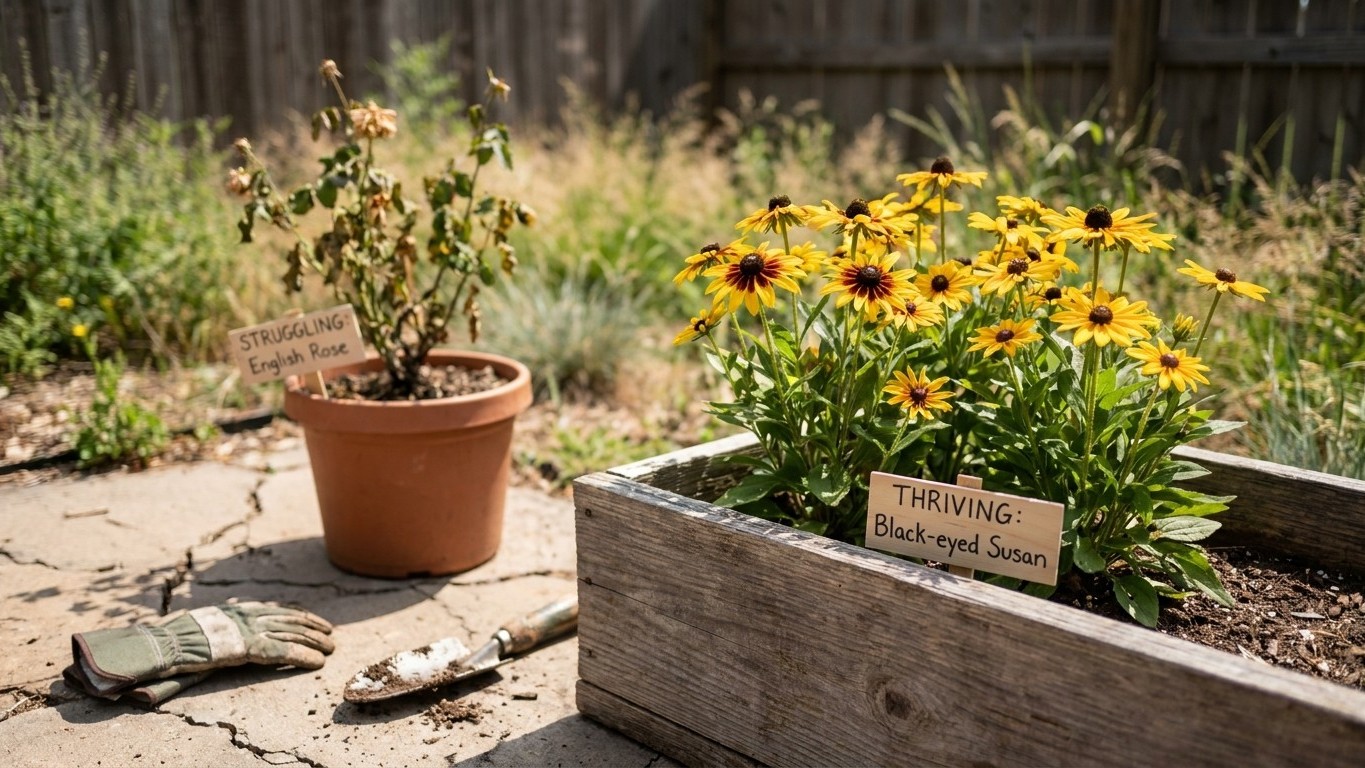

Twenty-two degrees below what most flowers can shrug off — that’s the average nightly low Kansas winters deliver, right before summer answers back with nearly two months of 90°F-plus days. Deep-rooted natives like coneflower and butterfly milkweed take that punishment in stride, drawing moisture from three feet down while thin-rooted garden favorites scorch and fold. The difference between a Kansas flowerbed that limps along and one that thrives isn’t luck. It’s root depth, leaf texture, and how well a plant tolerates extremes on both ends.
What thrives in Kansas

Kansas summers and winters both ask a lot of a flower. NOAA’s NCEI 1991-2020 climate normals for Wichita put the coldest month’s average nightly low at 22.5°F, and the same record shows 57.6 days a year that reach 90°F or hotter. A plant that can only handle one of those extremes will struggle here. The ones that thrive combine cold hardiness rated for USDA zone 5b to 7a, the range USDA’s 2023 Plant Hardiness Zone Map assigns across the state, with tolerance for long dry stretches and sun that does not let up.
Traits that matter more than looks
Deep taproots are the single biggest advantage a flower can have on the plains. A root that runs three or four feet down reaches moisture long after the top six inches of soil has baked hard, which is what lets prairie natives and prairie-bred garden perennials shrug off a month without rain. Silvery or fuzzy foliage helps too, since it reflects heat and slows moisture loss through the leaf surface, the same trick that lets Russian sage and lamb’s ear hold their color through August.
Kansas soil runs from heavy clay in the east to sandier, more alkaline ground in the west, and prairie natives tolerate both extremes better than most nursery-bred perennials do, since they evolved across that same gradient. Humidity tolerance matters less in western Kansas than it does around Wichita and points east, where summer storms bring enough moisture to encourage powdery mildew and black spot on crowded plantings. Air movement between plants matters as much as the species you choose, particularly for bee balm, garden phlox and other mildew-prone perennials.
The families that carry these traits best in Kansas gardens are Asteraceae (coneflower, black-eyed Susan, aster, Maximilian sunflower), the mint family (Russian sage, catmint, salvia) and the native grasses (little bluestem, switchgrass). All three groups evolved in or alongside prairie conditions and need nothing from a Kansas gardener beyond full sun and a spot that drains after a downpour instead of holding water.
Where Kansas gardeners get into trouble is bringing in plants bred for milder, wetter climates, like bigleaf hydrangea or delphinium, and expecting them to perform without extra water, afternoon shade and winter mulch. They can be grown here, but only with intervention the prairie natives never ask for.
Native plants worth the space
Plants native to the tallgrass and mixed-grass prairie that covers much of the central Great Plains, including Kansas, spent thousands of years adapting to exactly the swings NOAA’s Wichita normals describe: a hard freeze most winters and dozens of 90°F-plus days most summers. That history is why they need so little once established, usually after their first full year in the ground.
What to plant and why
- Purple coneflower (Echinacea purpurea) – upright, daisy-like pink-purple blooms that draw bees and, later, finches to the seed heads.
- Black-eyed Susan (Rudbeckia hirta) – bright yellow petals around a dark brown center, blooms through the hottest part of summer.
- Butterfly milkweed (Asclepias tuberosa) – clustered orange flowers, the only host plant monarch caterpillars can eat.
- Blazing star (Liatris spicata) – tall purple spikes that bloom top-down, a strong vertical accent among rounder shapes.
- Wild bergamot (Monarda fistulosa) – lavender, shaggy-petaled flowers that pull in bumblebees and hummingbird moths.
Pairing these forbs with a native grass like little bluestem gives the bed structure through winter, since the grass’s copper-orange blades stay upright and textured long after the flowers have gone to seed, feeding birds and holding snow instead of collapsing into a wet mat the way many nonnative ornamental grasses do.
Established stands of these plants pull water from far below the surface, which is why a bed of coneflower and blazing star can go through a dry August that would kill a bed of petunias. That same root structure holds soil against the wind Kansas is known for, cutting erosion on slopes and bare edges where turf struggles anyway.
The pollinator case for native plants is not abstract. Milkweed is the only food source monarch caterpillars can use anywhere in their range, and a Kansas garden without at least one milkweed species is a garden monarchs pass over on their way through. Bumblebees, native solitary bees and hummingbird moths all show a strong preference for open-faced native flowers over the tightly bred, often nectar-poor cultivars sold as improved versions of the same species.
None of this means avoiding cultivars altogether. A named selection like Rudbeckia ‘Goldsturm’ is still recognizably black-eyed Susan to a pollinator and still carries the drought tolerance of the species. The trouble starts with double-flowered or heavily hybridized forms, which often trade nectar and pollen access for showier petals.
Perennials that come back

At Wichita’s USDA hardiness range of zone 5b to 7a, the plants that come back reliably are the ones rated hardy to at least zone 5, since the western and northern edges of the state run colder than the reference city. Peonies, daylilies, purple coneflower, black-eyed Susan, catmint and Russian sage all hold up across that range without winter protection, and most spread a little wider every year rather than needing replacement.
What gets grown as an annual here
Plenty of popular flowers are technically perennial, just not at this hardiness level. Lantana and tropical hibiscus are perennial shrubs in zone 8 and warmer, but Kansas winters kill them to the ground or outright, so garden centers here sell them, and gardeners treat them as annuals, replaced every spring. The same goes for many salvias bred in Mexico and Central America. A gardener moving to Kansas from a warmer state is often the one who loses these plants over winter, having assumed a “perennial” tag meant perennial everywhere.
Reading a plant tag against your own zone is the habit that prevents that loss. A tag reading “hardy zones 7-10” is a flag in a state with a 5b-7a range: it will survive winter only in the state’s warmest pockets, and even then only in a year that does not dip far below Wichita’s 22.5°F average cold-month low. When a tag’s low end sits a full zone or more above where you garden, plan on treating the plant as an annual or moving it into a container that can come indoors for winter.
Microclimates inside a single yard can shift that math too. A perennial rated borderline for zone 6 often survives against a south-facing brick wall that holds heat, while the same plant fails in a low spot where cold air pools overnight. Kansas gardeners who push the hardiness envelope usually do it against a foundation wall or under the eaves, not out in an open bed.
Gardeners in Michigan deal with a similar sorting problem for a different reason: their summers stay cooler and wetter, so the plants that struggle there are heat lovers rather than the cold-tender ones that trip up Kansas gardeners. The lesson carries over regardless of state: match the tag’s hardiness range to your own before buying, not after a plant fails to return.
Putting a border together
A Kansas border works the same way any border does: tall plants at the back or center, then a step down in height toward the edge, with something in bloom in every season so the bed never goes flat. The difference here is how much space to leave, since drought-hardy prairie plants spread wider at maturity than their nursery pot suggests, and a bed planted at the tag’s minimum spacing turns into a solid, airless mat by the third summer.
Layering by height and bloom time
| Plant | Height | Bloom season | Border position |
|---|---|---|---|
| Maximilian sunflower | 5-8 ft | late summer to fall | back |
| Russian sage | 3-4 ft | midsummer to fall | middle |
| Purple coneflower | 2-3 ft | early to late summer | middle |
| Catmint | 1-2 ft | late spring to fall | front |
| Creeping phlox | 4-6 in | early spring | edge |
That table also shows how succession works without any planning beyond picking a few plants from each bloom window. Creeping phlox opens the season along the edge before most perennials have leafed out, catmint and coneflower carry the middle of the bed from late spring through summer, and Maximilian sunflower closes out the year at the back just as the earlier bloomers fade.
Repeating one or two colors through the length of a border reads as designed even in a bed built from a dozen different species. Three clumps of the same purple salvia spaced along a thirty-foot bed pull the eye down the row, where three unrelated purple flowers scattered at random just look busy. Leave the gaps between young plants that the tag calls for even though the bed looks sparse the first year. Kansas heat pushes prairie perennials to fill in fast, usually by their second summer, and a bed planted tight to look full on day one is the bed that needs dividing by year three.
Gardeners working with a much shorter, cooler growing season, like those in Saskatchewan, plan borders around a narrower bloom window and lean harder on perennials that flower fast after a late thaw. Kansas gardeners have the opposite problem: a bloom season long enough that a border planned for only one burst of color looks tired by August without a succession plan.
Local help
K-State Research and Extension, the state’s land-grant extension service, publishes county-specific plant lists and runs a Master Gardener program that trains volunteers to answer home gardening questions for free. Contact your county’s office through K-State Research and Extension for a plant list matched to your actual frost dates and soil, since Wichita’s figures in this article will not match every county exactly. Gardeners looking for guidance beyond flowers can also browse the broader Kansas guides on this site.
Common questions
What flowers grow best in Kansas without a lot of watering?
Prairie natives and prairie-bred perennials handle Kansas dry spells best because of their deep root systems, including purple coneflower, black-eyed Susan, butterfly milkweed, blazing star, Russian sage and little bluestem grass. All of these need regular watering only through their first growing season while roots establish, and much less after that.
When is it safe to plant flowers outside in Kansas?
NOAA’s 1991-2020 climate normals put Wichita’s last spring freeze between April 4 and April 18, so tender annuals and warm-season transplants are safest planted after that window closes for your county. Gardens outside Wichita, especially at higher elevation or farther from the city’s heat, often see frost a week or two later, so check your own county’s typical date through K-State Research and Extension before planting.
Why do my perennials from a big box store keep dying over winter?
Most likely the plant’s hardiness rating does not match your zone. Kansas spans USDA zones 5b to 7a, and a tag reading “hardy to zone 7 or 8” is a plant bred for winters milder than the one NOAA’s Wichita normals describe, where the coldest month averages a nightly low of 22.5°F. Check the tag’s low end against your zone before buying, not after it fails to come back.
Do I need to deadhead native prairie flowers?
Not for the plant’s health, though it can extend bloom on species like coneflower and black-eyed Susan. Leaving spent flower heads through fall and winter feeds finches and other seed-eating birds and gives overwintering pollinators a place to shelter, so many Kansas gardeners deadhead lightly through summer and stop by early fall.
Related guides
- Flowers That Actually Thrive in Nebraska, and the Ones That Struggle
- Flowers That Actually Thrive in Missouri, and the Ones That Struggle
- Flowers That Actually Thrive in Michigan, and the Ones That Struggle