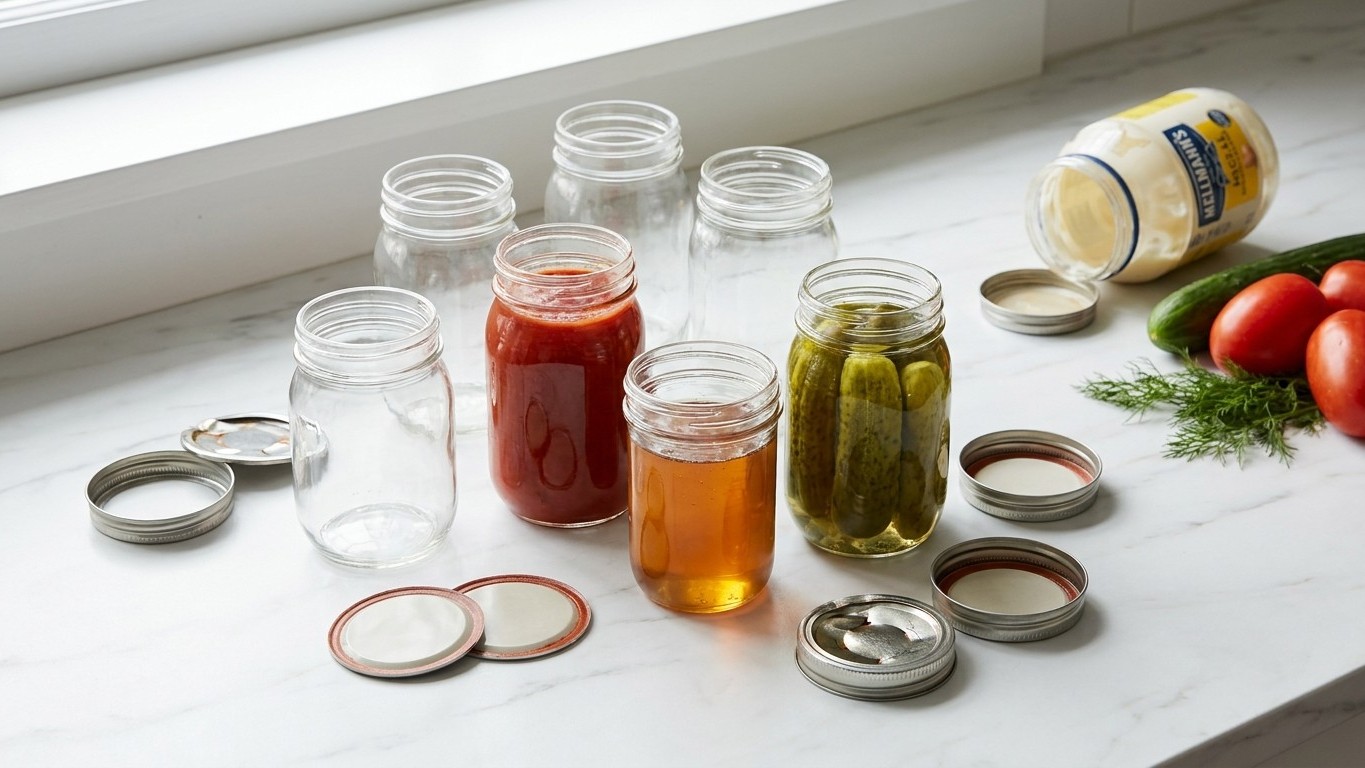

Not every jar in your cabinet belongs in a canner, and not every lid can go back on once it’s been used. The dividing line isn’t about price or brand. It’s about pH. Foods above 4.6 need a pressure canner reaching 240 to 250°F; foods at or below that line can go in a boiling-water bath that tops out at 212°F. Get the category wrong, and a jar can look perfectly sealed while hiding a toxin no taste test will ever catch.
Jars and Lids: What Is Recommended and What Is Not

The National Center for Home Food Preservation, a research center at the University of Georgia (nchfp.uga.edu), sets the reference point most home canners rely on: pH 4.6. That single number decides which equipment a food requires. It also decides which jars and lids are fit to hold that food safely through processing and months of storage.
Recommended jars are ones manufactured specifically for home canning. They’re made of glass formulated to withstand the swings in heat that happen inside a boiling-water or pressure canner, and they’re free of chips, cracks, or rough spots along the rim where a lid needs to make full contact. Recommended lids are the two-piece style, a flat metal lid with a sealing compound around the edge, paired with a separate screw band. The sealing compound is designed to soften once during processing and form a vacuum seal as the jar cools. That compound is a one-time-use component.
What isn’t recommended follows directly from those two facts. Jars that started life holding mayonnaise, pickles, or pasta sauce weren’t built for canner temperatures, and their glass can fail under stress even if it looks identical to a canning jar on a shelf. Reusing a flat lid whose sealing compound has already been compressed once is another common shortcut that undermines the seal, because that compound doesn’t reliably compress a second time.
| Jars | Lids | |
|---|---|---|
| Recommended | Jars made for home canning, free of cracks or chips, able to withstand canner heat | New two-piece flat lids used once, paired with a reusable screw band |
| Not recommended | Repurposed commercial food jars not designed for canner temperatures | Flat lids that have already sealed a previous jar |
What actually decides it
The pH 4.6 threshold isn’t an arbitrary rule. It marks the point where Clostridium botulinum, the bacterium responsible for botulism, can or can’t grow. Below that pH, the environment inside the jar is too acidic for the bacterium to multiply and produce its toxin. Above it, the food is classified low-acid, and acidity alone can no longer be trusted to stop the organism. That’s why low-acid foods, red meats, seafood, poultry, milk, and nearly all fresh vegetables, need the higher heat only a pressure canner delivers. Acid foods, meaning fruits, pickles, sauerkraut, jams, jellies, marmalades, and fruit butters, can be processed in a boiling-water canner instead.
A couple of foods sit close enough to the line that they need help getting on the safe side of it. Some tomato varieties now measure slightly above pH 4.6, and figs do too, which is why both are acidified with a measured amount of lemon juice or citric acid before canning rather than treated as automatically acid.
Clostridium botulinum doesn’t grow just because a food happens to be low-acid. It needs three conditions present together, and a sealed jar of unprocessed low-acid food happens to supply all three at once.
- A moist, low-acid food. This is removed by processing at a pH of 4.6 or below, or by processing at pressure-canner temperatures that destroy the bacterium’s spores in low-acid foods.
- A temperature between 40 and 120°F. This is removed by proper refrigeration below 40°F or by the sustained high heat of processing, both of which fall outside the bacterium’s growth range.
- Less than 2 percent oxygen. This condition is created by the vacuum seal itself and can’t be removed once a jar is sealed, which is exactly why the processing step has to happen before the seal, not after.
Put those three together and you can classify almost any food you’ve never canned before. Ask whether it’s moist, whether it will sit at room temperature once sealed, and whether it falls above or below pH 4.6. The answer tells you whether a boiling-water canner is enough or whether a pressure canner is the only safe option.
How to do it
The order of operations matters as much as the individual steps, because each one sets up the next. None of the steps below include a specific time, pressure, or jar size. Those numbers belong to a tested recipe for the specific food you’re canning, not to a general description of the method.
- Determine whether the food is acid or low-acid, and choose the boiling-water canner or the pressure canner accordingly.
- Inspect jars for cracks or chipped rims, and set aside new flat lids along with reusable screw bands.
- Prepare the food according to a tested recipe, including any acidification steps for foods like tomatoes or figs.
- Pack the food into the jars, leaving the headspace called for in that recipe.
- Wipe the jar rim clean, center a new flat lid on top, and screw the band down to fingertip tightness.
- Load the filled jars into the canner, following the recipe’s guidance on water or liquid level.
- Process the jars for the time and, for low-acid foods, the pressure specified in the tested recipe.
- Turn off the heat, allow a pressure canner to depressurize naturally, or remove jars promptly from a boiling-water canner, and let jars cool undisturbed on a towel or rack.
- Once jars are fully cool, check that each lid has sealed by pressing the center; a sealed lid won’t flex.
What goes wrong
- The lid doesn’t seal after cooling. The center of the lid still moves when pressed. Refrigerate the jar and use its contents soon, or reprocess it promptly with a fresh lid according to a tested recipe rather than assuming a second attempt will fix itself.
- Liquid siphons out of the jar during processing. This shows up as liquid loss and a jar that looks under-filled once cooled. If the lid still seals properly, the jar is generally fine to store; note the loss for next time and avoid sudden pressure changes in the canner, which are a common cause.
- A jar cracks or breaks inside the canner. This usually comes from a jar with an existing flaw, or from adding cold food to a hot jar or the reverse. Discard the jar and its contents, and inspect remaining jars closely before reusing them.
- A stored jar shows a bulging lid, spurts liquid when opened, or has an off smell. Any one of these signs means the jar should be discarded without tasting it. The absence of these signs is not proof a jar is safe on its own, since botulinum toxin has no taste and no smell.
Where the exact times come from
A tested time belongs to a tested recipe for one specific food, prepared one specific way, in one specific jar size. Change any of those variables and the tested time no longer applies. For the actual numbers, go to the National Center for Home Food Preservation’s page for the food you’re canning, where each recipe has been validated for safety.
Skipping that step and guessing at a time is not a small risk. Botulinum toxin has no taste and no smell, so an under-processed jar can look, smell, and taste completely normal while still being dangerous. The USDA’s Complete Guide to Home Canning (Agriculture Information Bulletin No. 539) is the other authority worth consulting for elevation adjustments, since water boils at a lower temperature at higher elevation, and a lower boiling temperature kills less. Increasing the process time or the canner pressure is how tested recipes compensate for that.
Common questions
Can I reuse canning lids?
No. The sealing compound on a flat lid is designed to work once. Screw bands can be reused as long as they aren’t rusted or bent, but a fresh flat lid is needed for every jar you process.
Can I use a mayonnaise jar or another repurposed food jar for canning?
It’s not recommended. Those jars aren’t manufactured to the same heat tolerance as jars made for home canning, and their rims may not be shaped to accept a canning lid properly.
How do I know if my tomatoes need added acid?
Some tomato varieties now measure slightly above pH 4.6, so tested recipes call for adding a measured amount of lemon juice or citric acid before canning, regardless of how acidic the tomatoes taste.
What should I do if a jar doesn’t seal?
Check it once the jar has fully cooled. If the lid center still flexes, refrigerate the contents and use them soon, or reprocess promptly with a new lid following a tested recipe.