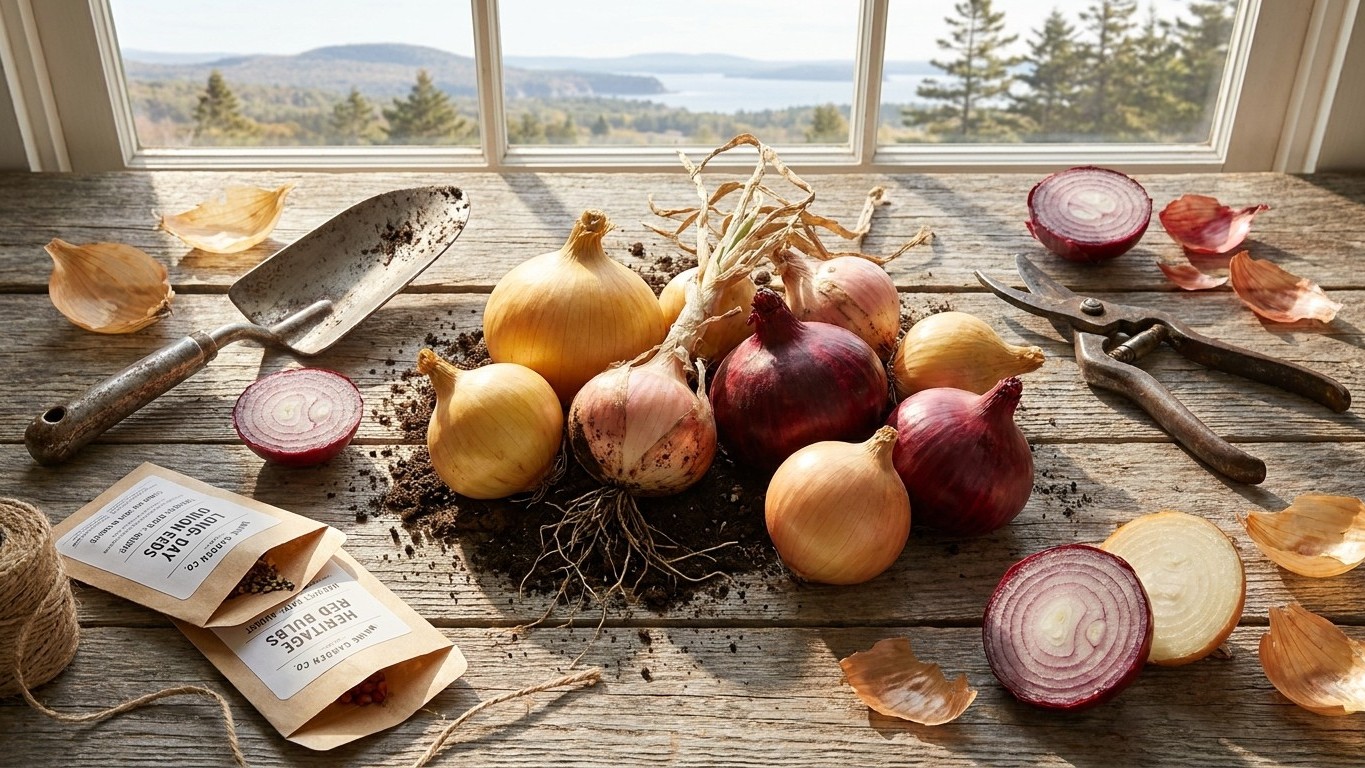

Maine sits at 43.65 degrees north latitude, measured at Portland, and the state gets 15 hours and 15 minutes of daylight on the longest day of the year. That number decides which onions will actually form a bulb here and which ones will just sit in the ground making leaves. The short answer: Maine is long-day onion country, with a handful of intermediate-day varieties working near the southern edge of the state.
The short answer for Maine

Onions do not bulb because of heat or soil temperature. They bulb because of day length, and the trigger point is different for every variety group. Long-day onions wait until the day stretches to somewhere between 14 and 16 hours before they stop building leaves and start building a bulb. At 15 hours and 15 minutes on the summer solstice, Portland clears that threshold with room to spare, which means long-day varieties are the safe, reliable choice across most of the state.
Of the varieties documented for this territory, the long-day group is the deepest and the one to lean on first: Ailsa Craig, Barolo, Blush, Bridger, Frontier, New York Early, Patterson, Powell, Red Carpet, Redwing, Rossa di Milano, Safrane, Talon, and Walla Walla Sweet. All of them have a published range that reaches up to or past the 43.65N mark, so they are built for a day length like Maine’s rather than merely tolerating it.
A second group also has room here: intermediate-day types, which bulb on a slightly shorter trigger and whose published ranges still cover this latitude. That list includes Cabernet, Calibra, Elsye, Expression, Monastrell, Red Long of Florence, Red Long of Tropea, Scout, and Sierra Blanca. They tend to suit the milder, more southern pockets of the state best, since their upper range limit sits closer to Maine’s latitude than the long-day group’s does.
Powell deserves a specific mention. Its published range runs from 43 to 47 degrees north, which is an almost exact match for Maine’s own latitude spread. That is not a coincidence gardeners should ignore: a variety bred for this narrow a band is about as close to a Maine-specific onion as the catalogue data gets.
What will not work here
Short-day onions are built for winter growing in the Deep South, where the day only needs to reach around 12 hours before bulbing starts. Plant one in Maine and it will hit that 12-hour trigger sometime in April or early May, long before the plant has grown enough leaf mass to feed a decent bulb. The result is not a smaller harvest so much as a failed one: a small, weak bulb, or in some cases no real bulb at all, followed by rot in storage because there was never enough substance there to keep. This is a variety mistake, not a feeding or watering mistake, and no amount of fertilizer fixes it.
Five varieties from the documented list fall into this trap for Maine gardens:
- Candy (intermediate-day, 33-40N): its upper range stops well south of Portland’s 43.65N, so it bulbs too early and too small here.
- Gabriella (short-day, 20-35N): a Deep South variety that will leaf out all season and never trigger a proper bulb this far north.
- Madalyn (short-day, 20-35N): same short-day trigger, same failure pattern, no bulb worth harvesting.
- Red Rock (short-day, 30-36N): bulbs on cue for the deep South, far too early for a Maine summer.
- White Castle (short-day, 30-38N): its range tops out five degrees south of Portland, which is enough of a gap to guarantee undersized bulbs.
None of these are bad onions in the right place. Plant them in Georgia or Alabama and they behave exactly as bred. Plant them in Maine and the plant spends the whole season making leaves, gets tricked into bulbing by a day length it was never designed for, and rots before it ever reaches a size worth pulling.
What changes across Maine
Portland, at 43.65N, sits near the southern edge of the state. Maine actually runs a long way north from there, stretching well past the 47th parallel up near Fort Kent and the Canadian border. That is a spread of roughly three to four degrees of latitude, which is enough to matter for a plant that reads day length down to the hour.
The general rule holds in one direction only: the farther north a garden sits within Maine, the more summer daylight it receives, not less. That favors the long-day varieties even more strongly toward the northern part of the state, while the intermediate-day group (Cabernet, Scout, Sierra Blanca, and the rest) is the better bet for gardens clustered near the southern coast, closer to Portland’s own latitude.
There is no verified day-length figure in hand for Fort Kent or any other far-northern Maine town, so no table of exact hours belongs here. What a gardener near the northern tip of the state should take away is simpler: check your own latitude, lean toward the long-day varieties with the widest published range, such as Redwing at 43 to 65N, and expect the trigger for bulbing to arrive slightly later in the season than it does around Portland, since the days keep lengthening a bit further north before the solstice arrives.
Reference point versus far edges
A reader gardening within a few miles of Portland can use the 43.65N figure and the 15-hour-15-minute daylight number directly. A reader up near Aroostook County is gardening at a meaningfully higher latitude, and while the same long-day logic applies, the specific timing of bulbing will shift later in the calendar than it does at the reference city.
Sweet now, or onions that last
Maine gardeners end up choosing between two kinds of onion, and the choice is chemical, not a matter of taste alone. The compounds that make an onion sharp on the tongue are volatile sulfur compounds, and those same compounds are what protect the bulb’s tissue during months of storage. A sweet onion has fewer of them. That is exactly what makes it mild and pleasant eaten raw in July, and exactly what makes it the wrong onion to still have in the pantry come winter.
Walla Walla Sweet is the clearest example from the list documented for this latitude. It is a long-day variety, so it bulbs reliably in Maine’s daylight, but it carries the sweet onion’s short storage life along with it. Eat those soon after harvest rather than counting on them to last.
The keepers on the same list run the other direction: Redwing, Patterson, Talon, and Safrane are long-day varieties bred toward pungency rather than sweetness, and pungency is the storage insurance. A Maine gardener who plants a mix of both groups is not hedging a bet so much as stocking two different jobs: sweet onions for the table this month, sharp ones for the cellar shelf in March.
That is the practical shape of a Maine onion harvest. The sweet varieties get used up fast, by necessity. The sharper long-day keepers are what is still sitting in a root cellar or a cool pantry corner when the snow is still on the ground and the garden itself is months from producing anything else.
Checking this against your own garden
The 43.65N figure belongs to Portland, not to every backyard in Maine. A garden near the coast in York County and one up near Presque Isle are gardening at meaningfully different latitudes, and the day-length math shifts accordingly. Before committing a full row to any variety on this list, a few checks are worth five minutes of a gardener’s time:
- Look up your own latitude if you garden more than an hour’s drive from Portland, since a few degrees north or south changes which day-length group fits best.
- Confirm your local last and first frost dates rather than relying on a statewide average, since Maine’s frost calendar varies noticeably between the coast and the interior.
- Call or check the website of your county’s University of Maine Cooperative Extension office for planting windows specific to your area.
- Match the variety’s published latitude range against your own number rather than against Portland’s, especially if you garden near either edge of the state.
A statewide figure is a starting point, not a guarantee. The onion in the ground only ever responds to the daylight actually falling on it, wherever in Maine that happens to be.