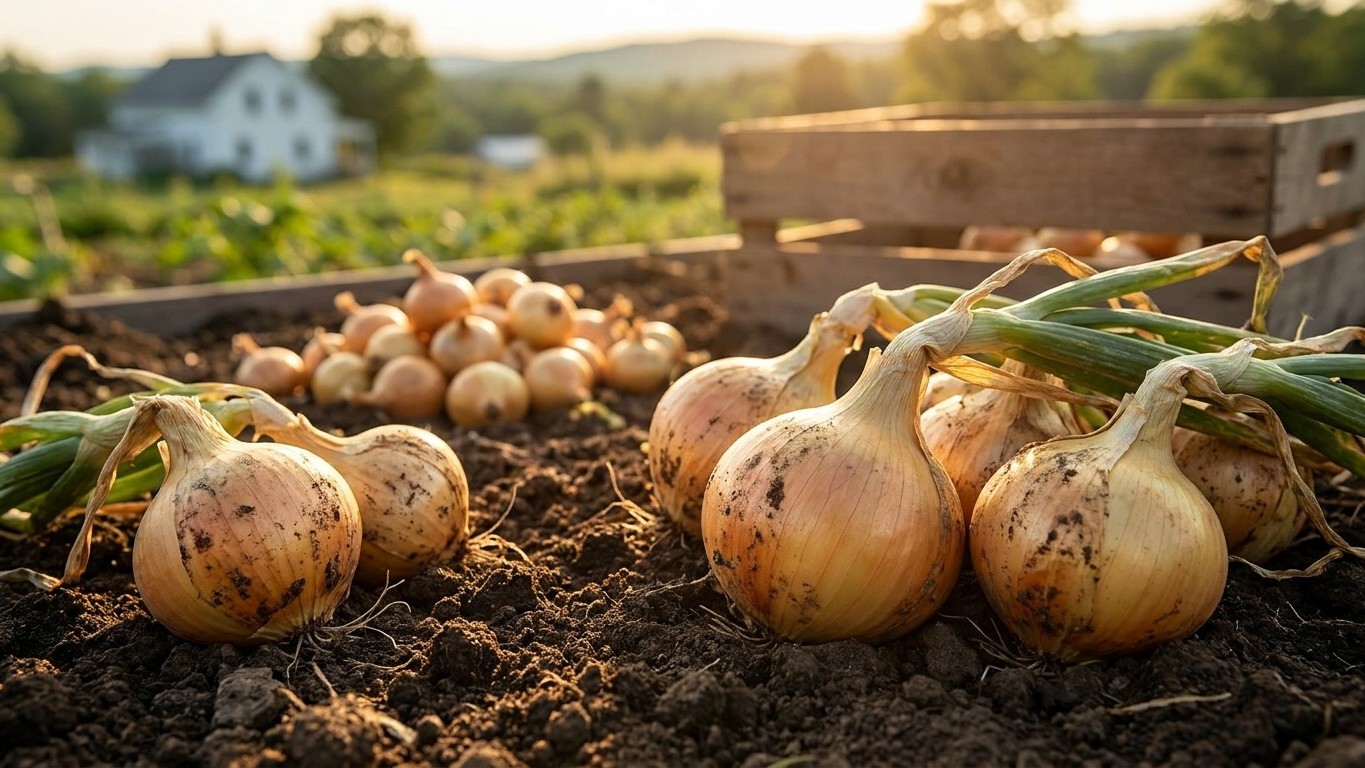

Onions grown from the wrong seed packet in Maine don’t fail quietly. They put up tall green tops all summer, then sit there with no bulb to show for it, and rot once the cold sets in. The fix isn’t more fertilizer or better soil. It’s matching the variety’s day-length requirement to Maine’s actual summer daylight, which is what this page walks through.
How long your longest day is

Portland, Maine sits at 43.65 degrees north, and on the summer solstice the sun there is up for 15 hours and 15 minutes. Those two numbers decide almost everything else on this page. An onion doesn’t bulb because the weather warms up. It bulbs because the days get long enough, and each variety has a threshold written into its genetics for how long “long enough” is.
Short-day onions start bulbing once daylight hits roughly 12 hours, a threshold documented by Clemson Cooperative Extension’s Home & Garden Information Center. That’s a spring-length day, not a summer one, and it’s why short-day varieties are built for the Gulf Coast and the Deep South, where winter days barely dip below that mark and summer days never get dramatically longer. Plant one in Portland and it hits its 12-hour trigger while the plant is still small, forms a golf-ball bulb, and stops.
Long-day onions need 14 to 16 hours before they’ll switch from making leaves to making a bulb. Portland’s 15 hours 15 minutes on the solstice lands squarely inside that window, which is why long-day varieties are the backbone of a Maine onion patch. Intermediate-day types, which typically need somewhere around 12 to 14 hours, can also work here, especially the ones whose published range stretches up toward the mid-40s latitude. Push much further past their upper limit and they behave more like short-day onions than long-day ones, bulbing early and staying small.
One caution worth repeating: 43.65 degrees is Portland’s latitude, not Maine’s. The state runs from the coast up past Caribou, a difference of several degrees of latitude and real minutes of summer daylight. A gardener in Aroostook County gets a longer solstice day than someone in Portland, which if anything makes long-day varieties an even safer bet up there. But it also means frost dates run later in spring and earlier in fall the farther north and inland you go, which matters more for section three than for variety choice. If you garden near either edge of the state, it’s worth checking your own latitude rather than assuming Portland’s numbers apply exactly.
Which varieties bulb in Maine
Twenty-three of the twenty-eight onion varieties documented on this site have a published latitude range that covers Portland’s 43.65 degrees north. That’s a wide field to choose from, and it includes most of the long-day workhorses along with several intermediate-day types whose range happens to reach this far north.
- Ailsa Craig (long-day, 38-60N)
- Barolo (long-day, 38-55N)
- Blush (long-day, 38-55N)
- Bridger (long-day, 35-50N)
- Cabernet (intermediate-day, 35-45N)
- Calibra (intermediate-day, 35-45N)
- Elsye (intermediate-day, 32-45N)
- Expression (intermediate-day, 32-45N)
- Frontier (long-day, 40-50N)
- Monastrell (intermediate-day, 35-46N)
- New York Early (long-day, 38-50N)
- Patterson (long-day, 38-55N)
- Powell (long-day, 43-47N)
- Red Carpet (long-day, 40-45N)
- Red Long of Florence (intermediate-day, 38-50N)
- Red Long of Tropea (intermediate-day, 35-48N)
- Redwing (long-day, 43-65N)
- Rossa di Milano (long-day, 38-50N)
- Safrane (long-day, 42-50N)
- Scout (intermediate-day, 32-46N)
- Sierra Blanca (intermediate-day, 32-45N)
- Talon (long-day, 42-50N)
- Walla Walla Sweet (long-day, 35-55N)
Now the list that actually matters if you’ve bought onion sets at a garden center without checking the label. Five documented varieties are published for latitudes below Portland’s, meaning they’re built for a shorter summer day than Maine provides:
- Candy (intermediate-day, 33-40N)
- Gabriella (short-day, 20-35N)
- Madalyn (short-day, 20-35N)
- Red Rock (short-day, 30-36N)
- White Castle (short-day, 30-38N)
Plant one of these in Maine and here’s what actually happens: it grows a healthy-looking top all June and July, hits its low day-length trigger early, and forms a bulb the size of a golf ball while the plant still has months of growing season left. Some gardeners mistake the small bulb for a nutrient problem and dump on more fertilizer, which only feeds more leaf growth on a plant that’s already decided it’s done bulbing. The bulb that did form often doesn’t cure well and rots in storage within weeks. It’s a variety mismatch, not something a different feeding schedule fixes.
When to plant onions in Maine
Because Maine’s onion list runs almost entirely long-day and intermediate-day, the calendar looks nothing like an onion-growing guide written for Georgia or Texas. There’s no fall planting here. Long-day onions need to build leaf mass through spring and into early summer so they have enough top growth to size up a bulb once the solstice day length triggers it, and a fall-planted bulb would simply freeze out over a Maine winter instead of overwintering the way it might in a mild coastal climate further south.
The practical calendar starts indoors, typically 8 to 10 weeks before your last spring frost, growing onion seedlings or sets under lights until they’re ready to go into the ground. According to NOAA’s 1991-2020 climate normals, Portland’s last spring freeze falls in the window of April 22 to May 1, and transplanting seedlings out around that window gives the plants a full season of long summer days to bulk up before the solstice trigger kicks in.
Fall is when you’re pulling onions, not planting them. Portland’s first fall freeze lands between October 9 and October 21, and a well-timed long-day onion should already be curing in a shed or garage by then, not still in the ground. Those two frost windows are the bookends of the Maine onion season.
Both of those dates come from a 30-70% freeze probability band, which means they’re averages built from three decades of records, not a promise. A late-May frost or an early-October cold snap both fall outside that band but happen. And Portland, sitting on the coast, is the mild end of Maine’s climate. Inland valleys and the northern counties run their last spring frost later and their first fall frost earlier, sometimes by several weeks, so a gardener in Millinocket or Caribou needs to shift this whole calendar and build in extra margin rather than borrowing Portland’s dates directly.
Sweet onions or onions that keep
Every Maine onion grower eventually runs into a trade-off, and it isn’t really about which variety happens to taste better. The bite in an onion comes from volatile sulfur compounds, and those same compounds are what protect the bulb from rot in storage. A sweet variety has fewer of them, which is exactly why it eats better raw and exactly why it won’t last the winter. The University of Missouri Extension puts it plainly in its guide to planting, growing and harvesting onions: sweet types don’t store as well as the more pungent ones, as a rule.
That mechanism lines up with day length, and it’s part of why the geography matters as much as the variety name. Short-day onions, grown farther south, tend to run sweeter and milder. Long-day onions, the ones that actually work in Portland’s 15-hour summer day, tend to run sharper and keep longer. A Maine garden growing almost exclusively long-day and intermediate-day varieties is naturally leaning toward the storage end of that spectrum, whether the gardener planned it that way or not.
There’s an exception worth flagging by name, since it’s on the “will bulb here” list above: Walla Walla Sweet is a long-day onion, so it will size up fine in a Maine garden, but it’s bred for sweetness and mildness, which means it carries the sweet-onion trade-off regardless of its day-length classification. Expect it to taste great in August and September and expect it not to make it to Thanksgiving in the pantry.
Plan the harvest with that pantry in mind. A Maine garden built around varieties like Redwing, Safrane, or Talon, all pungent long-day types with a solid published range up into the mid-latitudes, is a garden that can realistically feed you through a Maine winter, with onions still firm in a cool, dark storage spot come March. A garden weighted toward Walla Walla Sweet or other sweet long-day types will give you better burgers in July and an empty onion basket by New Year’s. Most gardeners end up growing a mix of both, on purpose, once they understand why the trade-off exists.