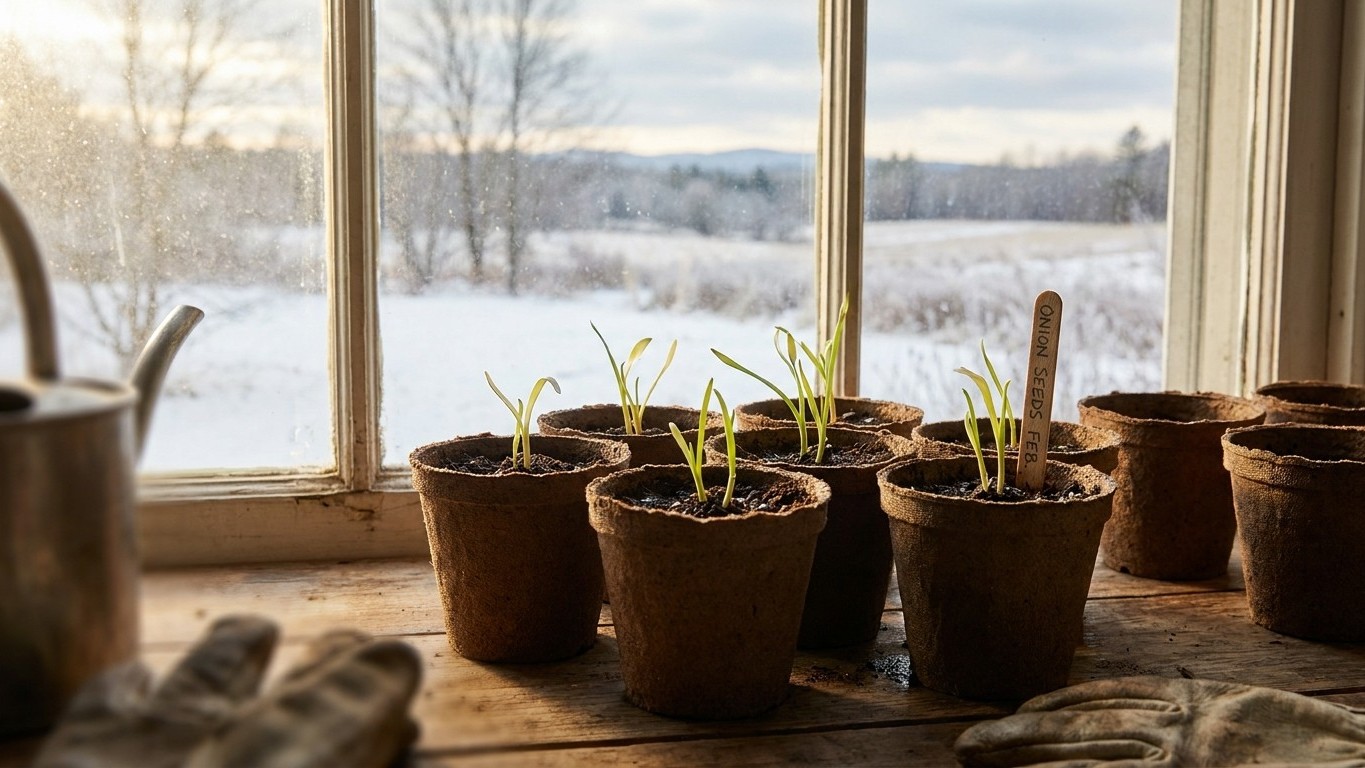

Maine onions go in the ground in early spring, not fall. At 43.65 degrees north (Portland), winters are long enough and cold enough that overwintered onion sets or transplants simply don’t survive the way they do farther south. What decides everything else, though, is daylight: Portland gets 15 hours and 15 minutes of sun on the longest day of the year, and that number is what tells an onion when to stop growing leaves and start growing a bulb.
The short answer for Maine

Start onion seed indoors in late winter, then move transplants (or sets) outside in early spring once the ground can be worked. That’s the opposite of what gardeners do in mild-winter states like Georgia or coastal South Carolina, where onions go into the ground in October and spend the whole winter quietly building roots before spring warmth pushes them into leaf growth. Maine’s ground freezes hard enough, for long enough, that a fall-planted onion would be dead by January. There’s no season to skip to.
The 43.65 degree latitude and the 15 h 15 of summer daylight it produces put Maine squarely in long-day onion territory. Long-day varieties don’t start forming a bulb until day length reaches somewhere between 14 and 16 hours, and Portland’s solstice comfortably clears that threshold. Onion catalogue ranges published for this latitude and matching this territory include Ailsa Craig, Bridger, Frontier, New York Early, Patterson, Powell, Red Carpet, Redwing, Rossa di Milano, Safrane, Talon, and Walla Walla Sweet, all classed long-day. A handful of intermediate-day types with ranges reaching this far north, such as Cabernet, Calibra, Monastrell, and Red Long of Tropea, will also bulb here, though closer to the northern edge of what they’re built for.
Why does the season matter so much more than in, say, Virginia or Texas? Because further south, the ground almost never freezes deep enough to kill a young onion, so gardeners get away with planting in autumn and harvesting a bigger bulb the following summer. Maine doesn’t get that option. The growing window here is compressed into spring and summer, and the planting date has to work backward from the summer solstice rather than forward from the first fall frost.
What will not work here
Planting an onion late in Maine doesn’t push the harvest back a few weeks. It shrinks the bulb outright. An onion doesn’t decide to bulb based on how long it’s been in the ground, it decides based on day length, and day length arrives on schedule whether the plant is six inches tall or barely sprouted. A late-planted onion that’s only grown a few small leaves by the time daylight crosses the bulbing threshold will form a small bulb, permanently, because bulbing has already started and the plant stops adding leaf mass once it does. There is no catching up later in the season.
The same clock rules out an entire category of variety, regardless of when you plant. Short-day onions are built for a solstice with roughly 12 hours of daylight, the kind found much farther south, and every one of them bulbs far too early at 43.65 degrees north. Planted in Maine, a short-day onion reads the long summer days as a signal to bulb almost as soon as it’s out of the ground, well before the plant has built enough leaf to feed a full-size bulb. The result: a small, unusable onion, or in some cases none at all, followed by rot once the plant tries and fails to mature normally.
- Candy (intermediate-day, published range 33-40N): bulbs too early this far north, undersized bulbs result.
- Gabriella (short-day, published range 20-35N): triggers bulbing almost immediately at this latitude, no size to show for it.
- Madalyn (short-day, published range 20-35N): same failure, tiny bulbs before the plant has grown.
- Red Rock (short-day, published range 30-36N): bulbs while still seedling-sized here.
- White Castle (short-day, published range 30-38N): far too aggressive a bulbing trigger for a Maine summer.
None of these are a timing problem you can fix by planting earlier. They’re a variety mismatch, and no adjustment to the calendar corrects it.
What changes across Maine
Maine isn’t one latitude any more than it’s one climate. The state runs from around 43 degrees north near Kittery on the southern coast up past 47 degrees north in Aroostook County near the Canadian border, a span of roughly four degrees. Portland, the reference city for the 43.65 degree figure and the 15 h 15 daylight number used above, sits toward the southern end of that range. A gardener in Fort Kent or Presque Isle, near the top of the state, gets meaningfully more summer daylight than Portland does, and a shorter, colder growing season around it.
| Location | Approx. latitude | What changes |
|---|---|---|
| Portland (reference city) | 43.65N | 15 h 15 daylight on solstice; standard long-day recommendation applies |
| Bangor (central Maine) | ~44.8N | Slightly more solstice daylight; frost-free window opens later than Portland’s |
| Fort Kent (far north) | ~47.25N | Longest solstice daylight in the state; shortest frost-free season, spring transplanting pushed later still |
For most varieties suited to this territory, that spread inside the state doesn’t change the long-day recommendation. Every point in Maine gets enough summer daylight to clear the 14-to-16-hour bulbing threshold. What it does change is timing: a gardener near the northern edge of the state should expect a later last frost date and a shorter window to get transplants established, which can mean starting seed indoors earlier rather than later to compensate. Anyone gardening well north of Portland, especially in Aroostook County, should treat the local frost dates as the real planning tool, not the statewide average.
Sweet now, or onions that last
Maine’s northern latitude nudges gardeners toward onions that keep rather than onions that eat sweet and soft. That’s not a matter of taste, it’s chemistry. The compounds that give an onion its sharp bite are volatile sulfur compounds, and those same compounds are what protect the bulb in storage. A variety with fewer of them tastes milder raw, but it has less built-in protection and breaks down faster once it’s out of the ground. University of Missouri Extension puts it plainly: sweet onion types simply do not store as well as the more pungent ones.
Day length lines up with this trade-off almost exactly. Short-day varieties, the kind that never bulb properly in Maine anyway, tend to run sweeter and shorter-keeping, which is part of why southern gardens are built around eating onions fresh through summer and fall. Long-day varieties, the ones that actually work at 43.65 degrees north, trend sharper and longer-keeping, because the same long summer days that let them bulb also happen to favor higher sulfur content.
Practically, that means a Maine pantry in March can still hold onions from last summer’s harvest, something a Georgia garden built around sweet short-day types generally can’t manage. Varieties suited to this latitude such as Redwing, Patterson, or Talon are built for exactly that kind of storage life. A gardener who wants sweeter eating onions alongside the keepers can still grow a sweeter long-day variety like Walla Walla Sweet, but should plan to eat those earlier in the season rather than count on them making it to spring.
Checking this against your own garden
The figures here come from one weather station in Portland, and a garden fifty or a hundred miles away, especially further north, is standing under a slightly different sky. Before locking in a planting date or a variety list, it’s worth confirming a few things against your own location rather than trusting a statewide number as gospel.
- Look up your own latitude if you’re gardening well north or south of Portland, particularly in Aroostook County or along the far southern coast.
- Check your local average last spring frost date and first fall frost date, not a generic Maine-wide estimate.
- Confirm which onion varieties are actually sold or recommended for your county, since availability shifts even within one state.
- Call your county’s University of Maine Cooperative Extension office for planting windows calibrated to your specific area.
- Track how many hours of daylight your location actually gets at the solstice if you’re near the state’s northern or southern edge, since that’s the number the onion responds to, not the calendar date.
A planting calendar built on Portland’s numbers is a solid starting point for most of the state, but it’s still a starting point. The extension office covering your county has seen how these varieties actually perform on local soil, in local frost patterns, and that’s worth more than any single statewide figure.