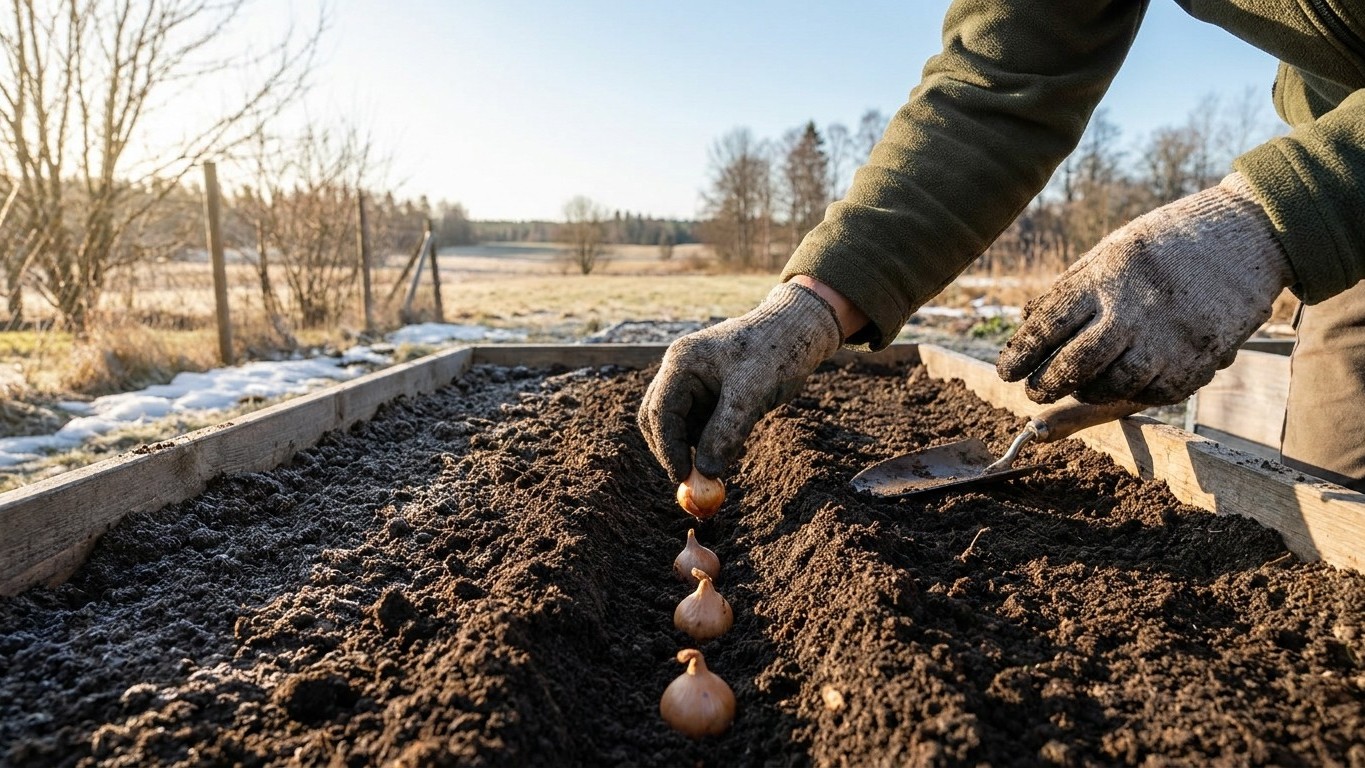

Manitoba does not get an autumn onion planting window the way the mild-winter South does. With Winnipeg sitting at 49.92 degrees north and pulling 16 hours and 8 minutes of daylight on the summer solstice, the calendar here runs on cold ground and long days, not on a fall head start. That combination decides both when you plant and which onions are worth planting at all.
The short answer for Manitoba

Plant Onions in Manitoba in early spring, as soon as the soil can be worked, not in the fall. That’s the opposite of the advice given to gardeners in Georgia, Texas, or the Carolinas, where onion sets and transplants go into the ground in October and November and spend winter quietly building roots under soil that never freezes solid. In Manitoba, the ground does freeze solid, for months, and any onion left exposed to that will not survive to see June.
So the whole strategy shifts. Instead of a long, mild winter to build a root system before spring growth kicks in, Manitoba gardeners get a short window between the last hard frost and the summer solstice to build leaf mass fast. That’s the only head start available, and it matters more here than almost anywhere else, because of what happens on June 21.
On the longest day of the year, Winnipeg logs 16 hours and 8 minutes of daylight. That’s the number an onion plant is actually reacting to. Onions don’t decide to form a bulb because the weather warmed up; they decide based on day length, a process called photoperiodism. According to Clemson Cooperative Extension’s Home & Garden Information Center, short-day onions start bulbing once daylight reaches around 12 hours. Long-day types wait until day length climbs to somewhere between 14 and 16 hours before they switch from making leaves to making a bulb.
Winnipeg’s 16 hours and 8 minutes comfortably clears that 14-to-16-hour threshold, which is exactly why long-day onions are the ones that work here, and why the planting date matters so much. Every week you plant early is a week of extra leaf growth banked before the solstice trips the bulbing switch. Miss that window and the plant simply doesn’t have enough leaf tissue on hand when the switch flips, and a small plant makes a small bulb, full stop.
This is the core difference between Manitoba and states like Georgia or Texas: those gardeners are working with a mild-winter overwintering strategy and short-day varieties that bulb around 12 hours regardless of location. Manitoba gardeners are working with a compressed spring, a long summer day length, and long-day varieties bred to wait for it.
What will not work here
Planting onions late in Manitoba doesn’t push the harvest back a couple of weeks. It shrinks the harvest. The bulbing trigger is tied to the calendar, not to the plant’s size or your schedule. Whatever leaf growth the plant has managed by the time day length hits that 14-to-16-hour mark is the leaf growth it’s stuck with when bulb formation starts. Plant three weeks late and you don’t get onions three weeks later; you get onions that are permanently smaller, because the plant only had three fewer weeks to build the leaves that feed the bulb.
The other mistake is a variety mistake, and it’s a costly one because it isn’t obvious until midsummer. Short-day and intermediate-day onions are bred for latitudes where summer daylight tops out around 12 to 14 hours. Plant them in Manitoba, where the solstice delivers 16 hours and 8 minutes, and they hit their bulbing trigger almost immediately, often before the plant has grown past a handful of thin leaves. The result isn’t a smaller onion. It’s barely an onion at all, followed by rot in storage because there was never enough bulb tissue to cure properly. Eighteen documented varieties fall into this trap for Manitoba’s latitude:
- Cabernet (intermediate-day, 35-45N), bulbs at day lengths well short of Manitoba’s summer, leaving small bulbs.
- Calibra (intermediate-day, 35-45N), same early-trigger problem.
- Candy (intermediate-day, 33-40N), bred for latitudes far south of the 49.92N reference point.
- Elsye (intermediate-day, 32-45N), bulbs before Manitoba’s plants reach useful size.
- Expression (intermediate-day, 32-45N), same limitation.
- Gabriella (short-day, 20-35N), bulbs around 12 hours of daylight, months of leaf growth short of what Manitoba’s long days allow.
- Madalyn (short-day, 20-35N), same short-day trigger issue.
- Monastrell (intermediate-day, 35-46N), range stops short of Manitoba’s latitude.
- Powell (long-day, 43-47N), a long-day type, but its published range still falls short of 49.92N.
- Red Carpet (long-day, 40-45N), same gap.
- Red Long of Tropea (intermediate-day, 35-48N), just misses Manitoba’s latitude.
- Red Rock (short-day, 30-36N), far too southern a trigger point.
- Red Sensation (short-day, 25-35N), same issue.
- Scout (intermediate-day, 32-46N), bulbs too early for Manitoba’s day length.
- Sierra Blanca (intermediate-day, 32-45N), same limitation.
- Texas Grano 1015Y (short-day, 25-35N), a warm-climate short-day classic, wrong tool for this latitude.
- Vidora (short-day, 25-35N), same short-day mismatch.
- White Castle (short-day, 30-38N), bulbs too early, too small, for Manitoba.
Plant any of these in Manitoba and the pattern is the same: leaves all season, a bulb that never fills out, and a soft, watery result in storage instead of a cured onion.
What changes across Manitoba
The 49.92-degree figure belongs to Winnipeg, and Winnipeg sits close to Manitoba’s southern edge. The international border with the United States runs along the 49th parallel, just south of the city, while the province stretches north well past the 55th parallel toward the 60th, where it meets the Northwest Territories and Nunavut. That’s roughly a ten-degree spread from south to north, and ten degrees of latitude is enough to change the growing math.
| Location | Latitude | What it changes |
|---|---|---|
| Southern border area (near Winnipeg) | 49.92N (reference city) | 16h 08min of daylight on the solstice; the figures on this page apply directly here |
| Mid-province | ~53-55N | Summer days run longer than Winnipeg’s; growing season shortens due to a later spring thaw and earlier fall frost |
| Far north, near the 60th parallel | ~58-60N | Daylight climbs well beyond 16 hours in summer, but the frost-free window narrows sharply, sometimes to a matter of weeks |
The practical takeaway for anyone gardening outside the Winnipeg area: longer summer daylight up north isn’t a bonus, because the growing season shrinks even faster than the day length grows. A gardener near Thompson or Flin Flon isn’t dealing with a bulbing-threshold problem, since long-day onions will still get their 14-to-16 hours easily. The real constraint further north is time: fewer frost-free weeks to build leaf mass before that trigger arrives, which means starting seed indoors earlier and getting transplants into the ground the moment the soil allows it.
Checking this against your own garden
The numbers in this article describe Winnipeg specifically, not every Manitoba backyard. Before planting, it’s worth confirming a few things locally rather than assuming the province-wide figures apply exactly to your plot:
- Look up your own latitude if you garden well north or south of Winnipeg; a difference of even two or three degrees shifts your summer day length and your frost timing.
- Check your area’s average last spring frost date and first fall frost date, since those bookend the leaf-growing window before the solstice trigger.
- Contact your local Manitoba Agriculture regional office or a nearby agricultural extension service for frost and planting data specific to your municipality.
- Watch soil temperature and workability in early spring rather than a fixed calendar date; a late thaw pushes the whole window back regardless of what the calendar says.
- Ask local garden clubs or nurseries which long-day varieties they’ve seen perform well in your specific microclimate, since shelter, slope, and soil type all shift results within the same latitude band.