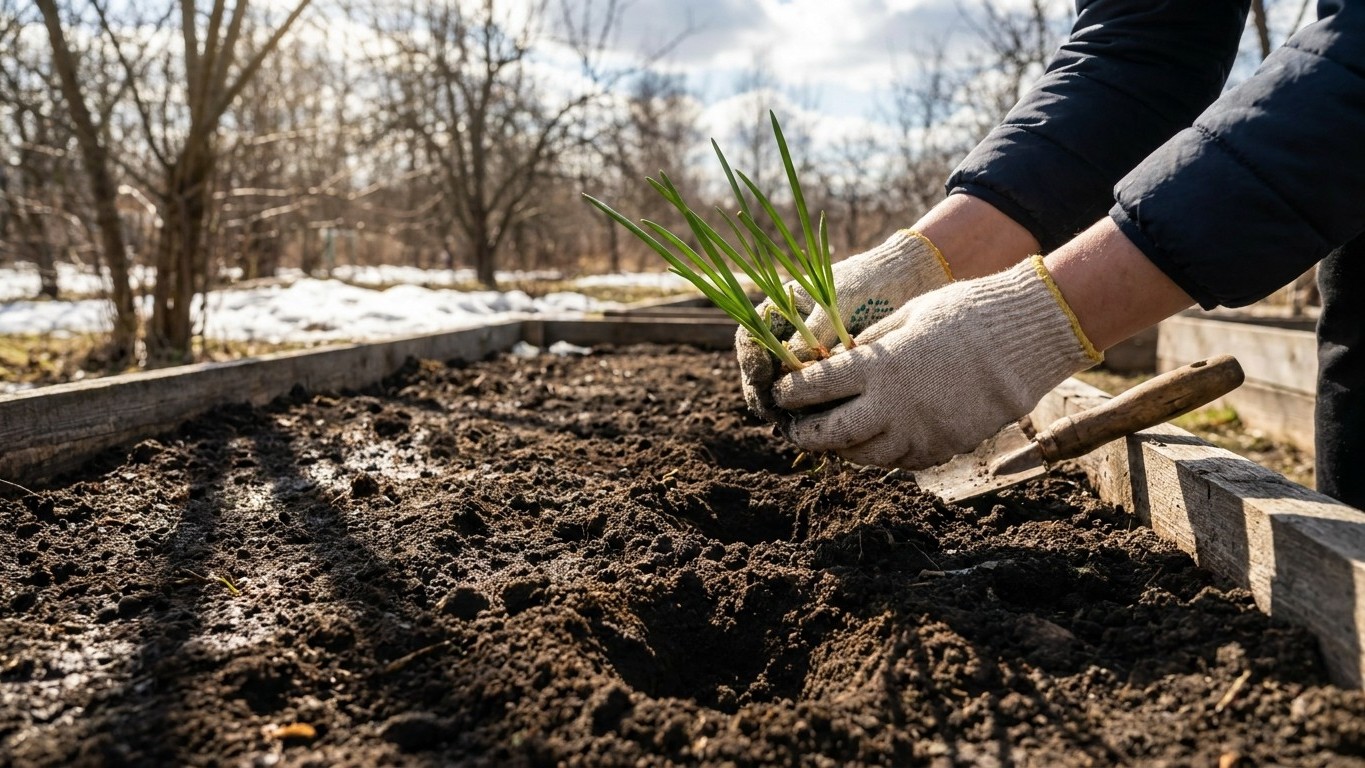

In Massachusetts, onions go into the ground in early-to-mid spring, not fall. Boston sits at 42.36 degrees north and gets 15 hours and 6 minutes of daylight on the longest day of the year, plenty for long-day onions to bulb well and enough for many intermediate-day types too. Winters here are too cold for the fall-planting approach that works in the Deep South, so the calendar here runs from indoor seed-starting in late winter through transplanting once the ground thaws.
The short answer for Massachusetts

Start onion seeds indoors 8 to 10 weeks before your last expected frost, typically sometime in February for most of the state. Transplant seedlings, or set out onion sets, outdoors about four weeks before that last frost date, once the soil can be worked and daytime temperatures reliably clear the 40s. For most of Massachusetts, that lands somewhere between late March and mid-April, with the Cape and Islands running a little earlier and the Berkshires a little later.
The reason this window matters more than the calendar date is day length. Onions do not decide to bulb because they feel warm; they bulb because the days have gotten long enough. At Boston’s 15 hours and 6 minutes of daylight on the June solstice, the region comfortably clears the 14-to-16-hour threshold that long-day onions need, and it also clears the lower end of the 12-to-14-hour range that intermediate-day onions respond to.
That puts Massachusetts squarely in long-day and intermediate-day territory. Of the 28 onion varieties documented across this site, 21 have published latitude ranges that cover 42.36 degrees north, including long-day types like Ailsa Craig, Frontier, Patterson, Safrane, and Walla Walla Sweet, alongside intermediate-day types like Cabernet, Scout, and Monastrell. The practical takeaway is straightforward: pick a long-day or intermediate-day variety, get it into the ground early enough that it has built real leaf mass before the solstice, and let day length do the rest.
What will not work here
Short-day onions do not work in Massachusetts. Full stop. These varieties are bred to start bulbing once day length hits around 12 hours, which happens here well before the plant has had time to grow. The result is not a smaller harvest that’s still worth having; it’s a bulb that never develops properly, a plant that keeps throwing leaves it has no business growing at that point, and eventually rot setting into a crown that was never going to size up.
Five of the varieties tracked on this site fall into that excluded category for this latitude:
- Candy — intermediate-day, published for 33 to 40 degrees north; Massachusetts sits above its range.
- Gabriella — short-day, published for 20 to 35 degrees north; far too southern a variety for New England.
- Madalyn — short-day, published for 20 to 35 degrees north; same problem, same result.
- Red Rock — short-day, published for 30 to 36 degrees north; will trigger bulbing far too early here.
- White Castle — short-day, published for 30 to 38 degrees north; not suited to Massachusetts’ longer summer days.
Timing mistakes cause a related but different failure. Planting a suitable long-day variety too late does not push the harvest back by a few weeks the way a late tomato transplant might. It shrinks the harvest, because whatever size the onion plant has reached when the day length trigger arrives is roughly the size the bulb will end up. An onion set out in May instead of April has lost real growing time it will never get back, and it shows up as a smaller onion at harvest, not a later one.
What changes across Massachusetts
Massachusetts is a small state, but it is not a single latitude. It runs from around 41 degrees north near Nantucket and the Cape and Islands up to nearly 43 degrees north along the New Hampshire and Vermont borders, a spread of roughly two degrees. The figures above, 42.36 degrees north and 15 hours 6 minutes of daylight, belong specifically to Boston, the reference city tied to the climate station behind these numbers, and Boston sits almost exactly in the middle of the state’s latitude range.
| Region | Approximate latitude | What it changes |
|---|---|---|
| Cape Cod / Islands | ~41.2°N | Slightly shorter summer daylight than Boston; last frost arrives earlier, so planting can start a bit sooner |
| Boston (reference) | 42.36°N | 15h06 on the longest day; the figures used throughout this page |
| Berkshires / northern border | ~42.8°N | Slightly longer summer daylight than Boston; last frost arrives later, pushing the planting window back |
The practical effect is small but real. A gardener on the Islands can likely set out onions a week or so earlier than someone in Boston, while a gardener near the northern border should expect to plant roughly a week or two later and watch for a shorter frost-free stretch overall. None of this changes which day-length group works here, long-day and intermediate-day still apply from one end of the state to the other, but it does shift the exact week to get plants in the ground.
Sweet now, or onions that last
Every onion gardener in Massachusetts eventually runs into the same trade-off: sweet onions do not store well, and pungent onions do. That’s not a marketing distinction, it’s chemistry. The volatile sulfur compounds responsible for an onion’s bite are the same compounds that protect the bulb once it’s cured and sitting in a basement or pantry, according to University of Missouri Extension. A mild, sweet variety simply has fewer of those compounds, which makes it excellent sliced raw in July but a poor candidate for lasting through a New England winter.
Day length lines up with this trade-off almost perfectly. Long-day onions, the group best suited to Massachusetts’ 15-plus hours of summer daylight, tend to run sharper and store longer. Intermediate-day varieties, several of which also work here, skew sweeter and keep for a shorter stretch. A gardener who plants mostly long-day types like Patterson or Frontier is setting up a pantry that still has usable onions in March. A gardener who leans on intermediate-day, sweeter varieties like Scout or Sierra Blanca is planting onions meant to be eaten in the months right after harvest, not stored deep into winter.
Neither choice is wrong. It depends on whether the goal is a stash of onions that carries a household through winter cooking, or a batch of milder onions to eat fresh through late summer and fall. Many Massachusetts gardeners split the difference and grow both, keeping the long-day varieties for storage and the intermediate-day ones for the kitchen counter.
Checking this against your own garden
The figures in this article describe Boston. A backyard on Martha’s Vineyard or up near the Vermont line is not identical to a backyard in Jamaica Plain, even though both are technically “Massachusetts.” Before locking in a planting date or a variety list, it’s worth confirming a few details specific to the actual garden in question.
- Look up your town’s actual latitude if you’re near the Cape, the Islands, or the northern border, rather than assuming Boston’s 42.36 degrees applies exactly.
- Check your local average last spring frost date, since that’s what actually sets the transplant window, not the calendar month alone.
- Contact your county’s UMass Extension office for frost-date data and soil-temperature guidance specific to your area.
- Watch your own yard’s microclimate, a south-facing slope or a low frost pocket can shift things by a week or more even within the same town.
- Confirm the day-length range printed on any seed packet or catalog listing against the figures here before buying, especially for varieties not covered on this page.