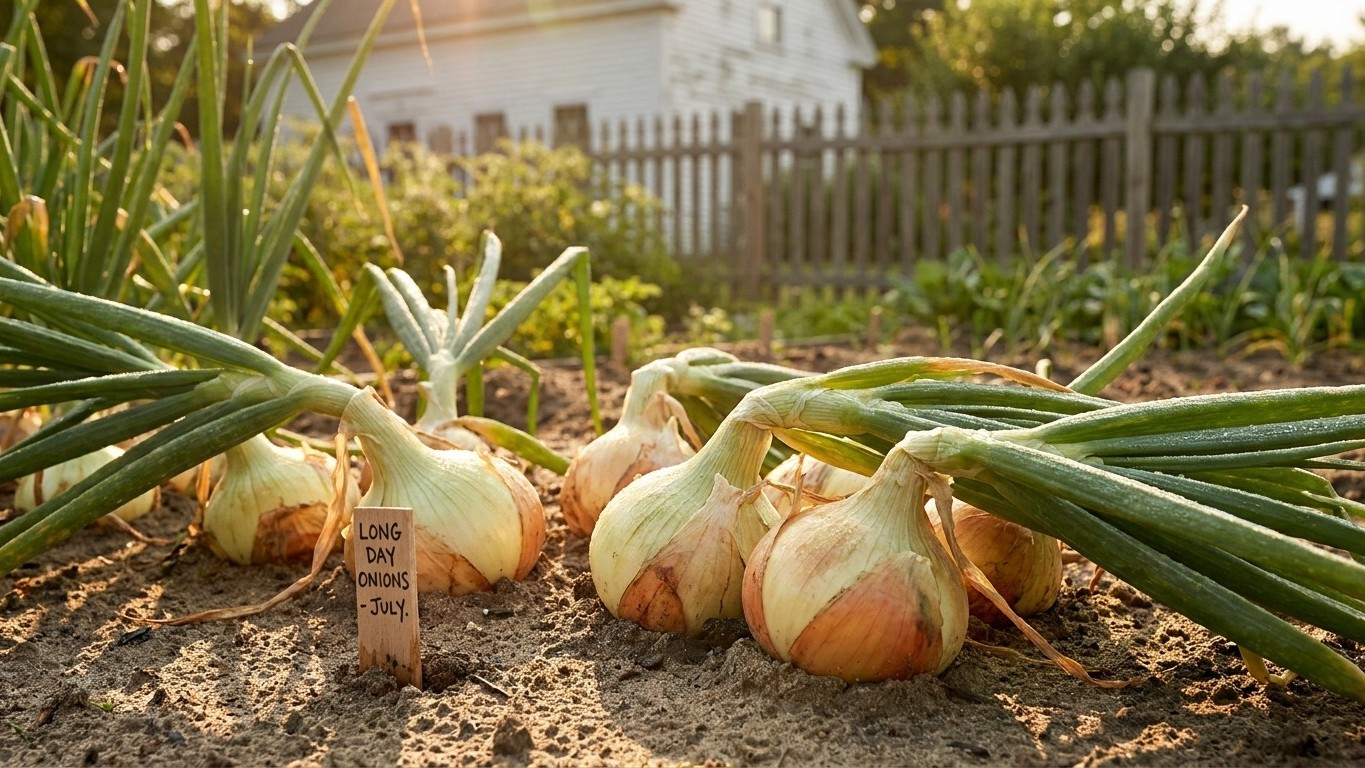

Massachusetts sits at 42.36 degrees north, and on the longest day of the year the Boston area gets 15 hours and 6 minutes of daylight. That single number decides which onions will actually form a bulb in your garden and which ones will just sit there making leaves. Long-day and intermediate-day onions work here. Short-day types, the kind sold in big-box stores every spring, mostly do not. Knowing When to Plant Onions in Massachusetts is just as important as picking the right variety.
How long your longest day is

Everything else in this article follows from two numbers. The reference station for these figures, USW00014739, sits at 42.36 degrees north latitude, at Logan Airport in Boston. On the June solstice, that latitude gets 15 hours and 6 minutes of daylight, calculated from the standard sunset hour-angle formula using a solar declination of 23.44 degrees. That figure is geometric, meaning it does not include the roughly seven extra minutes that atmospheric refraction adds to real daylight, so the true number in the garden is a touch longer.
Onions do not care about Temperature nearly as much as gardeners assume. What triggers a plant to stop growing leaves and start swelling a bulb is day length, and each variety has a threshold written into it by generations of selection. Short-day onions, according to Clemson Cooperative Extension’s Home & Garden Information Center, start bulbing at around 12 hours of daylight. That threshold is so low that in a place getting 15 hours and 6 minutes at the peak of summer, a short-day onion bulbs while the plant is still small and undeveloped. Long-day onions wait for 14 to 16 hours before they respond, and intermediate-day types split the difference, usually triggering somewhere between 12 and 14 hours. At 15 hours and 6 minutes, Massachusetts clears the long-day threshold with room to spare and sits comfortably inside intermediate-day territory too.
That 15 hours and 6 minutes belongs to Boston specifically. Massachusetts runs from the Atlantic coast to the Berkshires, and while the state isn’t huge in latitude terms compared to somewhere like California or Texas, it still spans real degrees of latitude between its southern coastal edge and its northern border with Vermont and New Hampshire. A gardener in Pittsfield or North Adams sits at a noticeably higher latitude than someone on Cape Cod, and that means slightly more daylight at the summer peak in the northern part of the state. If you’re near either edge of the state, it’s worth checking your own latitude rather than assuming Boston’s number applies exactly to your backyard. The difference is usually small, but onions respond to minutes, not just hours.
Which varieties bulb in Massachusetts
Of the 28 onion varieties in The Best Onion Varieties for Massachusettss documented across this site, 21 have a published latitude range that covers 42.36 degrees north. These are the ones with a real shot at bulbing properly in a Massachusetts garden:
- Ailsa Craig (long-day, 38-60N)
- Barolo (long-day, 38-55N)
- Blush (long-day, 38-55N)
- Bridger (long-day, 35-50N)
- Cabernet (intermediate-day, 35-45N)
- Calibra (intermediate-day, 35-45N)
- Elsye (intermediate-day, 32-45N)
- Expression (intermediate-day, 32-45N)
- Frontier (long-day, 40-50N)
- Monastrell (intermediate-day, 35-46N)
- New York Early (long-day, 38-50N)
- Patterson (long-day, 38-55N)
- Red Carpet (long-day, 40-45N)
- Red Long of Florence (intermediate-day, 38-50N)
- Red Long of Tropea (intermediate-day, 35-48N)
- Rossa di Milano (long-day, 38-50N)
- Safrane (long-day, 42-50N)
- Scout (intermediate-day, 32-46N)
- Sierra Blanca (intermediate-day, 32-45N)
- Talon (long-day, 42-50N)
- Walla Walla Sweet (long-day, 35-55N)
Two more, Powell (long-day, 43-47N) and Redwing (long-day, 43-65N), sit just outside the published range, within a degree and a half of the lower bound. Latitude ranges are a continuum, not a hard cutoff, so both of these may bulb in Massachusetts. Treat them as an edge case worth trying rather than a guaranteed yes.
Now the part that actually matters if you’ve gardened here before and come away disappointed. Five varieties documented on this site are published for latitudes well south of Massachusetts, and none of them belong in a Massachusetts garden:
- Candy (intermediate-day, 33-40N)
- Gabriella (short-day, 20-35N)
- Madalyn (short-day, 20-35N)
- Red Rock (short-day, 30-36N)
- White Castle (short-day, 30-38N)
If you’ve ever planted a bag of onion sets from a garden center in April and ended up with a fistful of green leaves and a bulb the size of a marble, this is why. A short-day variety planted this far north hits its 12-hour trigger while the plant still has just a handful of leaves, so it bulbs small, then the leaves keep growing a little longer before the whole thing gives up and rots in the ground. That’s a variety mismatch, not something you did wrong with fertilizer or watering.
When to plant onions in Massachusetts
In mild-winter states, gardeners plant onions in the fall and let them overwinter. Massachusetts is not that kind of place. The state’s frost dates put it firmly in late-winter to early-spring planting territory for long-day and intermediate-day onions, the same varieties that actually bulb here.
The 1991-2020 NOAA climate normals for the Boston station put the last spring frost between April 1 and April 8, and the first fall frost between November 3 and November 14. That’s the frame to plan around: onion sets or transplants go in as soon as the soil can be worked in late winter or very early spring, well before that last frost date, since onions tolerate a light frost far better than heat stress later in the season.
Those dates come from a waterfront, urban station at Logan Airport, which happens to be the mildest spot in the state. Inland suburbs frost earlier in the fall and later in the spring than Boston does, and the Berkshires later still on the spring end. If you garden west of Worcester or up in the hills, push your planting window later and your fall harvest expectations earlier than the Logan dates suggest.
It’s also worth remembering these are averages built from probability bands, not a promise. NOAA’s 30-70% freeze probability window means there’s real chance of frost on either side of those dates in any given year. Treat April 1 to April 8 as the middle of a range you should watch season by season, using your local extension office’s guidance and your own soil conditions, rather than circling a date on the calendar and planting no matter what.
Because the varieties suited to Massachusetts are long-day and intermediate-day types, timing matters more here than it does in southern states. Those onions need to build a substantial root and leaf system before the long days of June trigger bulbing. Plant too late and the plant hits its day-length trigger before it has enough leaves to build a decent-sized bulb, similar to the failure mode of planting a short-day variety in the wrong place, just for a different reason.
Sweet onions or onions that keep
Every onion grower eventually has to choose a side, whether they realize it or not: sweet onions that taste great raw but spoil in a few weeks, or pungent onions that bite back but sit in the pantry until spring. According to University of Missouri Extension, sweet onions do not store as well as the more pungent types, and that’s not a marketing distinction. The compounds that give an onion its sharpness are volatile sulfur compounds, and those same compounds are what protect the bulb during storage. Breed the sulfur down for a milder bite and you also breed out the natural defense that keeps the onion firm on a shelf.
This lines up with day length in a way that matters directly for what you can grow in Massachusetts. Short-day varieties, grown in the South, tend to run sweeter because they bulb fast under less daylight stress. Long-day varieties, the ones suited to 42.36 degrees north, tend to run more pungent and store longer. Since Massachusetts is long-day and intermediate-day territory almost by definition, most of what grows well here leans toward the keeping side of that trade-off rather than the sweet side.
There’s one clear exception on the qualifying list: Walla Walla Sweet, a long-day variety with a published range of 35-55N that covers Massachusetts comfortably. It bulbs here just fine, but it’s still a sweet type at heart, meaning it will not store through the winter no matter how well it grows. If you want onions to eat fresh through late summer and early fall, that’s the one to plant. If you want onions still good in your pantry in March, look toward the more pungent long-day and intermediate-day varieties on the list instead, and don’t expect a sweet onion to somehow do both jobs. The chemistry doesn’t allow it.