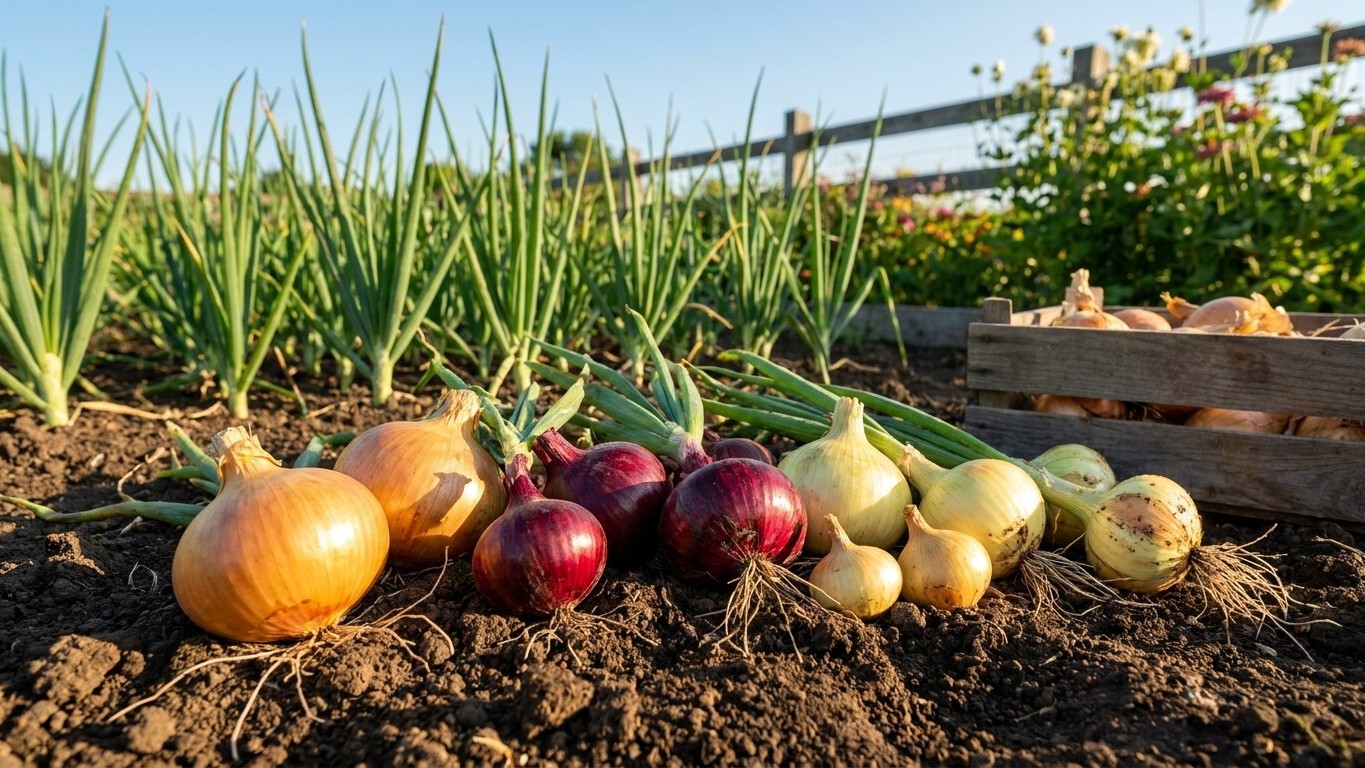

Minnesota gardeners need long-day onions, full stop. At 44.88 degrees north, the reference point for this page, the sun delivers 15 hours and 25 minutes of daylight on the summer solstice, well inside the 14-to-16-hour window that triggers bulbing in long-day types. Some intermediate-day varieties whose range creeps up to 45 or 46 degrees also work, mostly in the state’s southern third. Anything rated for shorter days is a mismatch here, not a maybe.
The short answer for Minnesota

The reference figures for this page come from the weather station at Minneapolis-St. Paul: 44.88 degrees north, and 15 hours 25 minutes of daylight on the longest day of the year. That single number, the day length, is what an onion plant actually reads. It doesn’t care about soil temperature or the calendar date. Once daylight hits the threshold a variety is bred for, the plant stops pushing out leaves and starts building a bulb, whatever size it happens to be at that moment.
Long-day onions are bred to wait for 14 to 16 hours of daylight before they bulb. Minnesota’s 15 hours 25 minutes sits comfortably in that range, which makes long-day the primary group for the whole state. Among the varieties documented on this site whose published range covers 44.88N, the long-day options include Ailsa Craig, Barolo, Blush, Bridger, Frontier, New York Early, Patterson, Powell, Red Carpet, Redwing, Rossa di Milano, Safrane, Talon, and Walla Walla Sweet.
A second group, intermediate-day onions, needs somewhat less daylight to bulb, usually in the 12-to-14-hour range, but several of these varieties still have published ranges that stretch up to 45 or 46 degrees north, which puts the Minneapolis-St. Paul latitude right at their upper edge. That group includes Cabernet, Calibra, Elsye, Expression, Monastrell, Red Long of Florence, Red Long of Tropea, Scout, and Sierra Blanca. They’re a reasonable second option, especially in the warmer southern counties, but long-day is the safer default across the state.
What will not work here
Short-day onions are built for a different planet’s worth of daylight. They start bulbing at around 12 hours, which in the Upper Midwest arrives in late spring while the plant is still a few skinny leaves tall. Plant one in Minnesota and the bulb doesn’t fail to form, it forms too soon, locking in at whatever size the plant had already reached. The result is a marble-sized onion instead of a fist-sized one. That’s not a fertilizer problem or a watering problem. It’s a variety mismatch, and no amount of feeding fixes it.
One intermediate-day variety on the documented list also falls short of Minnesota’s latitude. Here’s the full list of varieties whose published range sits below 44.88 degrees north, with the reason each one is off the table:
- Candy (intermediate-day, rated 33-40N): tops out ten degrees south of the Twin Cities; it will bulb early and small.
- Gabriella (short-day, rated 20-35N): needs roughly 12 hours of daylight, which arrives here while the plant is still tiny.
- Madalyn (short-day, rated 20-35N): same short-day trigger, same undersized result.
- Red Rock (short-day, rated 30-36N): bred for Gulf Coast and Deep South daylight patterns, not Minnesota’s.
- White Castle (short-day, rated 30-38N): its bulbing signal fires long before a Minnesota plant has grown enough to make a decent-sized onion.
Plant any of these in a Minnesota garden and the season plays out the same way. The plant grows a modest set of leaves, senses the daylight it’s waiting for sooner than a long-day variety would, and shifts into bulb mode with whatever top growth it has. There’s no rescue once that switch flips. The bulb that forms is the bulb you get, and it won’t grow larger no matter how much longer you leave it in the ground.
What changes across Minnesota
Minnesota is not one latitude, it’s a stretch of roughly five and a half degrees, from around 43.5 degrees north near the Iowa border to close to 49 degrees north at the Canadian line. That’s over 350 miles of north-south distance, and it shifts both day length and planting timing more than gardeners expect from a single state.
A gardener near International Falls, close to the state’s northern edge, gets noticeably more daylight on the summer solstice than the 15 hours 25 minutes measured at Minneapolis-St. Paul. That extra daylight makes long-day varieties bulb with room to spare, and it’s exactly why a variety like Redwing, rated up to 65 degrees north, exists at all. A gardener near the Iowa border, on the other hand, sits closer to the lower edge of the intermediate-day range for varieties like Cabernet or Sierra Blanca, which makes those a more comfortable fit there than they’d be farther north.
| Location | Approx. latitude | What it changes |
|---|---|---|
| Northern MN (International Falls area) | ~48.6N | More summer daylight than the reference city; long-day varieties bulb well before frost, less pressure on timing |
| Minneapolis-St. Paul (reference city) | 44.88N | 15 h 25 min on the longest day; the baseline figure this page is built on |
| Southern MN (near Iowa border) | ~43.5N | Day length closest to the reference figure; intermediate-day varieties with upper limits near 45-46N fit comfortably |
A reader gardening near either edge of the state shouldn’t treat the Minneapolis-St. Paul figures as their own. The difference of even one degree of latitude shifts both the exact day-length trigger and the local frost dates enough to matter for variety choice and planting timing.
Sweet now, or onions that last
The trade-off here is chemistry, not chance. According to University of Missouri Extension, sweet onions do not store as well as more pungent types, because the volatile sulfur compounds responsible for an onion’s bite are the same compounds that protect it in storage. A mild onion is mild because it has fewer of them, and a mild onion is also the one that softens in the pantry by midwinter.
Minnesota’s long-day growing conditions lean toward the pungent, long-keeping side of that spectrum, which lines up well with a climate where root cellars and cold storage have always mattered. Varieties like Redwing or Safrane, both long-day, tend toward the sharper end that holds up in storage. Walla Walla Sweet is the exception worth flagging: it’s rated long-day and will bulb fine in Minnesota, but it’s bred for sweetness over storage life, so it belongs in the eat-soon pile no matter where it’s grown.
What that means for the pantry come March depends on what got planted in May. A bed of storage-oriented long-day onions, cured properly and kept cool and dry, can realistically still be feeding a household well into late winter. A bed of Walla Walla Sweet, however well it grew, is usually gone by the holidays, softened past the point of use if it’s still hanging around. There’s no wrong choice here, just a decision about whether the reward is a better sandwich onion in August or a full pantry in March.
Checking this against your own garden
Everything above is built from a single reference point, the Minneapolis-St. Paul weather station at 44.88 degrees north. That’s a solid baseline for most of the state’s population centers, but Minnesota’s north-south spread means a garden near Duluth or Rochester deserves its own check before betting a season on a specific variety. A few things worth confirming before ordering seed:
- Your own latitude, if your garden sits well north or south of the Twin Cities metro, since even a couple of degrees shifts the day-length trigger.
- Your local frost dates, both last spring frost and first fall frost, which set the real planting and harvest window regardless of what the state average suggests.
- Your county extension office, which tracks local soil and climate data than any statewide figure can.
- The day-length rating printed on the variety you’re considering, checked against the numbers on this page before it goes in the ground.
- Your garden’s microclimate, including slope, wind exposure, and any nearby water that can shift your effective frost dates by a week or more.
A statewide figure is a starting point, not a guarantee. The gardener two counties away from Minneapolis-St. Paul is the one who actually knows whether their onions will have enough daylight to finish the job.