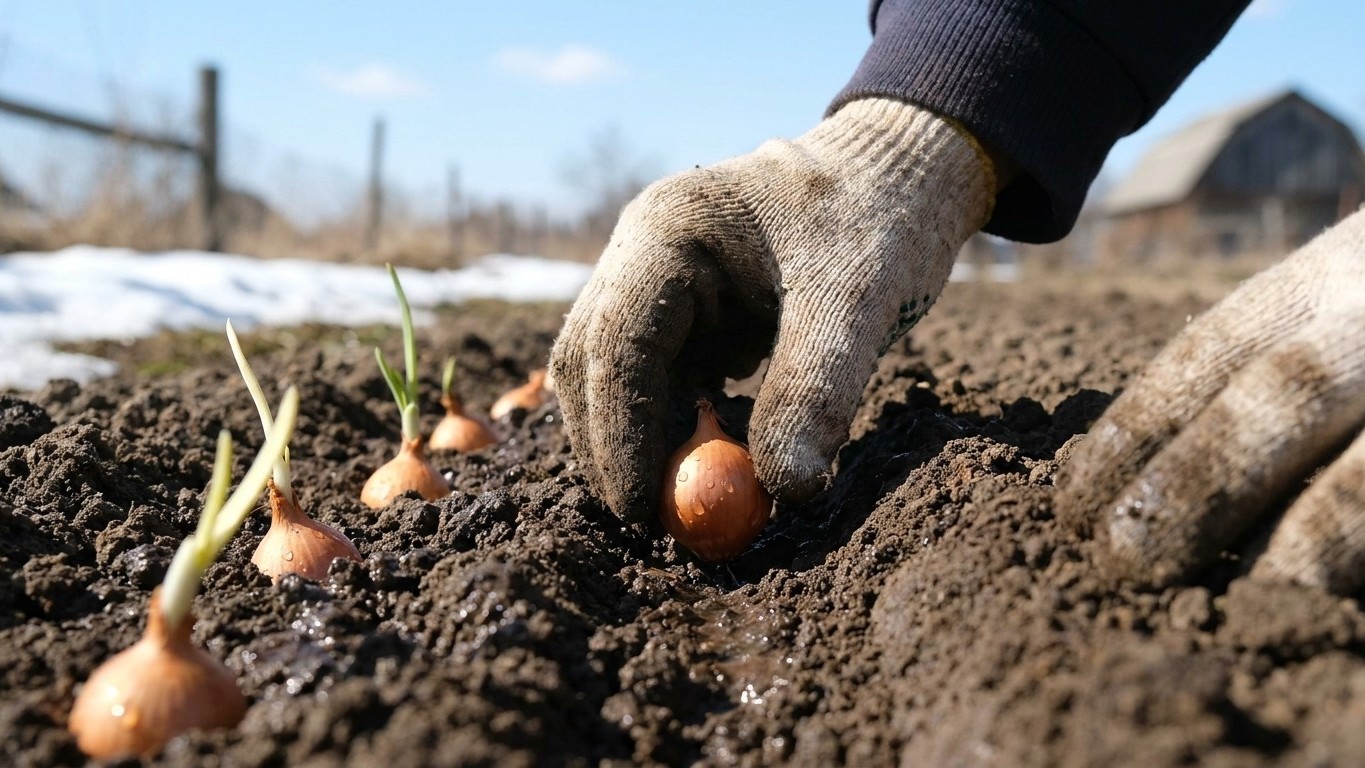

In Minnesota, onions go in the ground in early spring, not fall, and the variety has to be a long-day type. At 44.88 degrees north, the reference latitude for the Twin Cities, the longest day of the year delivers 15 hours and 25 minutes of daylight, well past the 14-to-16-hour trigger that long-day onions wait for before they start forming a bulb.
The short answer for Minnesota

Minnesota sits firmly in long-day onion territory. With 15 hours 25 minutes of daylight on the June solstice at the Twin Cities, the state clears the 14-to-16-hour bulbing threshold that long-day varieties need, and it clears it with room to spare. That single number decides almost everything else about how onions get grown here.
It also decides the season. Minnesota winters are too harsh for the fall-planting approach used in mild-winter states, where a young onion overwinters in the ground and resumes growth in spring. Here, onions go in as sets or transplants in late winter to early spring, timed to the last frost, so the plant has as many weeks as possible to build leaf mass before the long June days flip the switch to bulbing. The bulb that forms is only as big as the plant that existed the moment day length hit the threshold, so every week of growth banked before the solstice matters.
Of the 28 onion varieties documented across this site, 23 have a published latitude range that covers 44.88N, and the majority of them are long-day types built for exactly this kind of daylight. That list includes Redwing (43-65N), Powell (43-47N), Talon and Safrane (both 42-50N), Frontier (40-50N), Patterson, Barolo, and Blush (each 38-55N), along with Ailsa Craig and New York Early (38-60N and 38-50N). A handful of intermediate-day varieties also fit, including Monastrell (35-46N) and Scout (32-46N), which work at this latitude without needing quite as long a day.
Why does this differ from a state like Georgia or Texas? Those states plant short-day onions in the fall precisely because their winters are mild enough for the plant to survive, and their summer days never get long enough to suit a long-day type. Minnesota has neither mild winters nor short summer days, so both halves of the southern approach fail here for different reasons. The state’s onion calendar isn’t a stripped-down version of the southern one. It runs on different daylight physics entirely.
What will not work here
Five documented varieties have a published latitude range that tops out below 44.88N, which means Minnesota sits north of where they’re rated to grow. These are short-day and one intermediate-day variety, built to start bulbing at around 12 to 13 hours of daylight. Plant them here and the plant reaches that trigger point in early summer, long before it has built any real size, and the result is a small, undersized bulb rather than a delayed or missing one. This is a variety mistake, not a feeding or watering mistake, and no amount of fertilizer fixes it.
- Candy (intermediate-day, rated 33-40N), bulbs too early here, giving small onions before the plant has finished growing.
- Gabriella (short-day, rated 20-35N), triggers to bulb at roughly 12 hours, far too soon for a Minnesota-grown plant to reach size.
- Madalyn (short-day, rated 20-35N), same short-day trigger, same result: undersized bulbs from an undergrown plant.
- Red Rock (short-day, rated 30-36N), bulbs while leaves are still developing, producing a fraction of its normal size.
- White Castle (short-day, rated 30-38N), designed for a day length Minnesota reaches weeks before this plant is ready.
The mechanism is the same across all five. Day length, not temperature, tells an onion when to stop making leaves and start making a bulb. A short-day variety hits its trigger regardless of how far north it’s planted, so it doesn’t fail to bulb in Minnesota. It bulbs on schedule, at a size that reflects only a few weeks of growth instead of the two or three months a long-day variety gets before its own, later trigger arrives. Planting one of these five doesn’t cost you the harvest. It shrinks it, permanently, the moment the day length hits that mark.
What changes across Minnesota
Minnesota is a long state, running from around 43.5 degrees north near the Iowa border to roughly 49.4 degrees north at the Northwest Angle on the Canadian line, a span of nearly six degrees of latitude. The 15 hours 25 minutes figure used above belongs specifically to the Twin Cities, at 44.88N, and a gardener working land near either edge of the state is not gardening under quite the same sky.
Using the same geometric method that produces the Twin Cities figure, the southern edge of the state comes in only slightly under that number, while the northern edge picks up noticeably more summer daylight. These are estimates built on the same solar-angle calculation, not separate measured records, but they follow the same logic: latitude further from the equator means longer summer days.
| Location | Approx. latitude | Longest-day daylight (estimate) | What it changes |
|---|---|---|---|
| Southern border area | ~43.5N | ~15h 15m | Slightly less daylight than the Twin Cities; long-day varieties still bulb reliably, timing barely shifts |
| Twin Cities (reference) | 44.88N | 15h 25m | The figure this page is built on |
| Northern border area | ~49.4N | ~16h 0m | Noticeably more summer daylight; onions trigger bulbing at a slightly earlier calendar date, so early planting matters even more |
The practical upshot: a reader near the Iowa border isn’t gardening under meaningfully different daylight than the Twin Cities and can follow this page’s guidance directly. A reader near International Falls or the Iron Range, though, is working with a longer summer day, which means the bulbing trigger arrives a bit sooner relative to a fixed planting date. Getting sets or transplants into the ground as early as frost dates allow matters more the farther north you go, since there are fewer weeks available before daylight does its work.
Sweet now, or onions that last
Minnesota’s long-day status pushes gardeners toward onions on the pungent, long-keeping end of the spectrum, and that’s not a matter of taste so much as chemistry. According to University of Missouri Extension, sweet onion varieties do not store as well as the more pungent types, because the volatile sulfur compounds responsible for an onion’s bite are the same compounds that protect the bulb during storage. A sweet onion has fewer of them, which is why it eats well in July and turns soft by October.
Most long-day varieties suited to Minnesota, including Redwing, Talon, and Safrane, lean toward the sharper, better-keeping end of that spectrum. That’s a fair trade for a northern gardener: fewer trips to the store in January, February, and into March, drawing down a braid of onions that were sharp enough in August to make you blink and are still solid six months later.
There’s a notable exception worth knowing about. Walla Walla Sweet, despite being a long-day variety rated for 35-55N and perfectly capable of bulbing in Minnesota’s daylight, is grown specifically for its mild, sweet flesh, and it will not keep the way Redwing or Talon does. Choosing it is a deliberate trade of storage life for a shorter window of very good eating, not a mistake, but a gardener planning a root cellar’s worth of onions for winter should plant it alongside, not instead of, a pungent keeper.
Checking this against your own garden
Every figure above is anchored to the Twin Cities at 44.88N, and Minnesota’s real spread of nearly six degrees of latitude means that anchor doesn’t stretch evenly across the whole state. Before committing a season’s onion bed to any of this, a few checks are worth five minutes each.
- Look up your own approximate latitude if you garden well north or south of the Twin Cities metro, especially near International Falls, the Iron Range, or the Iowa border towns.
- Confirm your average last spring frost date, since long-day onions need as many weeks of growth as possible before the June solstice triggers bulbing.
- Confirm your average first fall frost date, which affects how late a fall-planted crop like garlic or overwintering greens can go in, even though onions themselves are spring-planted here.
- Contact your county’s University of Minnesota Extension office for soil test recommendations and localized planting windows, since soil and microclimate vary even within a single county.
- Cross-check any variety you’re considering against its published latitude range before ordering, rather than assuming a name that sounds familiar will perform the same way it does two states away.
A statewide figure is a starting point, not a guarantee for every backyard. The extension office nearest you has already worked out the local frost dates and soil quirks that this page can’t account for.