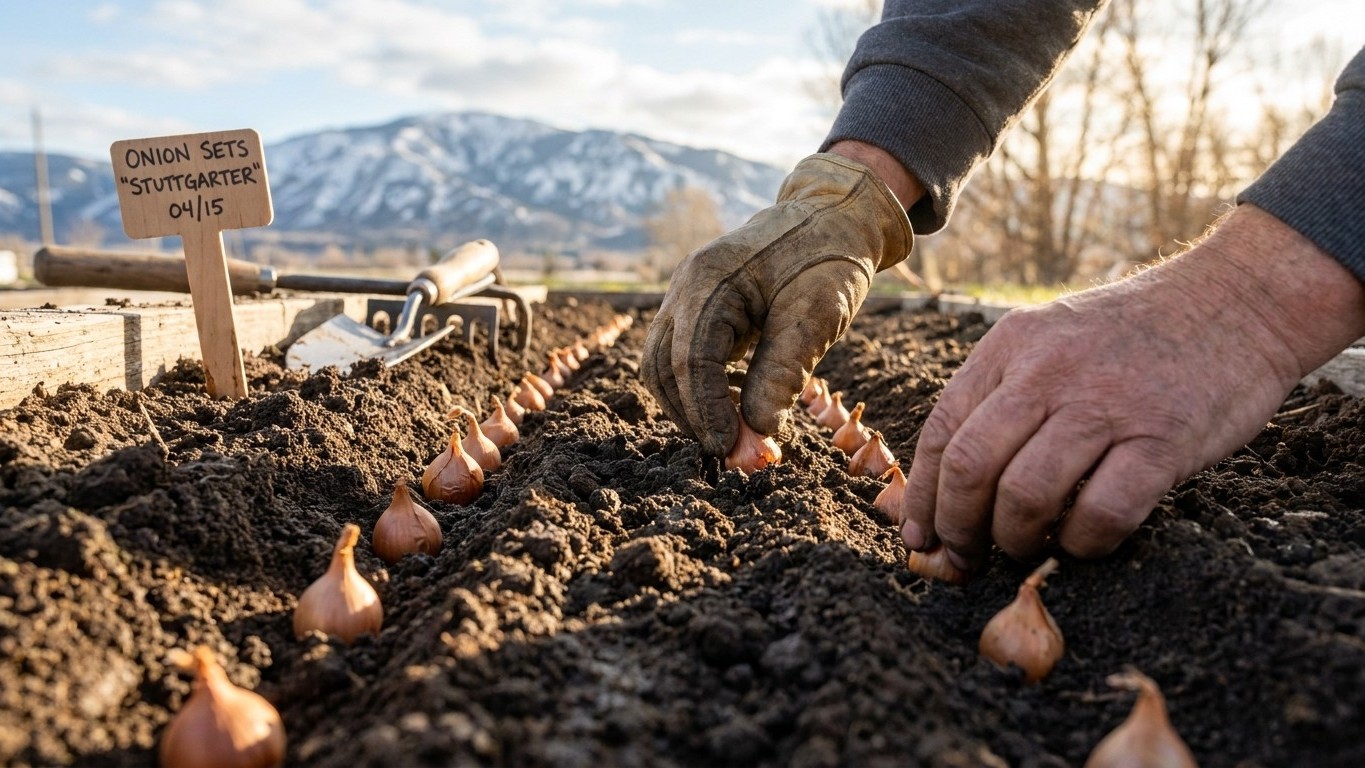

Montana sits at 45.81 degrees north latitude at the reference station in Billings, where the longest day of the year delivers 15 hours and 32 minutes of daylight. That number puts the state squarely in long-day onion territory, and it rules out fall planting entirely. The answer for most of Montana: set onion transplants or sets in the ground in early spring, as soon as the soil can be worked, not in autumn like a gardener in Georgia or Texas would.
The short answer for Montana

Onions respond to day length, not to the calendar and not to temperature. A long-day onion needs 14 to 16 hours of daylight before it will stop building leaves and start building a bulb. Billings hits 15 hours 32 minutes on the summer solstice, which is comfortably inside that window. That’s why Montana gardens belong to the long-day group, alongside states like Minnesota, North Dakota, and Maine.
The planting season follows from that. In mild-winter states, gardeners plant onions in the fall and let them overwinter as small plants, ready to size up fast once spring day length climbs. Montana winters make that impossible for most of the state: hard freezes and extended snow cover will kill young onion transplants outright rather than just slowing them down. So the calendar flips. Montana gardeners plant in early spring instead, typically as soon as the ground thaws and can be worked, giving the plant every possible week of long daylight before the solstice triggers bulbing.
That timing matters more here than it does farther south, because the growing season itself is shorter. A gardener in a mild climate can afford to plant a little late and still get a full-size bulb, because there’s slack in the season. Montana doesn’t offer that slack. Every week between the earliest possible planting date and the solstice is a week the plant needs to build the leaf mass that becomes bulb size later.
Within the long-day group, the varieties documented for this site whose published range covers 45.81N include Ailsa Craig, Barolo, Blush, Bridger, Frontier, New York Early, Patterson, Powell, Redwing, Rossa di Milano, Safrane, and Talon, along with intermediate-day types such as Monastrell, Red Long of Florence, Red Long of Tropea, and Scout, and the long-day Walla Walla Sweet. That’s a wide enough field that variety choice in Montana comes down to flavor and storage life, not whether the onion will bulb at all.
What will not work here
Planting a short-day variety in Montana is not a matter of it “struggling.” It fails in a specific, predictable way: the plant reads the 12-hour daylight trigger long before it has built enough leaf mass, starts bulbing while it’s still small, and produces a marble-sized onion instead of a full one. Planting a long-day variety too far south does the opposite: the day never reaches its 14 to 16 hour threshold, so the plant just keeps making leaves all season and eventually rots in the ground instead of bulbing at all. Montana’s problem runs in the short-day direction.
Based on catalogue ranges, the following varieties are published for latitudes below 45.81N and will not bulb properly in Montana:
- Candy (intermediate-day, 33-40N): too far south for Montana’s daylight window.
- Gabriella (short-day, 20-35N): bulbs on a 12-hour trigger, far too early here.
- Madalyn (short-day, 20-35N): same short-day mismatch as Gabriella.
- Red Rock (short-day, 30-36N): triggers bulbing before the plant has size.
- Red Sensation (short-day, 25-35N): rated for southern latitudes only.
- Texas Grano 1015Y (short-day, 25-35N): a Gulf Coast and Deep South variety.
- Vidora (short-day, 25-35N): same short-day ceiling as the varieties above.
- White Castle (short-day, 30-38N): falls short of Montana’s latitude by a wide margin.
The timing mistake compounds the variety mistake. Planting a correct long-day variety too late in spring doesn’t push the harvest date back the way a late-planted tomato might just ripen a bit later. The bulbing trigger is fixed by the calendar and the latitude, not by when you put the plant in the ground. Whatever size the onion has reached when the solstice’s day length hits the threshold is the size the bulb will be, full stop. A transplant set out three weeks late doesn’t harvest three weeks late with a normal bulb; it harvests on schedule with a small one.
What changes across Montana
Montana is not one latitude. The state runs from roughly 44.4 degrees north at the Wyoming line to about 49 degrees north at the Canadian border, a spread of more than four and a half degrees. Every figure above comes from Billings, at 45.81N, which sits closer to the state’s southern half.
| Location | Latitude | Daylight on longest day | What changes |
|---|---|---|---|
| Billings (reference station) | 45.81N | 15h 32m | Baseline for long-day bulbing and the spring planting window used above |
| Southern border area | ~44.4N | Slightly less than 15h 32m | Marginally shorter daylight window, minimal practical difference for long-day varieties |
| Northern border area | ~49N | More than 15h 32m | Longer summer daylight, a shorter frost-free season, and a spring planting date that may need to move earlier where the ground allows it |
A reader gardening near Kalispell or Havre, close to the northern edge, is still well inside long-day territory, so the variety list doesn’t change. What shifts is timing pressure: more daylight at the solstice combined with a later spring thaw in many northern valleys means less margin between “soil workable” and “bulbing triggered.” A reader near the southern border, closer to Billings’ own latitude, can treat the figures in this article as close to exact for their own garden. Anyone gardening at real elevation, in a mountain valley rather than the plains, should also expect a later last frost date than the state-level averages suggest, regardless of latitude.
Sweet now, or onions that last
Montana’s long-day climate pushes gardeners toward onions that are sharper in the kitchen and better in the root cellar, and that’s chemistry rather than coincidence. The compounds that give an onion its bite are volatile sulfur compounds, and those same compounds are what protect the bulb from rot during long storage. A sweet onion has fewer of them: better eaten fresh, off the vine, but it breaks down within weeks. University of Missouri Extension puts it plainly: sweet onion types do not store as well as the more pungent types, because pungency and shelf life come from the same chemistry.
Southern gardens growing short-day varieties tend to land on the sweet, short-keeping end of that spectrum almost automatically, since many of the classic sweet onions are also short-day types. Montana gardens, growing long-day varieties by necessity, land closer to the sharp, long-keeping end. Walla Walla Sweet is the notable exception in the list above, a long-day variety bred for sweetness that trades storage life for flavor, and Montana gardeners who plant it should expect to eat it early rather than store it into winter.
For most of the other long-day varieties suited to this latitude, that trade-off works in the gardener’s favor. A pantry stocked with pungent, long-day onions in October is still usable in March, often with little visible loss. A pantry stocked with sweet onions from the same October harvest is typically down to soft, sprouting bulbs well before the new year. The choice isn’t really about taste preference at that point; it’s about whether the reader wants onions to cook with in late winter or onions to eat within the first two months after harvest.
Checking this against your own garden
The figures in this article come from one station, in one city, at one specific latitude. They’re a solid starting point for most of Montana, but not a guarantee for every yard in the state. A few things are worth confirming locally before committing to a planting date or a variety list.
- Look up your own latitude if you garden well north of Billings or close to either state border, since a few degrees changes both daylight hours and frost timing.
- Check your local average last frost date rather than relying on a statewide figure, especially in mountain valleys where cold air pools and frost lingers later than the plains.
- Contact your county office of the Montana State University Extension Service, which tracks local frost data and planting windows specific to your part of the state.
- Watch soil temperature in early spring rather than the calendar date alone; onion sets and transplants do better once the ground has actually warmed enough to work, not just thawed on the surface.
- Confirm the day-length rating printed on any onion sets or transplants you buy locally, since retail stock sometimes includes varieties bred for other regions.