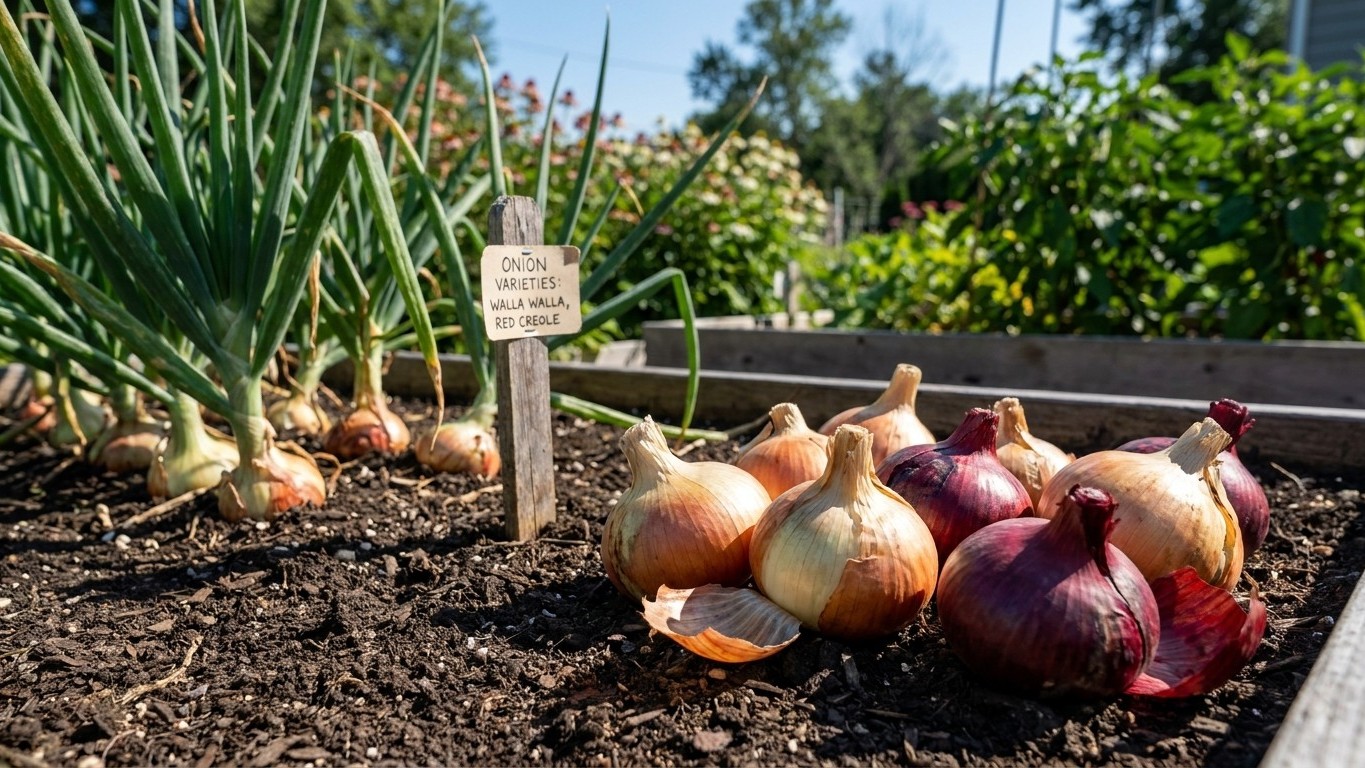

At 40.68 degrees north, the reference point for this state’s climate data, the longest day of the year delivers 14 hours and 55 minutes of daylight. That’s the number an onion actually cares about. It sits squarely in the range that triggers bulbing in intermediate-day and long-day onions, which means those two groups are what a New Jersey garden should plant. Short-day types don’t belong here at all.
The short answer for New Jersey

Onions don’t bulb because of heat, calendar dates, or how big the leaves look. They bulb when day length crosses a threshold written into the variety. Short-day onions switch over at around 12 hours of daylight, a benchmark reached almost everywhere on earth near the equinoxes, which is why they’re built for the Gulf Coast and the Southwest. Intermediate-day onions wait for roughly 12 to 14 hours. Long-day onions hold out for 14 to 16 hours before they’ll even start forming a bulb. At Newark’s 14 hours 55 minutes on the summer solstice, New Jersey gardens comfortably clear the intermediate-day threshold and land near the middle of the long-day range too.
That puts a wide field of varieties in play. Of the 31 onion varieties documented across this site, 19 have a published latitude range that covers 40.68 degrees north, meaning they’re built to bulb here without stress:
- Long-day: Ailsa Craig, Barolo, Blush, Bridger, Frontier, New York Early, Patterson, Red Carpet, Red Long of Florence, Rossa di Milano, Walla Walla Sweet
- Intermediate-day: Cabernet, Calibra, Elsye, Expression, Monastrell, Red Long of Tropea, Scout, Sierra Blanca
That’s a real choice, not a narrow lane. A gardener here can pick for storage life, for color, for sweetness, or simply for what’s available locally, because the day-length math already works in their favor. The variety decision in New Jersey is about flavor and keeping quality, not about whether the plant will bulb at all, which is the question growers in the Deep South or the far northern tier have to answer first.
What will not work here
Plant a short-day onion in New Jersey and the plant doesn’t fail quietly. It bulbs, just early, while the leaves are still small, because 12 hours of daylight arrives well before the plant has built enough leaf mass to feed a decent bulb. The result is a small, mediocre onion that never gets the chance it would have farther south. Seven varieties documented on this site are built for latitudes below 40.68 degrees and have no business in a New Jersey bed:
- Gabriella (short-day, 20-35N), bulbs far too early at this latitude, giving undersized onions
- Madalyn (short-day, 20-35N), same short-day mistake, small bulbs guaranteed
- Red Rock (short-day, 30-36N), outside its published range even in South Jersey
- Red Sensation (short-day, 25-35N), triggers bulbing well before New Jersey’s growing season builds enough leaf
- Texas Grano 1015Y (short-day, 25-35N), a Gulf Coast variety, wrong day-length group entirely
- Vidora (short-day, 25-35N), same problem, small onions instead of full-size bulbs
- White Castle (short-day, 30-38N), misses the range even at New Jersey’s southern edge
The other failure runs in the opposite direction, and it’s worse. Powell (long-day, 43-47N) and Redwing (long-day, 43-65N) need day lengths New Jersey’s summer never reaches. Plant them here and the day length that’s supposed to switch the plant from making leaves to making a bulb never arrives. The plant just keeps growing top growth all season, then the cold arrives, the leaves collapse, and the below-ground result rots in the bed. No small onion. No onion at all. That’s the distinction worth remembering: a short-day mistake gives you something disappointing to harvest; a long-day mismatch in the wrong direction gives you nothing.
What changes across New Jersey
New Jersey isn’t a single point on a map, and the 40.68-degree figure belongs specifically to Newark, where the climate station behind these numbers sits. The state actually stretches from around Cape May in the south, near 39 degrees north, up to the High Point area near the New York border, above 41 degrees north. That’s roughly two and a half degrees of latitude, enough to nudge the daylight math at the far ends of the state, even if it doesn’t flip the fundamental answer.
| Location | Approximate latitude | What it changes |
|---|---|---|
| Northern NJ (High Point area) | ~41.3°N | Slightly more summer daylight than Newark; long-day varieties near the upper end of their bloom, and borderline types like Safrane and Talon (long-day, 42-50N) lean more comfortably toward bulbing well |
| Newark (reference city) | 40.68°N | 14 h 55 min on the longest day; both intermediate-day and long-day groups suit this point directly |
| Southern NJ (Cape May area) | ~38.9°N | Slightly less summer daylight than Newark; intermediate-day varieties remain the safer bet, while northern-edge long-day types such as Frontier and Red Carpet (40-45N) sit closer to their limit |
Three varieties sit close enough to a published boundary that they belong in a gray zone rather than a firm yes or no: Candy (intermediate-day, 33-40N), Safrane (long-day, 42-50N), and Talon (long-day, 42-50N). None of these ranges are hard cutoffs. A gardener in far northern New Jersey, closer to 41 degrees, is a better match for Safrane or Talon than someone gardening near Cape May. A gardener in the southernmost counties sits closer to Candy’s comfort zone than someone up near the New York line. The state-wide answer holds for the middle of New Jersey. At either edge, it’s worth leaning toward the group that matches your specific latitude rather than the one that matches Newark’s.
Sweet now, or onions that last
New Jersey’s day length puts both intermediate-day and long-day onions on the table, and that choice comes with a trade-off that has nothing to do with luck and everything to do with chemistry. The bite in a pungent onion comes from volatile sulfur compounds. Those same compounds are what protect the bulb from rot and sprouting once it’s in storage. A sweet onion has fewer of them, which is exactly why it tastes better raw and exactly why it won’t make it to spring. University of Missouri Extension puts it plainly: sweet onions do not store as well as the more pungent types.
That mechanism lines up with the day-length groups themselves. Onions built for shorter days, including many of the intermediate-day varieties suited to New Jersey’s southern half, tend to run sweeter and milder, closer to something you’d slice for a sandwich the week you pull it. Long-day onions, better suited to the state’s northern reaches and its full range of latitude, tend to run sharper and keep longer in a cool, dry pantry.
A New Jersey gardener growing a full row of an intermediate-day sweet type should expect to eat most of that harvest by late fall or early winter, not stretch it through the cold months. Anyone planning to still be pulling onions out of storage in March needs the long-day, sharper-tasting varieties in the mix, because that’s what the sulfur compounds are actually for. Growing both, split by purpose rather than by habit, solves the problem better than picking one variety and hoping it does everything.
Checking this against your own garden
Everything above is built on Newark’s 40.68 degrees north and its 14 hour 55 minute longest day. That’s accurate for the middle of the state and a reasonable guide for most of New Jersey, but a garden near Cape May or up toward the High Point ridge sits far enough from that reference point that the fine details shift. Before ordering seed or sets, a few things are worth confirming locally rather than assuming they match the state-wide figures:
- Look up your own latitude if you’re gardening south of roughly 39.5 degrees or north of 41 degrees, since that’s where the borderline varieties like Candy, Safrane, and Talon start to matter
- Check your local spring and fall frost dates, since onion transplant timing depends on those, not on day length alone
- Contact your county’s Rutgers Cooperative Extension office, which keeps localized planting guides and can confirm which day-length group performs best in your specific county
- Note your garden’s microclimate, since a south-facing slope or a low frost pocket can shift your effective planting window by a week or two even within the same county
None of that changes the core answer for the state as a whole. It just means a gardener at either edge of New Jersey should treat the Newark figures as a strong starting point, then confirm the details that apply to their own square of ground before the seed order goes in.