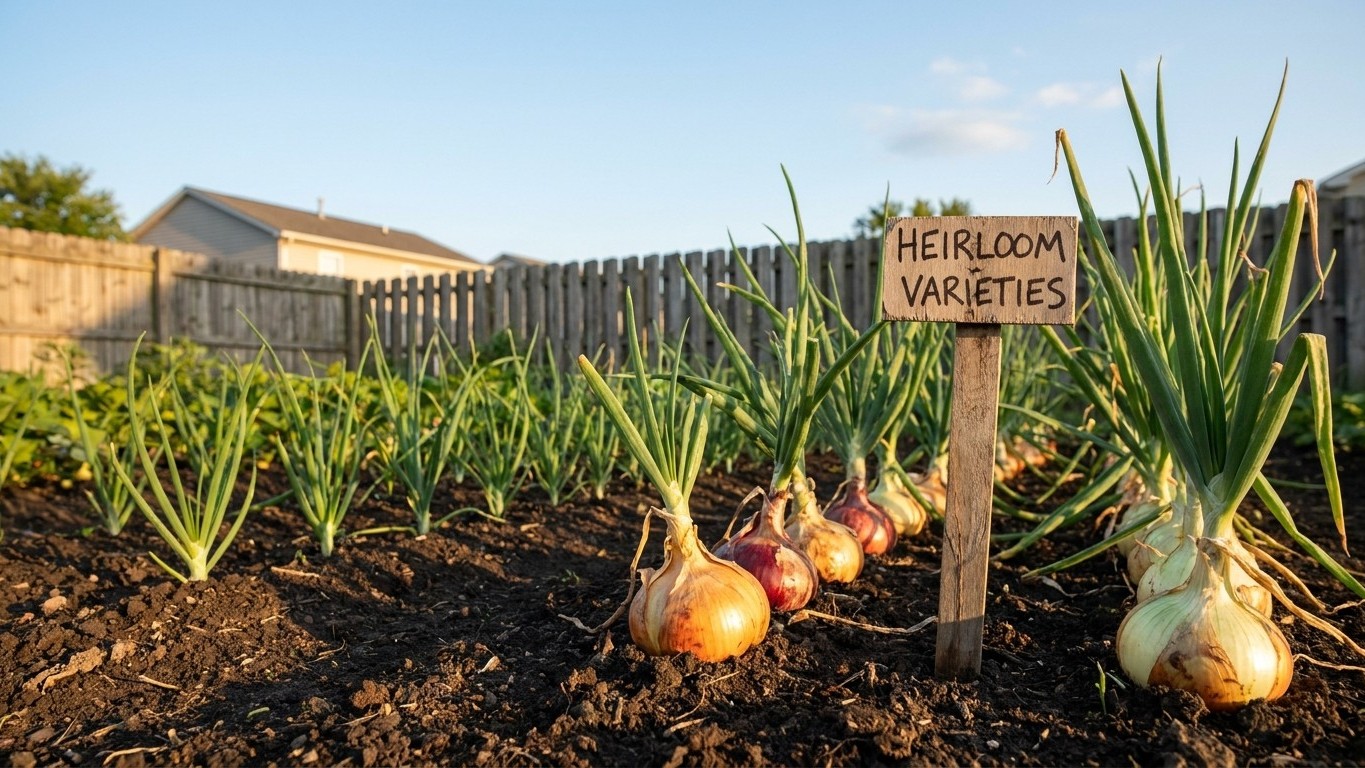

Columbus sits at 39.99 degrees north, and on the longest day of the year the sun stays up for 14 hours and 51 minutes. That single number decides which onions will bulb properly in Ohio gardens and which ones will just sit there making leaves. The short version: intermediate-day and long-day varieties are the right choices for this state, and a handful of well-known names in both categories fall within Ohio’s latitude range.
The short answer for Ohio

Onions don’t bulb because of heat. They bulb because of day length, and each variety has a threshold it’s waiting for. Short-day types start bulbing once daylight hits roughly 12 hours. Intermediate-day types wait for something closer to 12 to 14 hours. Long-day types hold off until daylight reaches 14 to 16 hours. At 14 hours 51 minutes on the longest day, Columbus clears the intermediate-day threshold easily and sits comfortably inside long-day territory too. That’s why both groups work here, while the short-day group, built for the Deep South and the Gulf Coast, never gets the trigger it needs.
Among the varieties with published latitude ranges that include 39.99N, the long-day group gives you Ailsa Craig, Barolo, Blush, Bridger, New York Early, Patterson, Rossa di Milano, and Walla Walla Sweet. The intermediate-day group adds Cabernet, Calibra, Candy, Elsye, Expression, Monastrell, Red Long of Florence, Red Long of Tropea, Scout, and Sierra Blanca. That’s eighteen varieties whose catalogue ranges cover the state’s reference latitude, which is a wide enough field to pick for color, storage life, or eating style without gambling on day length at all.
What’s worth understanding is why the range matters more than the name on the packet. A long-day onion isn’t “better” than an intermediate-day one. It’s simply built for a longer summer day, and Ohio happens to sit at a latitude where both kinds of day length show up depending on how far north or south in the state you’re standing. That distinction becomes the whole story in the next section, because getting it wrong doesn’t cost you a little yield. It costs you the crop.
What will not work here
Planting the wrong day-length group in Ohio doesn’t produce a smaller onion. It produces two very different failures, and neither one is a maybe. A short-day onion planted this far north will start bulbing as soon as daylight crosses its 12-hour trigger, which happens in early spring while the plant is still tiny. The bulb that forms is whatever size the leaves managed to reach by that point, usually not much bigger than a golf ball. Feeding it more or watering it longer won’t fix that. The bulbing switch already flipped.
The opposite failure is worse because it looks fine for months. A long-day variety bred for latitudes north of Ohio’s range never sees a day long enough to trigger bulbing here. The plant keeps making leaves all summer, looking healthy and green, and then falls apart with the first cool, wet stretch of fall. No bulb ever forms. It just rots in the ground.
Varieties that will not bulb here
- Gabriella (short-day, published for 20-35N): far south of Ohio’s daylight window, bulbs early and small
- Madalyn (short-day, 20-35N): same problem, wrong trigger for this latitude
- Red Rock (short-day, 30-36N): bulbs before the plant has grown enough leaf to size up
- Red Sensation (short-day, 25-35N): built for a much shorter summer day than Ohio provides
- Texas Grano 1015Y (short-day, 25-35N): a Gulf Coast onion, undersized this far north
- Vidora (short-day, 25-35N): same day-length mismatch as the others in this group
- White Castle (short-day, 30-38N): still short of Ohio’s daylight requirement
- Powell (long-day, 43-47N): Ohio’s longest day never reaches this variety’s threshold, so no bulb forms
- Redwing (long-day, 43-65N): built for far northern summers, leaves only in Ohio
- Safrane (long-day, 42-50N): needs more daylight than the state ever provides
- Talon (long-day, 42-50N): same failure, healthy foliage and no bulb
None of these are marginal cases. They’re published outside Ohio’s daylight range in either direction, and the reader who plants them anyway is choosing between undersized bulbs and no bulbs at all.
What changes across Ohio
Ohio isn’t a single point on the map, and the 39.99N figure belongs specifically to Columbus, the reference city these calculations are built from. The state actually stretches from around 38.4 degrees north near the Ohio River to nearly 41.9 degrees north along the Lake Erie shoreline, which is a real spread, not a rounding error. A gardener in Cincinnati or Portsmouth is working with a slightly shorter summer day than Columbus. A gardener near Toledo or Cleveland gets a slightly longer one.
| Region | Approx. latitude | Summer day length | What changes |
|---|---|---|---|
| Southern Ohio (Cincinnati, Portsmouth) | ~38.4-39N | Slightly under 14h51 | Intermediate-day varieties are the safer default; long-day types near the northern-limit list lose margin |
| Columbus (reference city) | 39.99N | 14h51 | Baseline for this page’s figures |
| Northern Ohio (Toledo, Cleveland, Lake Erie shore) | ~41.5-41.9N | Slightly over 14h51 | Borderline long-day varieties gain viability; deep long-day types still fail |
That extra sliver of daylight in the north matters for the two varieties sitting right at the edge of their published range. Frontier (long-day, 40-50N) and Red Carpet (long-day, 40-45N) are both listed just above Columbus’s latitude. Catalogue ranges aren’t hard cutoffs; they’re a continuum, and a gardener near the Lake Erie shore is close enough to that lower bound that either variety may bulb reliably, while a gardener near the Ohio River is far enough from it that betting on them is riskier. Nothing in the excluded list changes with this spread. Powell, Redwing, Safrane, and Talon still sit well north of even Ohio’s longest days, and the short-day varieties are still bulbing on a Gulf Coast clock no part of the state matches.
Sweet now, or onions that last
Once you’re past the day-length question, the next decision is about your pantry. According to University of Missouri Extension, sweet onions do not store as well as more pungent types, and that’s not a marketing distinction, it’s chemistry. The bite in a sharp onion comes from volatile sulfur compounds, and those same compounds are what slow down decay once the bulb is in storage. A sweet variety has fewer of them, which is exactly what makes it mild enough to eat raw, and exactly why it won’t make it to spring in a box in the basement.
This lines up with the day-length pattern too. Shorter summer days generally push varieties toward sweeter, softer-keeping onions, while longer summer days tend to produce the sharper, harder-keeping types. In Ohio’s mix, Walla Walla Sweet and Candy sit on the sweet, eat-soon end, best planned for slicing and grilling within a few weeks of harvest rather than for storage. Varieties like Patterson, built for keeping, lean toward the sharper end and are the ones worth setting aside for winter use.
A pantry that mixes both makes practical sense here. Grow a sweet variety for July and August eating, and grow a pungent storage type specifically for the onions you want left in March. Trying to store a sweet onion past its window doesn’t fail slowly, it fails visibly, going soft and starting to sprout while the pungent bulbs sitting next to it are still firm.
Checking this against your own garden
Every figure on this page is anchored to Columbus, not to your specific yard, and Ohio’s north-south spread is wide enough that it’s worth double-checking a few things before you commit to seed.
- Look up your own latitude if you’re near Toledo, Cleveland, Cincinnati, or Portsmouth rather than central Ohio, since a degree or two shifts which varieties sit safely inside their published range
- Check your local spring and fall frost dates, since these determine your actual planting window regardless of day length
- Call or visit your county extension office, which tracks soil and climate conditions specific to your part of the state
- Note whether you’re within a mile or two of Lake Erie, since the lake moderates both temperature and frost timing along the northern shore
- Re-check the borderline varieties, Frontier and Red Carpet, against your specific location before planting a full bed of either one