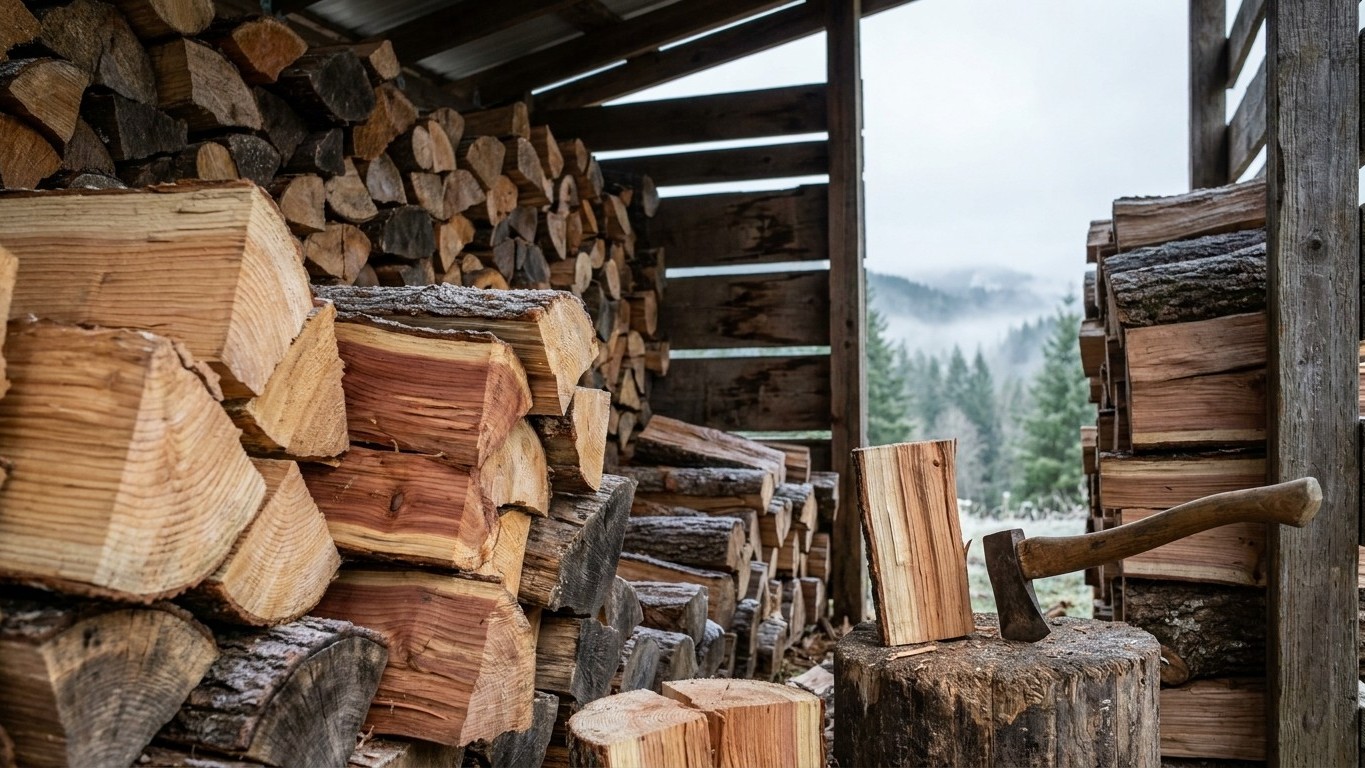

Washington’s winters don’t hit the extremes you’d find in Minnesota or Montana, but the mean low of 37.1°F at the coldest point in the season still means real heat loss on many nights. The question isn’t whether you need a fire. It’s which wood earns its space in your woodshed, how much you’ll actually burn, and why so many stacks split in April never reach the stove by December in good shape.
How cold it actually gets here

NOAA’s 1991-2020 Climate Normals put the average daily low for the coldest month at 37.1°F, using Seattle as the reference station. That’s not a record low and it’s not a seasonal average. It’s the typical bottom of the thermometer on an ordinary night in the coldest stretch of the year. And 37.1°F sits just above freezing, which tells you something specific about what a Washington winter demands from a woodpile.
This isn’t Fargo. It isn’t even Spokane on a hard January night, where continental air pushes numbers meaningfully lower than what the coastal reference station records. For most of western Washington, a cord of wood is working against damp cold, not brutal cold. The furnace or heat pump in most homes here is doing the bulk of the labor, and the woodstove or fireplace is filling gaps: the early morning chill before the thermostat kicks in, the power outage during a windstorm, the evening when running the heat pump at full tilt feels wasteful for one room.
What 37.1°F actually means for your stove
A mean low just above freezing means your firebox rarely needs to fight subzero air infiltration the way a stove in the northern Rockies does. Dense hardwood becomes valuable less because you’d freeze without it and more because a slow, hot overnight burn is genuinely comfortable and genuinely efficient use of a limited woodshed. If you’re on the east side of the Cascades, treat every number here as a floor, not a ceiling. Continental air in Spokane, Yakima, or the Okanogan routinely drops well below the coastal reference figure, and a stove that’s decorative in Seattle is closer to essential out there.
The honest takeaway: for a large share of Washington households, wood heat is a supplement and a comfort layer, not a survival system. That changes what “worth the effort” means when you’re choosing species and deciding how many cords to stack.
Which woods are worth the effort here
Density decides heat output because a cord is a fixed volume: 4 feet by 4 feet by 8 feet, or 128 cubic feet, no matter what species fills it. A dense hardwood packs more wood fiber and less air into that box, and more fiber means more BTUs when it’s seasoned. Michigan State University Extension puts a well-seasoned cord of hardwood at roughly 20 million BTU, the heat equivalent of about 145 gallons of #2 fuel oil or 215 gallons of LP gas. That figure is an average across species and moisture levels, so treat any single load as a variation on it, not an exact promise.
In a mild climate like most of Washington’s, that density advantage matters most for the long overnight burn, the one you want to still have coals in at 6 a.m. A lighter wood burns fast and hot right away, which makes it good for building a fire from cold and for shoulder-season nights in October or April when you want warmth for an hour, not a slow eight-hour hold. It’s a poor choice for banking a fire before bed.
Availability beats theory
The species table below only matters if you can actually buy or cut the wood, seasoned, near you. A dense species you can only find green, and can’t season in time, delivers worse heat than a lighter wood you bought properly seasoned last year. Ask any firewood seller in the Pacific Northwest and the same pattern holds: buyers chase the “best” wood on paper and end up burning wet rounds because that’s all that was locally stacked and ready.
| Category | Heat output | Smoke | Sparks |
|---|---|---|---|
| Dense, well-seasoned hardwood | Highest per cord, near the ~20 million BTU average | Low when properly dried | Few |
| Red oak (named for its drying quirk) | High once fully seasoned | Low when dry | Few |
| Lighter, lower-density wood | Lower per cord | Higher, especially if underseasoned | More, particularly with resinous softwoods |
Red oak deserves its own line because Michigan State University Extension flags it specifically: its cell structure makes it dry slower than most hardwoods, so a red oak stack needs more time than the standard one-summer estimate before it burns clean. Buy or cut it early, or plan on burning last year’s batch this winter and this year’s batch next winter.
How much wood a winter takes
There’s no honest single number for “cords per winter” in Washington, because the answer depends on three things that vary house to house, not region to region. A published average is close to useless without knowing where your home falls on each of these:
- How cold your specific location actually runs: a Puget Sound winter hovering near that 37.1°F average low burns far less wood than an east-side winter with sustained subfreezing nights.
- How well your house holds heat: insulation, air sealing, window quality, and even how open your floor plan is all change how much fuel it takes to hold a room at 68°F.
- Whether wood is your main heat source or a supplement: a household running a woodstove full-time burns several times what a household using it three evenings a week for ambiance burns.
The mechanism that makes these variables matter so much: a poorly insulated house sitting in a harder winter can burn roughly double what a tight, well-sealed house uses in that same climate. That’s not a small rounding error, it’s the difference between two cords and four. Run your own estimate down that list rather than trusting a flat number pulled from a national average, because a “typical Washington household” doesn’t really exist across a state that spans coastal rainforest and high desert.
If you’re new to burning wood as a supplement, a practical approach is to track how much you actually burn through one full winter, keep the receipts or the stack measurements, and use that as your personal baseline going forward. It’ll be far more accurate than anything a general guide can promise, because it accounts for your specific stove efficiency, your specific insulation, and your specific tolerance for a cooler house on a budget night.
Drying wood in this climate
Species selection matters less than most people think. Seasoning matters more, everywhere, including here. The target is 20 percent moisture content or less, and green wood fresh off the tree can run over 60 percent, according to Michigan State University Extension. That water has to boil off before the wood gives usable heat, and the energy spent boiling it off is energy you don’t get to warm your house. A “good” species burned wet performs worse than a mediocre species burned properly dry.
Western Washington’s marine climate complicates the timeline in a specific way: long, damp shoulder seasons and a shorter stretch of genuinely dry, breezy weather than you’d get in a continental climate east of the Cascades. What actually dries wood is air movement and time, not direct sun, so a stack in a shaded but breezy spot, split small and stacked loosely with the cut ends exposed to airflow, will outperform a dense, sun-baked pile that traps moisture inside.
The mistake almost everyone makes
Wood split and stacked in spring for that same year’s winter is, in most cases, not ready. MSU’s guidance is that split, stacked green wood typically needs one full summer of airflow to reach the 20 percent target, and that’s for average hardwood in reasonably favorable drying conditions. In a humid Puget Sound summer, or with a slow-drying species like red oak, that timeline stretches further, not shorter. The households that burn clean, hot, low-smoke fires in December are almost always burning wood they split at least a year earlier, not wood they cut this spring in a rush before the first cold snap.
If your stack was cut this spring, plan on burning it next winter and finding another source, even a partial cord, to get through the current season. That single planning shift, buying or splitting a full year ahead of when you’ll burn, solves more heating problems in Washington than any species choice on the table above.