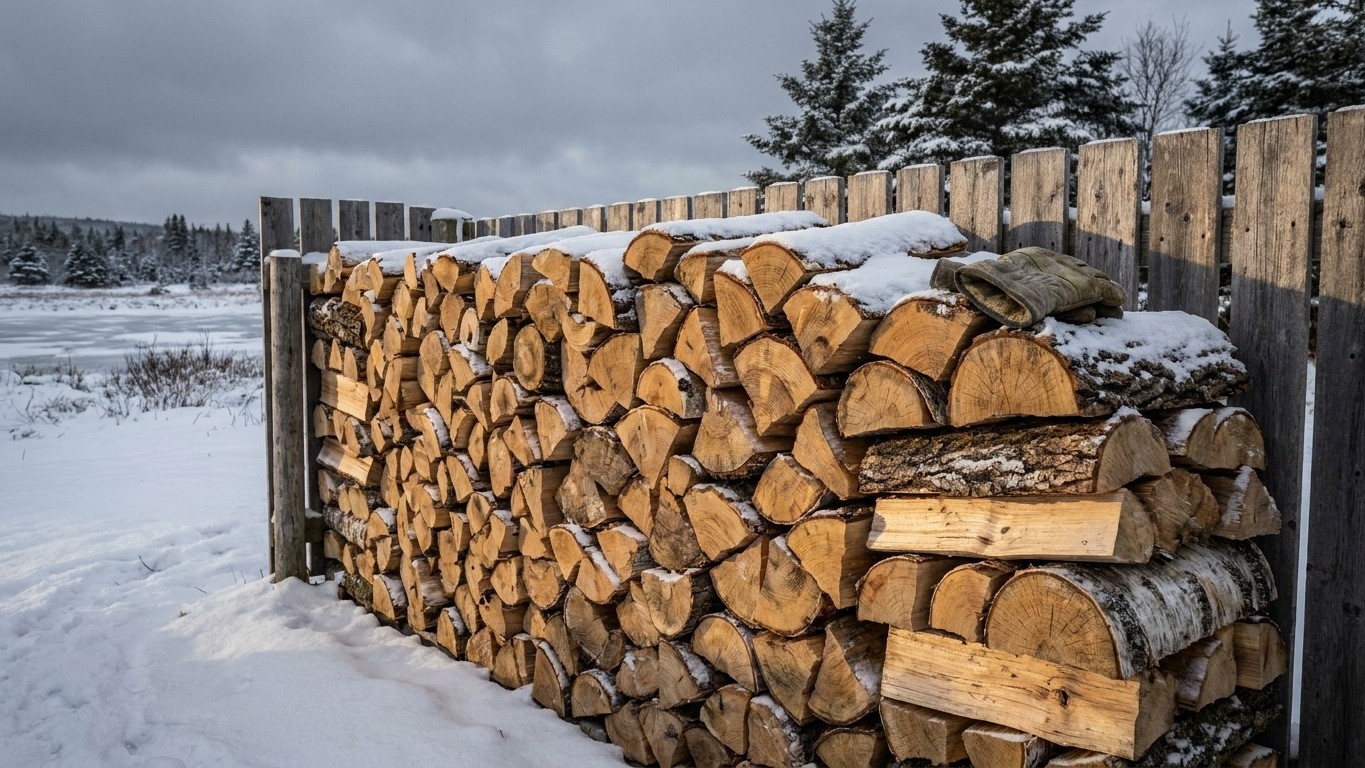

The coldest month at the St. John’s reference station averages a low of just 16.4°F. That single figure decides almost everything about heating with wood here: how many cords you need to get through the season, and whether a dense hardwood is nice to have or something you genuinely cannot do without. This guide breaks down what that cold means for a woodpile, which species carry the weight, and how drying works in a climate that doesn’t always cooperate.
How cold it actually gets here

Sixteen point four degrees Fahrenheit isn’t the record low for St. John’s, and it isn’t the average for the whole month either. It’s the mean daily minimum for the coldest month, according to the Canadian Climate Normals for 1981-2010. In plain terms, that’s the temperature you can expect a typical night to drop to, over and over, for weeks at a time. It’s not a freak cold snap. It’s the baseline.
That number puts Newfoundland and Labrador solidly in territory where wood heat matters for more than mood. A mean low in the teens Fahrenheit means a house is losing heat around the clock through most of the winter, not just on the odd bitter evening. If your stove or fireplace is doing real work, that work doesn’t stop when the sun goes down. It has to hold through eight, nine, sometimes ten hours of outdoor air that’s colder than a home refrigerator.
What this means for the woodpile
A climate that bottoms out in the teens changes the math on burn time. A fire that peters out at 2 a.m. in a place where nights only dip to 30°F is an inconvenience. The same fire dying at 2 a.m. here, with the outside air near 16°F, means a cold house by sunrise and pipes worth worrying about. That’s the practical difference between wood as ambiance and wood as infrastructure.
It also means the conversation about species, drying, and volume isn’t academic. Newfoundland and Labrador sits closer to the “needs to work” end of the spectrum than the “nice to have” end. Readers in milder pockets of the province, particularly closer to the coast where marine air moderates the extremes, will still see real cold, just with somewhat shorter stretches of it. Either way, this is not a climate where a half-seasoned pile of softwood gets you through comfortably. The winter here asks something of both the wood and the person burning it.
Which woods are worth the effort here
Once you accept that the cold here is real and sustained, density becomes the variable that matters most. A cord is a fixed volume, always 4 feet by 4 feet by 8 feet, or 128 cubic feet stacked. What changes from species to species is how much wood mass actually fits inside that volume, and mass is what carries heat. A cord of a dense hardwood packs more pounds of burnable material into that same box than a cord of a light softwood, and more pounds means more sustained heat output for the same amount of stacking, hauling, and stove-loading.
Michigan State University Extension puts a well-seasoned cord of hardwood at roughly 20 million BTU on average, comparable to about 145 gallons of #2 fuel oil or 215 gallons of LP gas. That figure is an average across hardwood species and assumes proper seasoning; a particular load can run well above or below it depending on exact species and how dry it actually is. Species and moisture both move that number, sometimes a lot, so treat it as a benchmark rather than a guarantee for any one truckload.
What locally available species are actually for
Newfoundland and Labrador’s working forest leans heavily on black spruce, balsam fir, tamarack, and white birch, with hardwood options like maple much harder to source in volume. Birch and tamarack sit toward the denser, harder-burning end of what’s regionally common, and they’re the ones worth prioritizing for the coldest overnight stretches and for a fire you want to still have coals from at 6 a.m. Spruce and balsam fir run lighter and burn faster and hotter up front, which makes them useful for getting a cold stove going or for shoulder-season evenings in October and April, but they’re a poor choice to load up and expect to carry you through a January night on their own.
| Species | Relative density vs. hardwood average | Smoke | Sparks |
|---|---|---|---|
| White birch | Closer to average; among the better regional options for overnight heat | Moderate | Occasional |
| Tamarack (larch) | Denser conifer, burns hotter and longer than spruce or fir | Moderate, can be resinous | Moderate, sap pockets can pop |
| Balsam fir | Below average; lights and burns fast | Heavier when not fully seasoned | Frequent, resinous |
| Black spruce | Below average; quick heat, short burn | Moderate | Frequent |
Availability decides as much as this table does. A species you can only find green, or can’t find locally seasoned at all, is worse to burn than a modest wood you can actually get dry. If maple or another dense hardwood shows up seasoned and affordable, it’s worth taking; if it means buying green and hoping it dries in time, a well-seasoned load of birch or tamarack you can get now is the better bet.
How much wood a winter takes
There’s no honest single number for how many cords a Newfoundland and Labrador winter takes, because the answer depends on three things that vary from house to house, and a published average hides all three of them. Anyone quoting you a flat “you’ll need X cords” figure is guessing, not calculating.
- The cold itself: a winter that sits near that 16.4°F average low for weeks demands steady output, not occasional bursts, which burns through wood faster than milder stretches of the same season.
- How well the house holds heat: insulation, air sealing, and window quality determine how much of the heat you generate actually stays inside instead of leaking out through walls, attics, and drafts.
- Whether wood is the main heat source or a supplement: a household burning wood as the sole heat source needs several times the volume of one using a stove to take the edge off while a furnace or heat pump carries the base load.
The mechanism that makes these variables move the needle so much is worth spelling out. A poorly insulated house heated through a hard winter can burn close to double the wood a tight, well-sealed house uses in that same climate, even sitting on the same street. That’s not a small rounding error. It’s the difference between three cords and six, and it has nothing to do with which species you burned. Fix the leaks and the seals before assuming you need more wood; often the house is the bigger variable than the woodpile.
The practical move is to run your own estimate rather than borrow someone else’s number. Start with how the house performed last winter, if you have that experience, then adjust up if this winter runs colder than average, or down if you’ve since sealed drafts or added insulation. Anyone new to a property is better off asking a previous occupant or a local dealer what similar homes in the area typically burn, then padding that figure rather than guessing cold.
Drying wood in this climate
Seasoning matters more than species, and it matters everywhere, but the local climate sets the clock. Michigan State University Extension puts the usable target at 20 percent moisture or less, with green wood often starting above 60 percent. That extra water has to boil off before the wood gives up any of its heat, and boiling it off costs energy you wanted for the room, not the wood itself.
What actually dries wood is air movement and time, not direct sun. Wood needs to be split, then stacked loosely enough that air passes through the pile, ideally off the ground and with the top covered while the sides stay open. A humid coastal summer, common across much of Newfoundland and Labrador, slows that process compared to a drier inland season, which means the drying window here often runs longer than guides written for drier climates assume.
The mistake this climate makes common
Wood cut and split in spring for use the following winter is, in most cases here, not actually ready. A single humid summer often isn’t enough time for a full cord to reach 20 percent moisture, particularly for anything cut later than early spring or stacked too tightly for air to move through it. MSU flags red oak specifically as a slow-drying exception even under good conditions, needing longer than most other hardwoods because of its cell structure; anyone burning oak here should plan on an extra season, not the standard one.
The safer approach is buying or cutting wood at least one full year ahead, so it has an entire summer plus the shoulder seasons to lose that moisture before it’s asked to heat a house through a night near 16°F. Wood that looks dry on the outside can still be wet at the core, so splitting a piece open and checking the interior, or using a moisture meter on a fresh-split face, beats guessing by how long it’s been sitting in the yard.