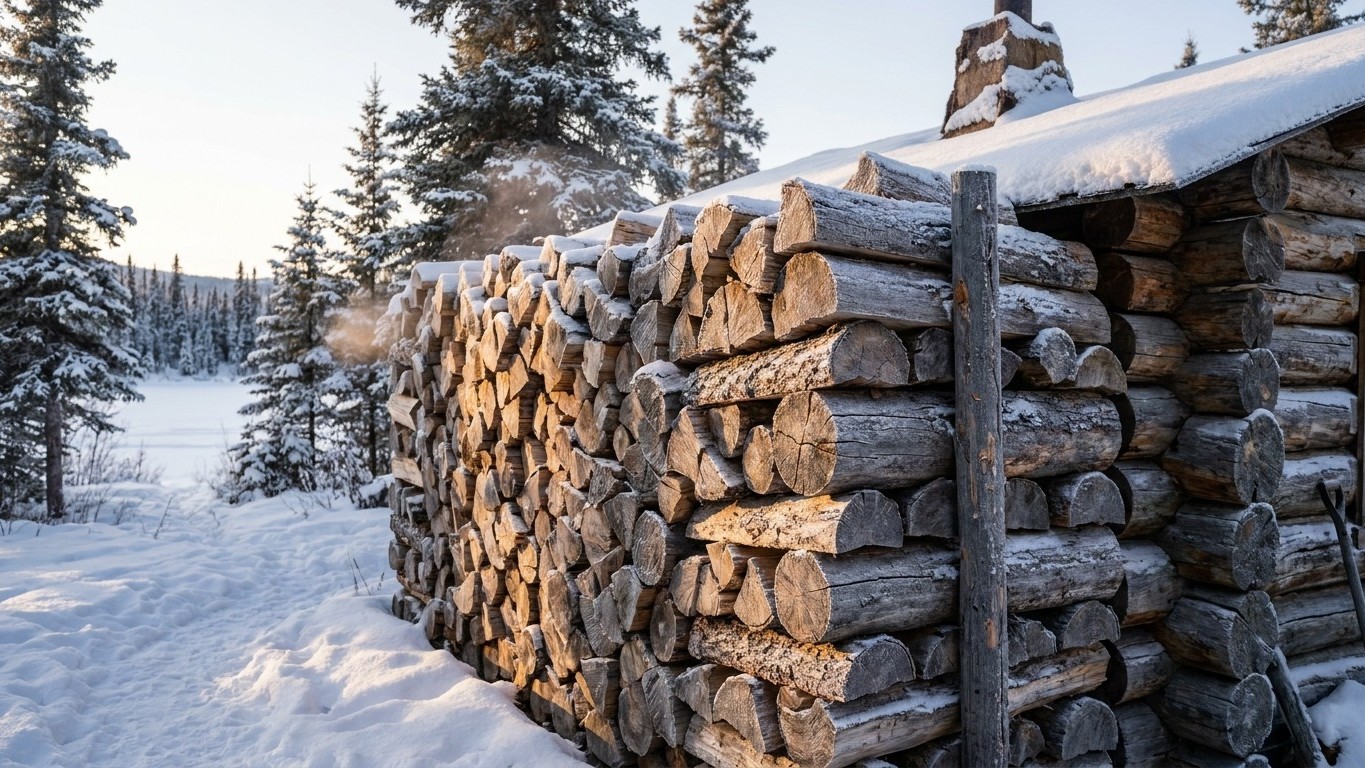

Firewood in the Yukon isn’t about ambiance. With coldest-month lows that sit below zero Fahrenheit, wood heat here is a survival system, and the wood you burn has to carry real weight per cord. That means choosing density over convenience, seasoning wood a full year before you need it, and sizing your woodpile to your house, not to a number you saw online.
How cold it actually gets here

The reference station for the territory is Whitehorse, and the number that matters most isn’t the record low everyone likes to quote around a campfire. It’s the mean daily minimum of the coldest month, which sits at -2.6°F, according to Environment and Climate Change Canada’s 1981-2010 Climate Normals. That’s not a one-night dip. That’s the average low, night after night, for the coldest stretch of the year.
A figure like that changes what firewood means. In places where the coldest-month low sits in the 30s or 40s, wood heat is a mood: a fireplace running a few evenings a week while the furnace does the real work. Below zero, that arrangement doesn’t hold. A house heated mainly by wood at -2.6°F average lows needs a stove running near capacity for hours at a stretch, often overnight, with no room for a fire that burns fast and dies.
Practically, this shows up in three ways. First, burn duration matters more than flame size, because a stove that needs reloading every two hours at 2 a.m. in January is a stove that lets the house go cold before anyone wakes up to feed it. Second, coal-bed retention (the ability of a fire to hold hot embers through a long stretch) becomes as important as peak heat output. Third, the margin for error shrinks. A cord of poorly seasoned or low-density wood that would just mean a chilly living room in Ohio can mean frozen pipes in Whitehorse.
None of this means atmosphere doesn’t matter. A wood stove or fireplace still adds something a furnace can’t: heat you can see and hear, a room that feels different when it’s running. But the reader planning firewood for a Yukon winter should plan first for the -2.6°F reality and treat any extra comfort as a bonus that comes along for the ride, not the reason for the purchase.
Which woods are worth the effort here
Cold like this puts density at the center of every firewood decision, for a simple reason: a cord is a fixed volume, 4 feet by 4 feet by 8 feet, or 128 cubic feet, whether it’s stacked with a heavy hardwood or a light one. A denser wood packs more solid wood fiber into that same box, which means more pounds of fuel and more stored energy per load you split, haul, and burn. Michigan State University Extension puts the benchmark at about 20 million BTU per cord of well-seasoned hardwood, on average, which MSU compares to roughly 145 gallons of #2 fuel oil or 215 gallons of LP gas. That’s an average across hardwood species and assumes the wood is properly dried; a green, low-density load will fall well short of it.
Matching wood to the job
In a winter like the Yukon’s, the densest hardwoods available are worth the extra weight and the extra effort to split, because they’re what gets a stove through the coldest nights without a 2 a.m. reload. They burn slower, hold coals longer, and deliver more of that 20-million-BTU ceiling per cord. Lighter woods, common softwoods and lower-density species, still earn their place in the woodshed: they light fast, so they’re the right choice for starting a fire or for shoulder-season evenings in September and April when the house needs a little heat, not a lot. What they’re not built for is holding a fire through a subzero night on their own.
Local availability decides as much as any table does. A denser species you can’t actually buy seasoned, or can’t season yourself in time, is worse than a lighter wood you can get dry and ready to burn. A yard full of green hardwood rounds is a yard full of steam and smoke, not heat, no matter how good the species looks on paper.
| Wood category | Relative density | Best use | Smoke (seasoned) | Sparks |
|---|---|---|---|---|
| Dense hardwood | High | Overnight burns, coldest nights, main heat source | Low | Few |
| Medium hardwood | Medium | Daily heating, mixed loads with denser wood | Moderate | Moderate |
| Softwood / conifer | Low | Kindling, quick starts, shoulder-season evenings | Higher, resinous | More, can pop |
How much wood a winter takes
Any number you read online for “cords per winter” is a guess dressed up as a fact, because the real answer depends on your specific house, not the territory average. Three things move the estimate more than anything else, and running through them for your own home will get you closer to a real figure than any published chart.
- The cold figure for your location: a house near Whitehorse, averaging -2.6°F lows in the coldest month, demands far more fuel than one in a milder pocket of the territory.
- How well the house holds heat: insulation, air sealing, window quality, and even ceiling height change how much of the wood’s energy actually stays inside.
- Whether wood is the main heat source or a supplement: a stove backing up a furnace on the coldest nights burns a fraction of what a stove working alone all winter needs.
The mechanism behind that spread is worth understanding, not just accepting. A poorly insulated house in a hard winter can burn through roughly double what a tight, well-sealed house uses in the exact same climate, because so much of the heat generated is escaping through walls, attics, and gaps around doors before it ever does its job. That’s not a rounding error. That’s the difference between three cords and six for the same square footage in the same town.
This is also why two neighbors on the same street can report wildly different firewood needs and both be telling the truth. One tightened up the house with weatherstripping and attic insulation; the other didn’t. One uses wood as the sole heat source; the other runs it alongside oil or electric baseboard on the coldest nights only. Before buying or cutting a season’s wood, it’s worth walking through those three variables for your own house rather than trusting a flat number pulled from a different climate, a different house, or a different heating setup entirely.
Drying wood in this climate
Seasoning matters more than species selection almost everywhere firewood gets burned, and the Yukon is no exception. The target is the same no matter where you live: wood should burn at 20 percent moisture or less. Green wood, fresh off the tree, can run well over 60 percent moisture, according to Michigan State University Extension, and that water has to boil off before the wood gives up any of its heat, which is energy stolen straight from the fire you wanted.
What actually dries wood is air movement and time, not sunshine. Wood that’s split and stacked so air can pass through the pile, ideally off the ground and loosely covered on top only, reaches that 20 percent target after one full summer of stacking, in most cases. Wood left in round, unsplit logs, or piled tight with no airflow, can sit for years and still be too wet to burn efficiently. Red oak is the named exception in MSU’s research: its cell structure makes it dry more slowly than other hardwoods, so it needs extra time beyond the usual one-season window.
The Yukon’s short summer window makes timing tighter than it is farther south, and this is where the most common local mistake happens: cutting and splitting wood in spring, then expecting it to be ready by the time the cold figure of -2.6°F shows up again in December. A few months of a short subarctic summer, even a dry one, rarely gets a fresh-cut round down to 20 percent moisture. Wood meant for this winter needed to be split and stacked last year, sitting through a full season of airflow before the first hard freeze. Anyone starting from green wood now is really preparing for next winter, not this one, and planning the woodpile a full year ahead is the single habit that separates a warm January from a cold one.