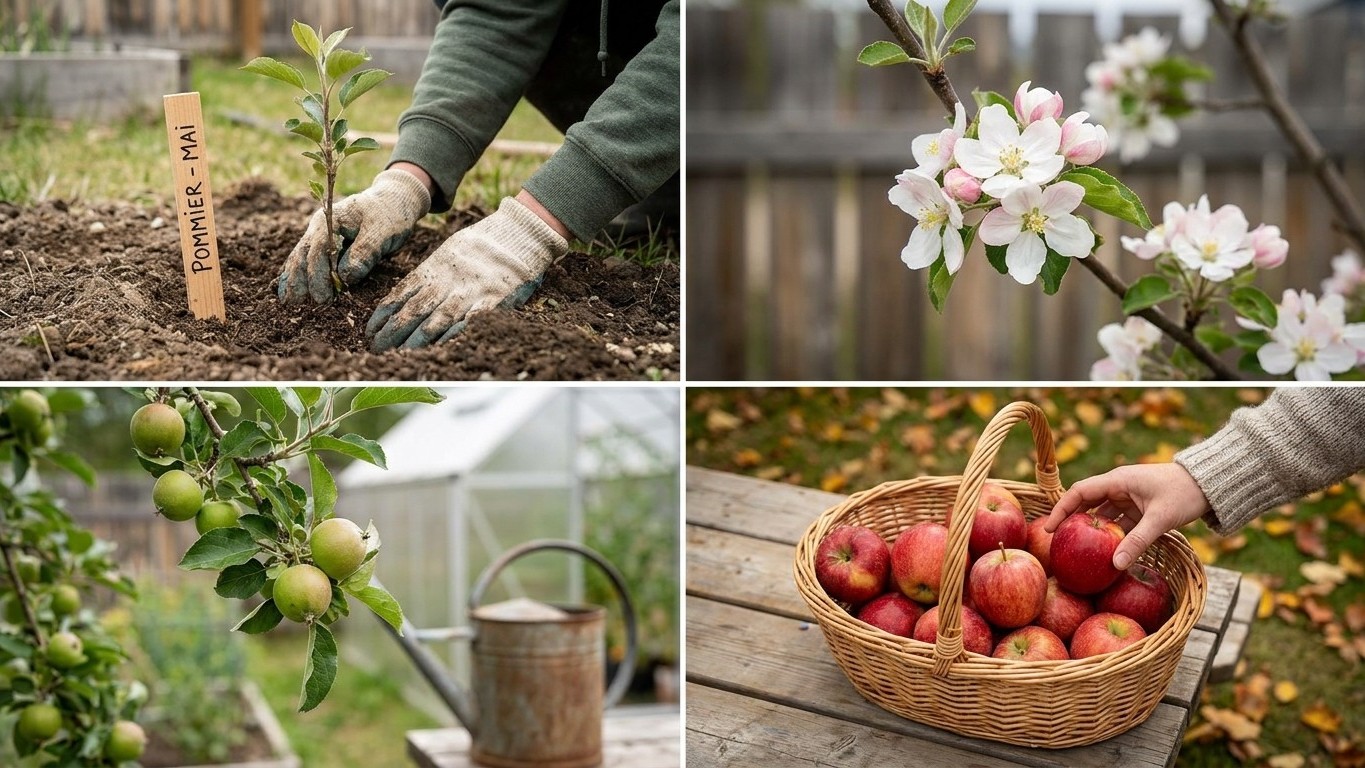

Yukon’s apple calendar runs on Environment and Climate Change Canada’s 1981-2010 normals for the Whitehorse A station: an average last spring frost of June 5 and an average first fall frost of August 25, a frost-free window of roughly 81 days. Half of all years miss that window at one end or the other, so treat both dates as midpoints, not guarantees. Before you plant anything, check that a cultivar’s catalog ripening time actually fits inside that 81-day span.
The short answer for Yukon
At Whitehorse, Environment and Climate Change Canada’s 1981-2010 climate normals put the last spring frost, on average, at June 5 and the first fall frost at August 25. That’s a frost-free window of roughly 81 days, one of the shortest apple-growing seasons anywhere this site covers. The same ECCC normals record a mean daily minimum for the coldest month of -19.2 °C at that station, and that number, not the frost dates, decides whether a tree can even survive the winter here.
Both frost dates are ECCC means, not safe dates. Environment and Climate Change Canada’s own definition of a normal means that in roughly half of all years, frost lands later than the June 5 mean in spring or earlier than the August 25 mean in fall, so the real window in a given year can run shorter than 81 days. Whitehorse A is the only station behind these figures, and a garden higher up, in a valley bottom that pools cold air, or well outside the Whitehorse basin will run behind these dates, sometimes by weeks rather than days.
What the calendar looks like for one particular tree depends on three separate filters: whether its rootstock survives the ECCC mean coldest-month minimum of -19.2 °C (and the colder individual nights that occur inside any winter), whether it gets enough accumulated cold to break dormancy and flower on schedule, and whether its bloom-to-harvest stages fit inside the June 5 to August 25 window. Miss the first filter and the tree dies outright. Miss the third and it lives for years without ever finishing a crop. The rootstocks and cultivars that clear all three are covered in Growing Apples in Yukon; this page is about when each stage of that tree’s year actually falls.
Working through it

Every one of these stages is triggered by the tree’s own accumulated warmth, not by a date on the wall, but each one still needs to be checked against Yukon’s own frost dates to know what’s actually at risk.
Dormancy

The tree sits fully leafless with no bud movement, and this is the stage that tests the winter, not the summer. The ECCC mean coldest-month minimum of -19.2 °C at Whitehorse is the number a hardy rootstock and cultivar need to shrug off, and colder individual nights inside that month go lower still. Prune now, while the wood is frozen solid and the tree can’t push sap into a fresh cut.
Green tip

The first sliver of green shows at the tip of the bud as the tree wakes up. In Yukon this generally happens before the ECCC mean last frost of June 5, since bud swell tracks accumulated warmth in the soil and air rather than the calendar, and a hard freeze at this stage does little damage because the tissue is still mostly protected inside the bud scale.
Pink

Petals are visible but still closed. This is the stage growers here watch hardest, because pink-stage buds have almost no frost tolerance left, and a freeze arriving anywhere near the ECCC mean last-frost date of June 5 can wipe out the year’s crop before a single flower opens.
Bloom

Petals open fully. A bloom that lands well after the June 5 ECCC mean is past the riskiest point of an average year, but since half of all years bring frost later than that mean date, a late cold snap can still catch an early-blooming cultivar in full flower. This is exactly why cultivar choice, covered in The Best Apple Varieties for Yukon, matters as much as the calendar.
Petal fall and fruit set

Petals drop and the fertilized fruitlets begin to swell. This is when the tree needs steady water and its main feeding of the season, because everything the fruit will need to size up over the following weeks gets built from growth made right now.
Harvest

Ripening has to finish before the ECCC mean first fall frost of August 25 at Whitehorse, or the crop is lost to cold before it’s picked. A cultivar whose catalog ripening window runs longer than the roughly 81-day gap between the June 5 and August 25 ECCC means will rarely finish here, whatever the label promises for a longer-season state.
What changes across Yukon
Whitehorse sits in the Yukon River valley at a moderate elevation for the territory, and its frost dates from ECCC’s 1981-2010 normals are the only dated figures behind this page. Every other community differs from that station by some margin, and the direction of the difference usually comes down to elevation, valley shape, or a large body of water nearby.
Colder and later
Dawson City, in the Klondike Valley, is known for pooling cold air along the valley floor overnight, the same effect that hits any low ground near a river bend. No dated frost normal for Dawson City is available here, but a valley that traps cold air overnight typically runs its last spring frost later and its first fall frost earlier than a station like Whitehorse sitting on more open ground. Haines Junction, closer to the St. Elias Mountains and at higher elevation, faces the same cold-air problem plus a shorter, cooler summer overall, for the same reason mountain foothills anywhere run behind the valley floor below them.
Milder, or just less documented
Watson Lake, in the southeast of the territory at lower elevation than Whitehorse, sits closer to the broader continental pattern shared with northern British Columbia, which can mean a marginally gentler spring, though no local frost-date figure is documented for it here. Teslin, on the shore of Teslin Lake, may see the lake moderate the sharpest overnight temperature swings right along its shoreline, the way any large body of open water buffers the land immediately around it, though this doesn’t extend far inland. Old Crow, north of the Arctic Circle, works to a shorter season than any of the above. No local source here documents a frost date for it, so treat any apple planting there as experimental rather than calendar-driven.
The mistakes this climate punishes
The frost dates above make some ordinary orcharding mistakes far more costly here than in a milder state, because Yukon’s growing season leaves almost no margin to recover from them.
| Mistake | What happens | When it shows |
|---|---|---|
| Planting a variety with a bloom-to-harvest window longer than the roughly 81-day ECCC-mean gap between June 5 and August 25 | Fruit never finishes ripening before frost | Every autumn, at harvest |
| Feeding nitrogen into July or later | New growth stays soft and hasn’t hardened off | At the first hard freeze after the August 25 mean |
| Choosing rootstock not rated hardy enough for the ECCC mean coldest-month minimum of -19.2 °C | Trunk or graft union damage from the colder nights inside any winter | In the coldest winter of several, not necessarily the first |
| Planting a young tree at the base of a slope or in a low pocket | Cold air drains downhill and pools, nipping bloom that survives everywhere else nearby | Any year frost lands later than the June 5 mean, roughly half of them |
The rootstock mistake is the one that costs the most, because it can take several winters to show. A tree can clear two or three ordinary winters and still be killed by the one that dips well below that ECCC mean of -19.2 °C, since that figure is only an average of the coldest month, not the floor of what a bad winter can do. Buying on hardiness rating rather than on how well a nursery catalog’s photo happens to match your climate is the only real defence against it.
Checking this against your county
Whitehorse’s frost dates are a starting point, not a verdict on your own yard, especially if you garden in Dawson City, Haines Junction, Watson Lake, or anywhere outside the Whitehorse basin. Agriculture and Agri-Food Canada, the federal department, keeps a current portal of growing information at agriculture.canada.ca, and it’s a reasonable place to start when the territorial department’s own site isn’t reachable to check directly.
Local Yukon garden clubs and community gardens often hold years of informal frost records for their own valley, and those beat a single Whitehorse station for deciding when to plant on your own ground.
Common questions
Do apple trees in Yukon need a second tree to pollinate?
Most apple cultivars are not reliably self-fertile, so plan on two different varieties, or one plus a hardy crabapple, blooming close enough in time to cross-pollinate each other. In a short season, pollinator activity usually picks up once bloom lines up with the warmer days around the June 5 ECCC mean last frost.
What happens if my tree blooms before the last frost date?
An early bloom lands right on the pink and bloom stages, which are the riskiest point of the whole calendar, since the June 5 ECCC mean is only a midpoint and frost after that date is common in roughly half of all years. Moving young trees off the base of a slope, or covering them overnight with frost cloth through the pink and bloom stages, is the practical fix, not shifting the whole calendar.
How many chill hours do apple trees need in Yukon?
Chill isn’t usually the limiting factor this far north. Yukon’s long, cold winters supply more chill than almost any hardy apple cultivar needs to break dormancy properly, so the real constraint here is winter survival and season length, not a chill deficit the way it can be in a mild-winter state.
Can a greenhouse or high tunnel push the season further in Yukon?
A tunnel can buy a grower some extra weeks on both ends of the frost-free window by holding heat overnight, but no local data is available here on how many days that adds for a fruiting apple tree specifically. Check with a local Yukon garden club or Agriculture and Agri-Food Canada’s site for anyone who has tried it in your own valley before relying on it.