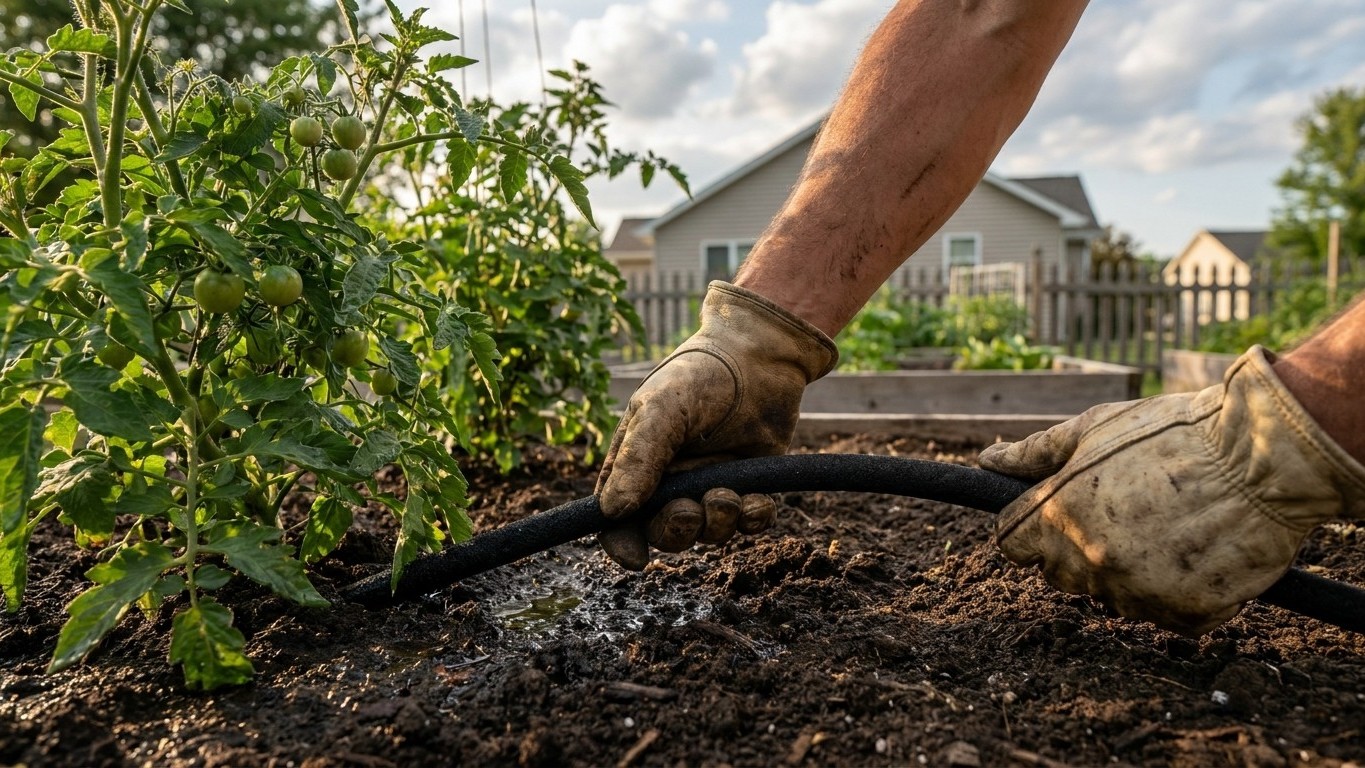

Indiana gardens want about an inch of water a week during the growing season, delivered slowly and at the root zone rather than sprayed daily on the leaves. How much of that inch comes from the sky and how much you have to haul out with a hose or drip line depends on your soil, your microclimate, and whether your water utility has put limits on outdoor use this summer.
What the climate asks of you

Start with the number that actually rules a vegetable bed or a new lawn in Indiana: 14.6 days a year reach 90F or higher, based on the 1991-2020 NOAA climate normals at the Indianapolis reference station. That’s not a huge number compared to states further south, but it’s enough heat stress, concentrated mostly in July, to push a shallow-rooted plant into wilting by early afternoon if the soil underneath it is already dry.
The state’s USDA Plant Hardiness Zones run from 5b to 7a, a range wide enough that a gardener in the far south of the state is working with a noticeably milder winter, and often a longer, hotter, drier summer stretch, than someone up near the Michigan line. That zone spread matters for watering because it tracks with how long the heat pressure lasts each season, not just how hot a single afternoon gets.
What the normals don’t hand you on a platter is a single, reliable summer rainfall figure you can apply blindly to your own yard. Indiana summer rain comes in bursts, thunderstorm-driven, uneven from one county to the next and even from one side of a city to the other. That unevenness is exactly why the standard advice, an inch a week, works better as a target to check against than a number to assume you’re already getting. The only honest way to know what your garden received this week is to set a rain gauge at bed height and read it, or pull the current season data from NOAA’s climate data tools for your nearest station.
Soil texture decides what happens to whatever rain does fall. Indiana ground ranges from sandy outwash in parts of the north, left behind by glacial meltwater, to heavy clay loams elsewhere that hold water for days after a storm. The same storm that leaves a sandy bed thirsty again within 48 hours can leave a clay bed still soggy at the same point. That’s the piece of the equation no statewide average will ever solve for you: know your own dirt before you set a watering schedule, and if you’re gardening in pots rather than open ground, the calculus changes again, since containers dry out far faster than beds, a topic covered in more depth in Watering Pots and Containers in Indiana.
How much, how often
The single biggest mistake in home watering is frequency without depth. A quick daily sprinkle wets the top inch of soil and nothing more, which trains roots to stay shallow, close to the surface, where they bake and struggle the moment rain stops falling, a risk covered in detail in Watering Through a Dry Spell in Indiana, rather than reaching down where moisture actually persists.e the moment a 90-degree afternoon shows up. Deep, infrequent watering pushes roots down where the soil stays cooler and holds moisture longer. That’s the whole logic behind every watering guideline that follows.
Before turning on anything, check whether the soil actually needs it. Push a finger, or better, a trowel, about two inches down near the root zone. If it’s dry at that depth, water. If it’s still moist, wait a day and check again. This one habit prevents more overwatering than any timer or app.
A watering sequence for Indiana beds
- Check soil moisture two inches down at the base of the plant, not just on the surface, before deciding to water at all.
- Water early morning, ideally before 9 a.m., so moisture soaks in before the day’s heat and evaporation peak, and foliage has time to dry before evening (wet leaves overnight invite fungal disease).
- Apply water at the base, directly over the root zone, using a soaker hose, drip line, or the tip of a watering can rather than an overhead sprinkler that loses a share of every gallon to the air.
- Deliver roughly one inch per week total, counting whatever rain fell, split into one or two deep sessions rather than several shallow ones.
- Adjust for soil texture: sandy ground drains fast and holds little, so it often needs shorter sessions spaced closer together, sometimes every third day in peak heat; heavy clay holds a week’s water in reserve but drowns roots if watered again before it has actually dried, and should never be worked or soaked while still wet from the last rain.
Tie the schedule to the hottest stretch of the year rather than the calendar. With 14.6 days a year hitting 90F or above, most of them clustered in July, that’s the window where a bed on sandy soil can go from fine to wilted in a single missed watering day. A bed in heavier clay has more of a buffer, but only until the surface cracks, at which point water runs off into the cracks instead of soaking in evenly, and the fix is a light scratching of the surface before the next soak.
Restrictions and rules
Outdoor watering restrictions aren’t unusual in Indiana during dry stretches, and they’re set locally, not by the state as a whole. A municipal utility, a rural water district, or a city might limit watering to certain days of the week, certain hours, or ban sprinkler use entirely during a drought declaration. These rules change from one summer to the next depending on reservoir levels and rainfall, and they can differ significantly between neighboring towns served by different water systems.
Because there’s no single statewide rule to quote, the only reliable move is checking directly with your own water provider before you set a schedule or install an irrigation timer. Most utilities post current restrictions on their website, and many post them seasonally even when no formal restriction is in place, as a guide for customers.
Given how the rainfall pattern here concentrates in scattered summer storms rather than steady soaking rain, restrictions are a real possibility during a dry July or August, and it’s worth building that uncertainty into any watering plan rather than assuming your hose will always be free to run. Purdue Extension offices in each county also track local conditions and can point you to your specific utility’s current rules.
Using less
Cutting the water bill and the workload doesn’t mean cutting corners on plant health. A handful of techniques do most of the work, and they stack, each one reducing how often you need to reach for a hose in the first place.
- Mulch, two to three inches deep, over the root zone of beds and around trees. It slows evaporation from the soil surface, which is often the single biggest water loss in a home garden, and it moderates soil temperature so roots aren’t stressed by surface heat swings.
- Drip irrigation or soaker hoses instead of overhead sprinklers. Water goes straight to the root zone instead of drifting off in wind or evaporating mid-air, which typically means less total water for the same result at the roots.
- Group plants by water need rather than scattering thirsty annuals among drought-tolerant perennials. A bed watered as a unit wastes less than one where some plants get soaked to satisfy the driest member of the group.
- Work organic matter into the soil, compost especially, which helps sandy soil hold more moisture between waterings and helps heavy clay drain a bit better so it doesn’t stay waterlogged after a storm.
- Rain barrels, where local rules allow them. An inch of rain falling on a thousand square feet of roof works out to roughly 600 gallons of runoff. In a summer where storms are scattered and July can run dry, a barrel fills fast during a downpour and can sit empty for stretches afterward, so it’s a supplement to a watering routine, not a full replacement for it.
None of these techniques require ripping out an existing garden or a major investment. Mulching a single bed this weekend, or swapping one sprinkler head for a soaker hose, already changes how often you’re out there with a hose in hand come the next 90-degree stretch.
Common questions
How do I know if my soil is sandy or clay without a lab test?
Squeeze a handful of moist soil. Sandy soil falls apart immediately and feels gritty. Clay holds its shape, feels smooth and sticky, and can be rolled into a ribbon between your fingers. Loam, the middle ground, holds a loose shape but crumbles with a light touch.
Should I water differently right after planting in spring?
Yes. New transplants set out around the last spring frost window (April 9 to April 21 at the Indianapolis reference point, earlier further south) need more frequent, shallower watering for the first couple of weeks while roots establish, before shifting to the deep, infrequent schedule described above.
Does watering in fall matter as much as summer?
It matters less for stress but still counts, especially for perennials and shrubs going into dormancy. With the first fall frost typically landing between October 21 and October 30 at the Indianapolis station, a deep watering in the weeks before that date helps roots handle winter better, particularly after a dry autumn.
What if my utility hasn’t posted any watering restrictions?
Absence of posted restrictions doesn’t guarantee none apply informally during a fast-developing drought. A quick call to your water provider or a check with your county Purdue Extension office confirms current status faster than assuming last year’s rules still hold.