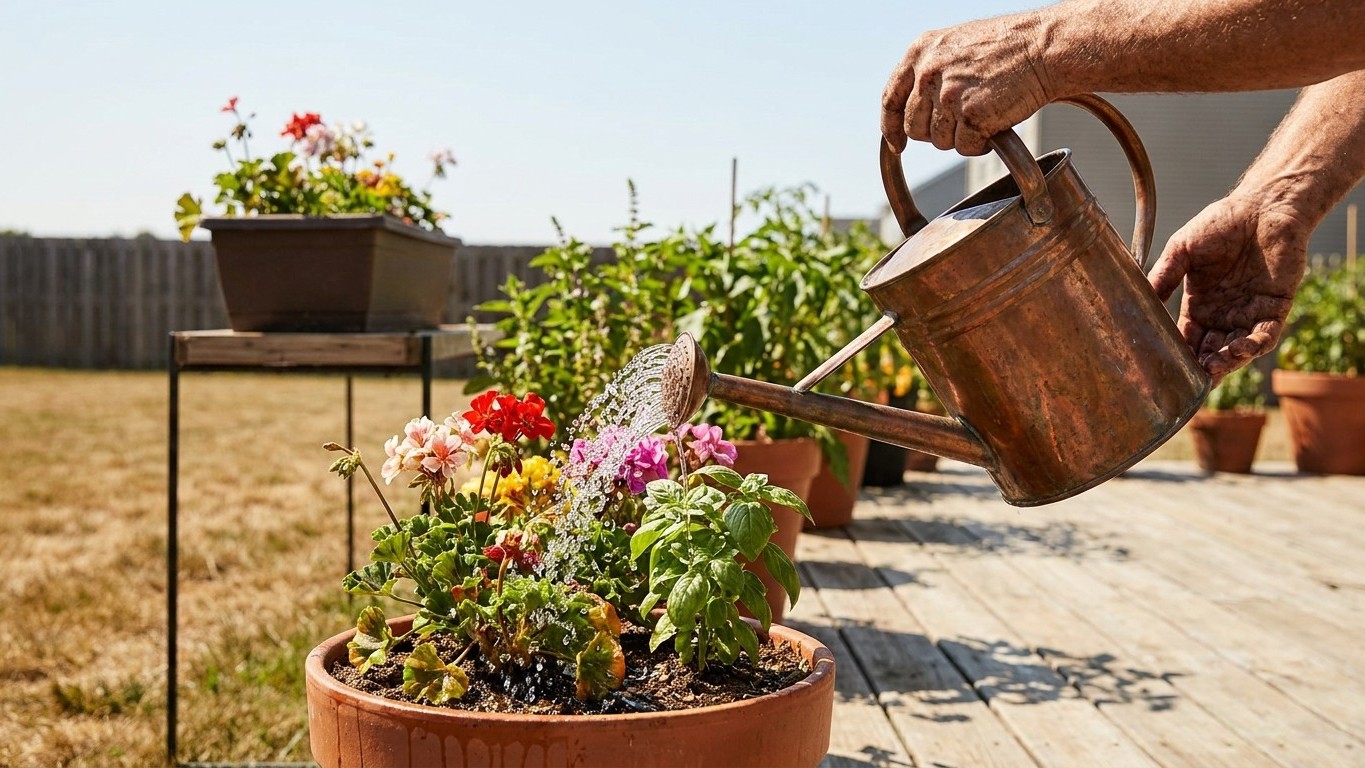

Indiana gardens need roughly an inch of water a week through summer, but the sky rarely delivers all of it at once. August, the driest month, averages just 3.2 inches of rain, while 14.6 days a year climb to 90F or higher and pull moisture straight back out of the soil. The gap between what falls and what a bed or a container actually needs is where a gardener’s hose comes in.
What changes here

Two numbers set the terms for watering in Indiana: 3.2 inches of rain in August, the driest summer month, and 14.6 days a year that reach 90F or above. Together they mean the state isn’t short on water over a full season, but the driest stretch lands right when heat is doing the most damage to soil moisture. That combination, not either figure alone, is what decides how often a gardener has to step in.
Run the arithmetic and the gap becomes concrete. A vegetable bed or a border of perennials wants about an inch of water a week. August has roughly 4.3 weeks in it, so 3.2 inches of monthly rain works out to about 0.74 inch a week on average, spread across however many rain events actually happen. That leaves close to a quarter inch a week that has to come from a hose, a can, or a drip line rather than a cloud. It isn’t a huge amount, but it’s rarely delivered on schedule. Indiana rain in late summer tends to arrive as thunderstorms, and a single storm can drop half an inch in twenty minutes and then nothing for ten days. Average rainfall and useful rainfall are not the same thing.
Soil texture changes how far that water actually gets used. Sandy soil lets water pass through quickly, so even a decent rain shower drains past the root zone within a day and the bed reads dry again soon after. Heavy clay holds onto the same inch for the better part of a week, but it also resists letting new water in once it’s dry and cracked, so a downpour after a dry spell can run off the surface instead of soaking down. Neither soil type changes the weekly target of about an inch. Both change how that inch needs to be delivered, and that’s the difference a gardener has to manage by hand, since the 3.2-inch August average and the 14.6 days above 90F are fixed by climate, not by what’s under a particular yard.
How to water when it matters
The method that works on Indiana ground is deep, infrequent watering at the base of the plant, done in the morning. Deep watering pushes moisture down to where roots actually grow, training them to follow the water downward instead of clustering near a surface that dries out in an afternoon. Watering at the base rather than overhead keeps leaves dry, which matters in a state where summer humidity already gives fungal disease plenty of help. Morning watering gives the sun time to dry any incidental moisture on foliage before evening, when a wet leaf left overnight is an invitation for mildew and blight.
Checking whether the soil actually needs water beats watering on a fixed calendar. A finger pushed two inches into the soil, or a small trowel pulled up for a quick look, tells the real story: if it’s dry at that depth, it’s time to water; if it’s still damp, it can wait, no matter what the surface looks like. Surface soil can look bone dry an hour after a good soaking and still be moist further down, especially in clay.
Soil texture sets the rhythm from there. Sandy soil holds little water at a time, so it calls for shorter, more frequent sessions rather than one big soak. Heavy clay holds a week’s worth of water once it’s fully wetted, but watering it again before it’s had a chance to dry invites root rot, since clay drains slowly and waterlogged roots suffocate.
A simple sequence to start from, then adjust against what the finger test actually shows:
- Check soil moisture two inches down with a finger or trowel before watering, not after.
- Water at the base of the plant, not overhead, using a hose, can, or drip line.
- Apply roughly one inch of water per week in sandy soil split into two or three sessions, or one deeper soak per week in clay soil.
- Water in the early morning so any splashed foliage dries before evening.
- Recheck soil moisture two to three days later and adjust frequency based on what the finger finds, not on a fixed calendar.
What goes wrong
Watering a little every day
A daily light sprinkle wets only the top inch or so of soil, which trains roots to stay shallow and close to the surface. Those roots then bake the moment a hot stretch hits, since the top inch of soil dries out and heats up fastest, especially on the days that reach 90F or higher.
Watering leaves in the evening
Wetting foliage after dinner feels efficient, but the water sits on the leaves overnight instead of drying off in the sun. Indiana’s humid summer air slows that drying even further, and a wet leaf surface left in the dark for eight hours is exactly the environment fungal diseases like powdery mildew and leaf blight need to take hold.
Trusting the last rain shower
A thunderstorm that looks like a soaking can leave the soil wet only in the top half-inch, particularly on sun-baked clay that sheds water instead of absorbing it. The only way to know is the finger test again: if the soil is dry two inches down, the storm didn’t do the job, no matter how hard it rained.
Skipping the mulch
Bare soil left uncovered gives back a good share of what was just watered in, since direct sun and warm air pull moisture straight out of exposed dirt. On the days when temperatures hit 90F or above, that evaporation happens fast enough to undo a morning’s watering by mid-afternoon. A two- to three-inch layer of mulch slows that loss and keeps the root zone from swinging between soggy and bone dry.
Local help
Purdue University’s Cooperative Extension Service is Indiana’s land-grant resource for soil testing, plant selection, and watering guidance tailored to local conditions. Find county offices and gardening publications at extension.purdue.edu. Watering restrictions vary by city and water utility, and can change during drought conditions, so check current rules with your own water provider before setting an irrigation schedule.
Common questions
How often should I water my garden in Indiana during summer?
Check soil moisture two inches down every two to three days. Sandy soil often needs water twice a week; clay soil may only need one deep soak, since it holds moisture longer.
Is August really the driest month in Indiana?
Yes, by the monthly normals: June averages 4.95 inches of rain, July 4.42 inches, and August drops to 3.2 inches, the lowest of the three summer months.
Do potted plants need different watering than garden beds?
Containers dry out faster than ground soil because they hold less volume and are exposed to air on all sides, so they often need checking daily during stretches with several days above 90F, even when garden beds can go two or three days between waterings.
Can I rely on rainfall alone in a wet summer?
Not safely. Even in a summer with above-average rainfall, storms tend to arrive in short, heavy bursts that can run off clay soil or drain past sandy soil, leaving the root zone dry between events. A rain gauge on the actual plot is the only way to know for certain.