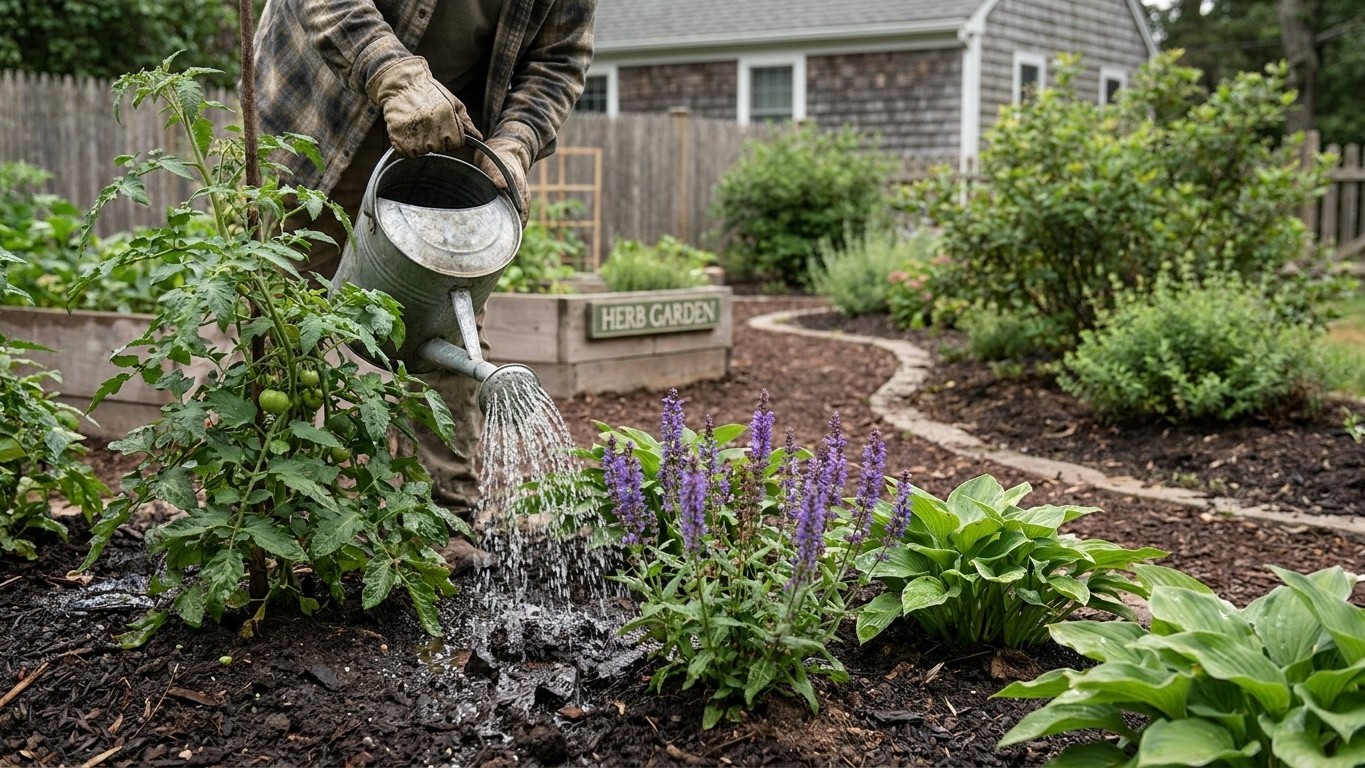

Washington has a reputation for rain, but that reputation is misleading once summer arrives. The state averages only 3.0 days a year above 90F at the Seattle reference station, so heat stress isn’t the enemy here. The real challenge is Watering Through a Dry Spell in Washington, a long stretch in July and August when beds and containers depend almost entirely on the gardener rather than the sky. What follows is the practical math and the rules that govern it.
What the climate asks of you

Start with the one number that’s actually measured and sourced for this state: an average of 3.0 days a year reach 90F or hotter, recorded at the Seattle station over the 1991-2020 normals period. That’s a low figure compared to most of the country, and it tells you something important right away: this isn’t a garden that scorches. It’s a garden that quietly dries out while the air stays mild and pleasant, which is exactly the kind of stress that catches people off guard because nothing about the weather feels alarming.
Western Washington’s growing season runs from a last spring frost between February 27 and March 18 to a first fall frost between November 13 and November 30, both based on the 32F freeze-probability window at the Seattle-area station. That’s a long window, but a mild frost date doesn’t mean an early planting date here. Cold, wet soil and low spring light hold crops back well past the last freeze, so the watering season for most beds really begins once the soil has warmed, not the moment the frost risk clears.
Zones and regional differences
The USDA Plant Hardiness range for the state runs from zone 4a to 9a, which is a state-wide span, not a single number you can apply everywhere. Seattle and the western lowlands sit at the mild end of that range, with a maritime climate that keeps winters gentle and summers dry but rarely hot. East of the Cascades, the climate turns to high desert: shorter growing windows, harsher winters, and a very different relationship with water. Any recommendation tied to the Seattle frost dates or the 3-day heat figure applies to the western, maritime part of the state. If you garden east of the mountains, treat those specific dates as a reference point for the milder coastal climate, not your own conditions, and check locally through Washington State University Extension for figures that match your area.
Soil texture changes the arithmetic further. Sandy ground drains fast and holds little water no matter how much falls; heavy clay holds water for days but can drown roots if it’s watered again before it’s had a chance to dry. Neither soil type is forgiving of a fixed schedule. Both ask you to check the ground itself before deciding whether to run the hose. Raised beds and pots follow their own logic too, since Watering Pots and Containers in Washington dry out far faster than ground soil and need to be checked on their own schedule.
How much, how often
The standard target most gardeners are told to aim for is roughly an inch of water a week delivered to the root zone, whether that comes from rain, irrigation, or a mix of both. The instinct many people have is to water a little bit every day, which feels responsible but actually works against the plant. Shallow, frequent watering keeps roots near the surface, where they’re exposed to heat and dry out fast. Deep, infrequent watering pushes roots down into cooler, more stable soil, which is exactly where you want them heading into the driest stretch of summer.
The simplest way to know whether it’s time to water isn’t a calendar, it’s the soil itself. Push a finger or a trowel about two inches down near the base of the plant. If it’s dry at that depth, water. If it’s still damp, wait. This one check replaces almost every guessing game gardeners get stuck in, and it works whether you’re in a raised bed in Spokane or a container garden in Tacoma.
The method, step by step
- Check the soil first. Two inches down at the base of the plant, not the surface, which dries out and misleads you long before the roots are actually thirsty.
- Water in the morning. Early hours let moisture soak in before the day’s evaporation kicks in and reduce the window fungal disease has to take hold overnight.
- Aim at the base, never the leaves. Wet foliage in the evening is one of the most common ways home gardeners invite mildew and blight, especially in a maritime climate already prone to damp air.
- Water deeply, less often. One long soak that reaches several inches down beats three shallow sprinkles, and it trains roots to grow toward stored moisture rather than the surface.
- Adjust for soil texture. Sandy soil needs shorter, more frequent soakings because it can’t hold much at once. Heavy clay needs longer gaps between waterings, and should never be watered, dug, or walked on while it’s still wet, since that compacts it and squeezes out the air roots need.
Tie this back to the season itself: a state where the driest stretch of summer brings very little natural rainfall to established beds is a state where the garden is effectively on irrigation, not on rain, from midsummer onward. The mild temperatures (that 3-day-a-year 90F figure) mean plants aren’t gasping the way they would in a hotter climate, but they still need a deliberate, planned water source once the dry weeks set in.
Restrictions and rules
Watering restrictions are common across Washington, and they vary by city, water district, and even by year depending on snowpack and reservoir levels. Some municipalities move to odd-even day watering schedules in summer, others cap outdoor watering hours, and some issue formal drought declarations that carry real penalties for noncompliance. None of that is uniform statewide, and rules that applied last summer may not apply this one.
Because the state’s driest month leaves gardens largely dependent on supplemental watering, restrictions here aren’t a minor inconvenience, they’re a real planning factor. If you’re setting up a drip system or an automatic timer, check your local water utility’s current rules before you commit to a schedule. A timer set to run every morning at 6 a.m. might be perfectly legal in one district and a violation in the next town over.
The most reliable way to get current, local information is through your county’s water provider or through Washington State University Extension, which tracks regional conditions and can point you toward the specific rules for your area. Given how often these rules shift with drought conditions, treat anything you read here, or anywhere else, as a starting point for your own research rather than a fixed rule you can rely on season after season.
Using less
Cutting water use in a Washington garden doesn’t mean cutting corners on plant health. It means being deliberate about where the water goes and how long it stays there. A few techniques do most of the work, and they’re worth treating as separate tools rather than one vague strategy.
- Mulch. A two- to three-inch layer of bark, straw, or compost over the soil surface slows evaporation dramatically and keeps that two-inch root zone from drying out as fast between waterings, which matters most during the driest weeks of July and August.
- Drip irrigation. Delivering water directly to the root zone instead of spraying it into the air cuts losses to wind and evaporation and puts water exactly where the two-inch check tells you it’s needed.
- Grouping plants by need. Thirsty vegetables and drought-tolerant natives on the same zone waste water on one group or starve the other. Splitting beds by actual water demand lets you run shorter cycles where they’re enough.
- Organic matter in the soil. Compost worked into sandy soil helps it hold water longer between soakings; worked into clay, it improves drainage so the ground doesn’t stay saturated and starve roots of oxygen.
- Rain barrels, where legal locally. An inch of rain falling on a thousand square feet of roof works out to roughly 600 gallons of runoff. In a maritime climate where the wet season runs fall through spring and the dry stretch lands squarely in summer, that means barrels fill fast during the cooler months and can run empty just when the garden needs them most in August. Sizing storage for that gap, or pairing barrels with a backup source, matters more here than in a state with steadier summer rain.
None of these techniques replace the basic check of testing the soil before watering. They just reduce how much water that check ends up calling for, week after week, through the part of the year when the sky isn’t doing the job for you.
Common questions
Do I need to water my garden every day in Washington?
No. Daily shallow watering keeps roots near the surface where they dry out fast. Deep watering once the soil is dry two inches down, typically every few days depending on soil type, builds a stronger root system.
Is Seattle’s climate the same as the rest of the state for watering purposes?
No. Seattle and western Washington have a mild maritime climate with a long, dry summer stretch. Eastern Washington, beyond the Cascades, is high desert with a shorter season and different rainfall patterns entirely. Local Extension guidance is the better source for that region.
Why does clay soil need different watering than sandy soil?
Clay holds moisture for days and can drown roots if watered again before it dries, while sandy soil drains fast and needs shorter, more frequent soakings to keep up with plant demand.
Where can I check current watering restrictions for my area?
Contact your local water utility or district directly, since rules shift with drought conditions and vary by city. Washington State University Extension is also a reliable source for regional water guidance.