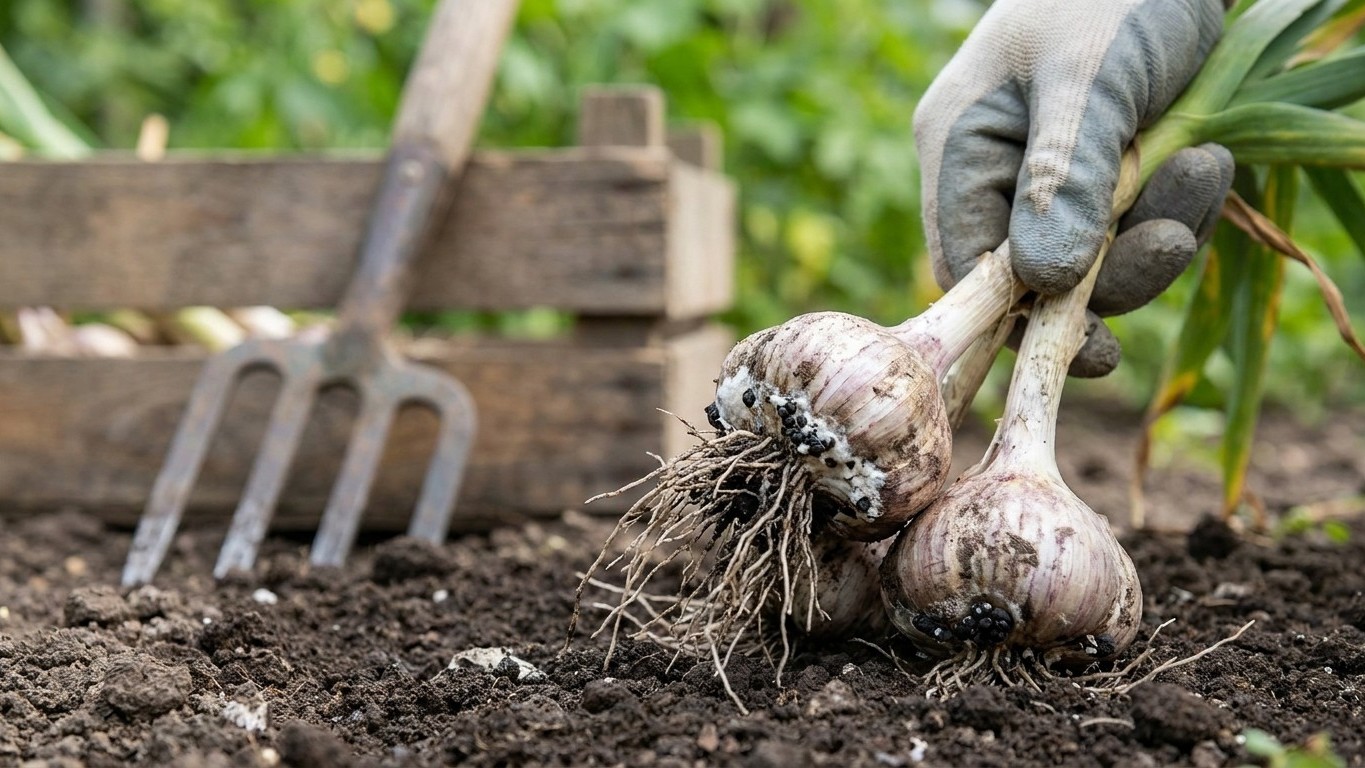

White rot in garlic does not go away once it shows up. The fungus behind it, Sclerotium cepivorum, produces sclerotia that UC IPM’s Onion and Garlic guidelines (UC ANR Publication 3453) say can survive in soil for more than 20 years, so a single bad batch of seed garlic can make a bed unusable for every allium you might want to grow there for the rest of your gardening life. Check any new planting stock for small black specks on the root plate before it goes in the ground, and never plant garlic, onion, leek or shallot in soil where you have had a confirmed case.
What you are looking at

The first thing most gardeners notice is a patch of garlic that looks off before the rest of the row does: leaves yellowing and dying back, then the whole plant wilting even though the soil is not dry and the season is not yet over. That combination, yellowing paired with leaf dieback and wilting that shows up out of sequence with the rest of the bed, is the first flag for white rot, though on its own it is not enough to confirm it.
What is happening at the base
Pull one of the affected plants and look at the base, where the roots meet the bulb. This is where the disease actually lives. The decay starts there, not in the leaves, and the leaves are simply reacting to a root system that has stopped working. On a plant far enough along, you will find fluffy white fungal growth wrapped around the base and lower roots. Within that white growth, and this is the detail that removes any doubt, sit numerous small, round, black sclerotia, embedded in the fungal mat or scattered loose in the soil clinging to the roots. Fluffy white mycelium studded with these black sclerotia is the confirming sign, and nothing else common in a home garlic bed produces that exact combination.
The pattern in the ground usually starts as a cluster, one or two plants going down together, then spreading outward to their neighbors as the fungus moves through the soil from root to root. That expanding-circle pattern, more than any single symptom, is often what makes an experienced grower suspect white rot before they have even dug up a bulb.
What it is not
Garlic yellows for plenty of reasons that have nothing to do with soil disease, and most yellowing you will see in an ordinary season is completely normal. Garlic naturally dies back as it approaches harvest, the lower leaves going yellow and then brown as the bulb finishes sizing. Uneven watering, a nitrogen deficiency, or simple heat stress will also turn leaves yellow, usually across the whole bed rather than in the isolated clusters white rot produces.
The discriminating detail is at the base, not the leaves. If you dig up a yellowing plant and the roots and root plate look clean, with no white fungal growth and no black sclerotia, you are not looking at white rot, whatever the top growth looks like. Nitrogen-deficient garlic has thin, pale leaves but a perfectly firm base. Drought-stressed garlic wilts but greens back up after a deep watering. Natural pre-harvest dieback happens on a predictable schedule across the whole planting, not as a spreading patch.
| Pattern | Likely cause | Where to check |
|---|---|---|
| Isolated cluster of plants yellowing and wilting, spreading outward | White rot | Base and roots: white mycelium, black sclerotia |
| Whole bed yellowing evenly, leaves thin and pale | Nitrogen deficiency | No base decay, roots intact |
| Lower leaves browning on schedule near harvest | Natural dieback | Bulb sized and firm |
| Rot and mold appearing after curing, not in the field | Storage rot (neck rot or blue mold) | Neck and clove tissue, not the field base |
Storage problems are worth ruling out separately, since they show up after the plant has already been lifted rather than while it is still growing. If trouble appears once bulbs are curing rather than in the field, you are more likely dealing with neck rot or blue mold, both of which start at or after harvest rather than at the root.
Where it comes from and when it strikes
White rot is caused by the soil fungus Sclerotium cepivorum, a pathogen that infects only alliums, garlic, onion, leek, shallot and their wild relatives. It does not arrive on the wind and it does not need an insect to move it. It arrives almost always in one of two ways: in soil clinging to tools, boots or transplants brought in from an infected site, or already present in a piece of seed garlic that came from an infected field, whether or not that garlic showed any symptoms when it was planted.
Once sclerotia are in the soil, whether they cause visible disease depends heavily on temperature, and this is where a lot of confusion sets in. UC IPM’s Onion and Garlic guidelines (UC ANR Publication 3453) put the range for disease development at 50 to 75°F, with an optimum between 60 and 65°F, and note that development is markedly inhibited above 78°F. Those figures are soil temperature, not air temperature, and the two can differ by a wide margin, especially under mulch or in the top few inches where garlic roots sit. Checking a weather forecast will not tell you whether conditions are right for the fungus. A soil thermometer pushed a few inches into the bed will.
This is also why white rot tends to show up during the cooler, damper stretches of the growing season rather than during the height of summer heat, and why a planting that looked fine through a hot spell can suddenly show symptoms once soil temperatures drop back into that range. The fungus does not need much encouragement once established. Even a single sclerotium near a root is enough to start an infection under the right conditions, which is part of why the disease is so difficult to dislodge once it takes hold in a piece of ground.
What to do about it now
Once a plant shows the white mycelium and black sclerotia at the base, there is no product or treatment that will cure it. There is no rescue treatment for a plant already showing symptoms, and spending money on a fungicide at that point is spending it after the fact. The realistic goal for this season is limiting how much sclerotia gets added to the soil, not saving the infected plants.
Pull affected plants as soon as you spot them, roots and all, lifting them with as much of the surrounding soil intact as possible rather than shaking soil back into the bed. Do not compost anything from an infected plant, including the soil clinging to it. A home compost pile rarely reaches temperatures capable of killing sclerotia, and adding infected material to it will spread the problem to every bed that pile is ever used on. Bag the plants and the soil that came up with them and put it in the trash rather than the garden waste bin.
Clean tools and boots before moving to another part of the garden, since sclerotia move in soil far more easily than most gardeners expect. A trowel used to dig up an infected plant, then wiped on a pant leg and used elsewhere, is a plausible way to spread the fungus to a bed that was previously clean. Mark the affected area clearly so you remember not to plant any allium there next year, and note it somewhere more permanent than memory, since the consequences of forgetting last for decades rather than one season.
Keeping it out of your garden
The most effective control available to a home gardener happens before anything goes in the ground: start with clean seed garlic. Buy from a supplier who can speak to the disease history of their stock, and inspect every bulb before planting, looking for the same white mycelium and black sclerotia described above, especially around the root plate and in the wrapper layers near the base. A bulb from a garden or farm with a known history of white rot is not worth planting no matter how good it looks otherwise.
After clean stock, the next most useful tool is rotation, and the rule is stricter than most rotation advice you’ll read for other crops. Never follow garlic with any other allium, onion, leek, shallot or garlic again, in the same ground, and extend that rotation as long as your space allows. This matters more for white rot than almost any other garlic problem, because of how long the pathogen persists. UC IPM’s guidelines note that sclerotia can survive in soil for more than 20 years, waiting for a host root to trigger germination. A rotation measured in a couple of seasons does essentially nothing against a pathogen with that kind of staying power. Treat any bed with a confirmed case as retired from alliums for the rest of your gardening life, not just for a few years.
What is not realistic for a home garden
Commercial growers facing white rot sometimes turn to soil fumigation or deep ploughing to bury sclerotia below the depth garlic roots reach, and some use hot-water treatment of seed cloves to kill sclerotia riding on the outside of the bulb. That last option has a real limit worth knowing even if you never plan to use it: treatment hot enough to kill the fungus, above 120°F according to UC IPM’s guidelines, also kills the garlic itself, which leaves very little margin for error and is not something to improvise in a home kitchen. Fumigation and field-scale ploughing are simply not tools available to a backyard grower. For a home garden, prevention through clean stock and strict rotation is not the fallback option, it is the whole strategy, since garlic diseases in general are far easier to keep out than to remove once established, and white rot is the clearest example of why that is true.
Common questions
Can I still eat garlic that had white rot?
Bulbs from an infected planting are not toxic, but they are usually undersized, poorly filled and often partly rotted by the time you notice the disease, so most of what you dig up will not be worth keeping. Do not save any of it as seed garlic, even bulbs that look clean, since sclerotia can be present without visible symptoms on every plant in an infected patch.
Will crop rotation eventually get rid of white rot?
Not on any timeline a home gardener can plan around. Sclerotia surviving over 20 years in soil, per UC IPM, means a rotation of a few years barely dents the population, and the safest assumption is that an infected bed stays infected for the rest of your time gardening that plot.
Does raised bed soil or potting mix protect against white rot?
Fresh, uncontaminated soil in a raised bed is genuinely safer, since the fungus has to arrive from somewhere, either in soil that gets tracked in or on infected seed garlic. The risk is not the raised bed itself, it is what you fill it with and what you plant in it, so the same rules about clean seed stock apply even in a brand new bed.
How do I know if my soil already has it before I plant?
There is no simple home soil test for sclerotia. The practical answer is watching the previous history of the ground: if alliums have grown there before without any sign of the base decay and sclerotia described above, that is reasonable evidence, though not a guarantee, that the site is clean. Check with your state extension service if you want guidance on soil testing options in your area.