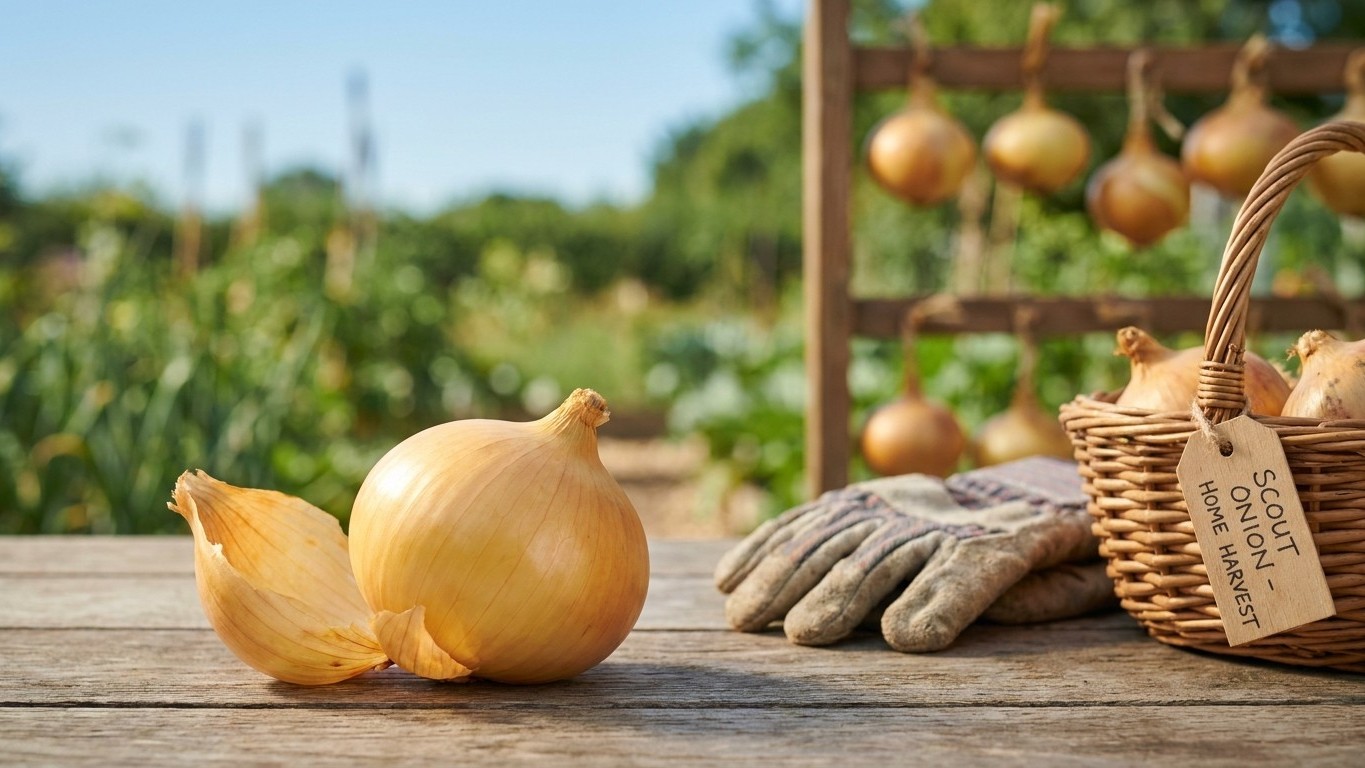

Scout is an intermediate-day yellow onion that bulbs reliably between roughly 32 and 46 degrees north latitude, matures in about 107 days from transplant, and cures into one of the longest-keeping onions a home grower can put in storage. Outside that latitude band, it won’t just bulb small, it may not bulb at all. Here’s what that means for your garden, your planting calendar, and your root cellar.
Will Scout bulb where you are

Scout falls into the intermediate-day group, which means it needs somewhere between 12 and 14 hours of daylight to switch from growing leaves to building a bulb. That trigger point places its working range at 32 to 46 degrees north latitude, a band that covers most of the country’s middle tier, from around the Georgia-Tennessee border up through the Great Lakes states and into the northern Rockies.
The mechanism matters more than most gardeners assume. Bulbing in onions isn’t a response to heat or soil temperature. It’s a response to how many hours of light the leaves receive each day. That’s counterintuitive, because the far north actually gets more daylight hours during the growing season than the Gulf Coast does. It’s why long-day onions are the ones planted in Minnesota and Maine, short-day onions belong in Texas and Florida, and intermediate-day types like Scout occupy the middle ground, where day length during the growing season lands in that 12-to-14-hour window at the right time.
Plant Scout well south of 32 degrees, and the days may never lengthen enough during the growing season to flip the bulbing switch. The plant keeps producing leaves, the season runs out, and what’s left in the ground is a swollen stem base at best, not a cured, storable bulb. Plant it well north of 46 degrees, and the trigger can arrive before the plant has built enough leaf mass, leaving a bulb far smaller than the variety is capable of.
If you’re near the edge
Gardeners around 30 to 32 degrees north, or up near 46 to 48 degrees, sit in a blurred zone. The latitude bounds for intermediate-day onions describe a continuum, not a hard line, and local conditions, an early spring, a mild fall, microclimate around a south-facing bed, can shift results in either direction. Don’t take a location a few degrees outside the range as an automatic yes or no. Treat it as worth a trial planting before committing a full bed to it.
What Scout is like
Scout produces a yellow onion, ready roughly 107 days after transplanting, with flesh described as pungent and firm. That combination of words tells you exactly what to expect at the cutting board and in the pantry.
The pungency and the firmness are not separate traits. They come from the same source: sulfur compounds concentrated in the bulb’s cell walls. Those compounds are what make your eyes water when you slice into a sharp onion, and they’re also what make the bulb resistant to the bacteria and fungi that cause rot in storage. A mild, sweet onion has thinner cell walls and far less of that sulfur chemistry, which is exactly why sweet varieties taste pleasant raw on a sandwich but soften and spoil within weeks of harvest. Scout sits at the other end of that spectrum. It won’t be the onion you want raw in a salad, but it’s the one that survives a Midwest winter in a cool, dark closet.
Where it earns its keep in the kitchen
Cooking changes the equation. Heat breaks down those sharp sulfur compounds, converting pungency into the deep, rounded sweetness that shows up in caramelized onions, braises, and long-simmered soups. A firm, pungent yellow onion like Scout holds its shape through sautéing better than a soft, high-moisture sweet variety, and its flavor deepens rather than disappearing when it hits a hot pan. Among the three onion colors, yellow onions consistently keep the longest in storage, which is the reason they’re the color worth curing and setting aside for winter use, while milder red and white varieties are usually best eaten within the season they’re grown.
When to plant it
Planting timing for onions follows day length, and that means the calendar shifts depending on where you live, which trips up a lot of first-time growers who assume every onion goes in the ground at the same time everyone else’s tomatoes do.
Short-day onions are planted in the fall across the mild-winter South and harvested the following late spring, using the region’s warm winters to build leaf growth before the shorter days of that latitude trigger bulbing. Long-day onions go in during late winter to early spring across the northern tier, racing to grow before the long summer daylight hits. Scout, as an intermediate-day type, follows the pattern used across the middle latitudes: transplants go into the ground in late winter to early spring, giving the plant a stretch of cooler weather to establish roots and leaves before the day length climbs into that 12-to-14-hour bulbing range.
The size test that matters more than the date
A planting date on a calendar is a rough guide. The real benchmark is leaf growth. Onion bulb size is set largely by how much top growth the plant has built by the moment day length triggers bulbing, not by anything that happens afterward. A plant with four or five healthy leaves when the trigger hits will bulb up much larger than one with two spindly leaves, because the bulb essentially forms from stored energy in those leaf bases. That’s the practical reason to get transplants in early and growing strong well before the solstice stretch of long days arrives, rather than waiting for a specific weekend on the calendar.
Growing it well
Onions have shallow, sparse root systems, and they compete poorly against anything else growing nearby. That’s not an abstract warning, it shows up directly in bulb size. A bed choked with weeds or allowed to dry out between waterings doesn’t produce onions that struggle a little. It produces onions that stay noticeably smaller than the variety’s potential, because the plant simply can’t pull enough water and nutrients through those thin roots once something else is competing for the same shallow soil zone. Keeping the bed clean and evenly moist through the growing season is the single most direct lever a home gardener has over final bulb size.
Bolting is the other issue worth watching for. A cold snap after transplanting, or a stretch of stress from drought or crowding, can push an onion plant to send up a flower stalk instead of focusing on the bulb. A bolted plant will still often size up, but the bulb won’t cure or store well, since energy that should have gone into building storage layers went into the flower stalk instead. Any plant that bolts should be flagged for the kitchen, not the storage shelf. Pull and use those onions first, while the rest of the crop continues maturing toward harvest.
Harvesting and keeping it
The plant tells you when it’s ready. As Scout approaches maturity around that 107-day mark from transplant, the green tops start to yellow, weaken at the neck, and eventually flop over on their own. That fall-over is the signal to harvest, not a specific date circled on the calendar, since actual timing shifts year to year with weather and planting conditions. Once most of the tops in a bed have gone down, it’s time to lift the bulbs.
Curing is the step that separates onions that last through winter from onions that rot in the bin by Thanksgiving, and it’s the step most home gardeners skip or rush. After pulling, bulbs need to sit somewhere warm, dry, and well-ventilated, out of direct sun, until the outer skins papery and the neck where the leaves attach dries down tight and brittle. That papery neck is doing the same job the sulfur compounds do inside the flesh: sealing out the moisture and organisms that cause storage rot. Skip curing, or store onions with soft, green necks, and even a naturally long-keeping variety will spoil early.
Done right, a firm yellow onion like Scout is built for the long haul rather than quick use. That’s the practical payoff of its pungency: a properly cured batch can carry a household’s onion supply well past the growing season, into the months when nothing fresh is coming out of the garden, while the milder red and white onions from the same bed get eaten first simply because they won’t hold as long.