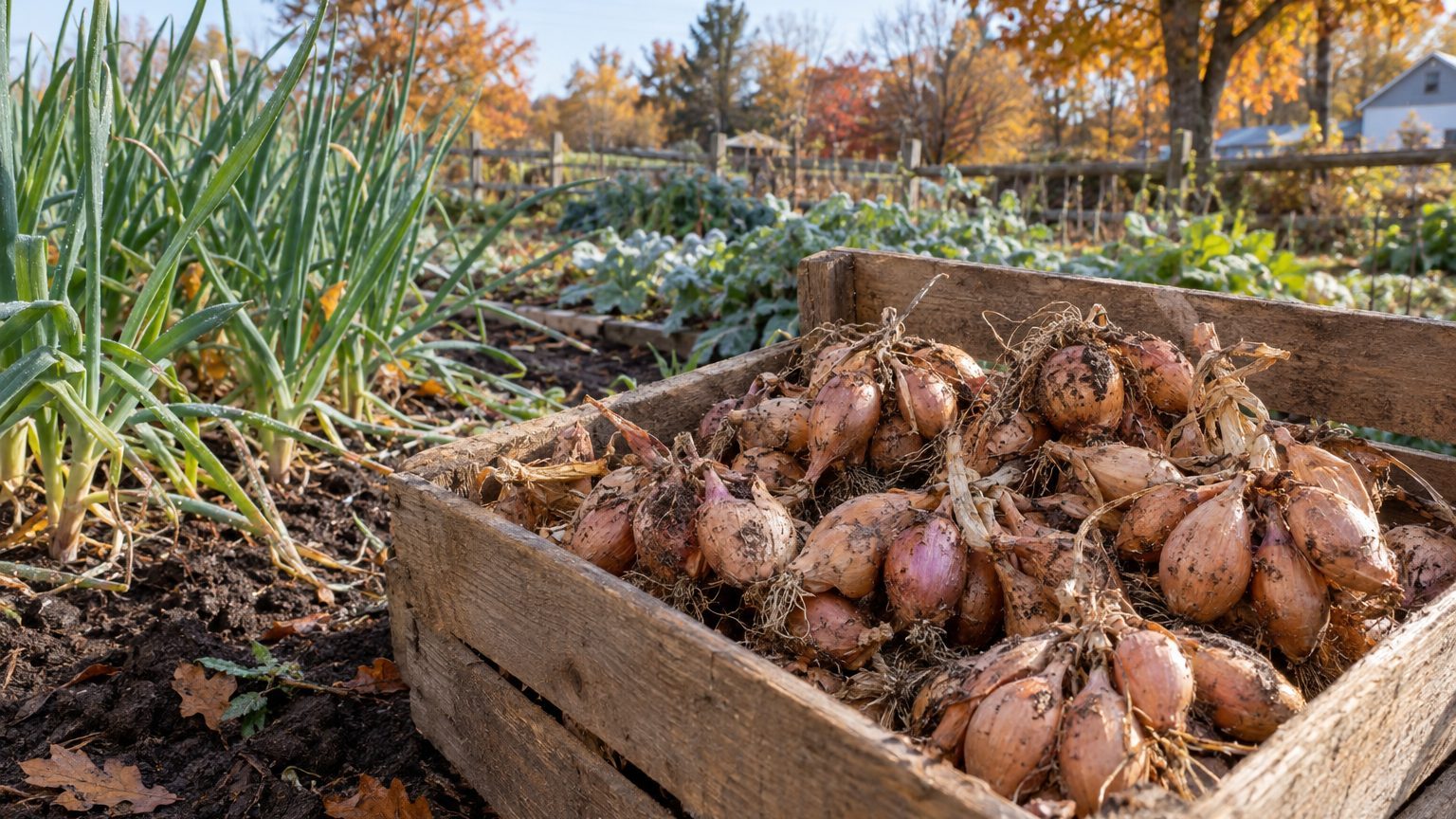

For most Illinois gardens, the best shallots are multiplier types grown from bulbs and planted in fall, with spring-planted bulbs as the fallback. Seed-grown shallots also work, but they demand more of your calendar. The state spans hardiness zones 5a to 7b, so the right pick in Rockford is not automatically the right pick in Cairo. Below: the types sorted, what fails, and where the final call belongs.
The short answer for Illinois
Choose multiplier shallots from bulbs, and plant them in fall if you can. The reference numbers come from the Chicago airport station in NOAA’s 1991-2020 normals: a last spring frost between April 11 and April 22, and a first fall frost between October 24 and November 3. Those dates are a probability, not a promise. They mark the band where the odds of a 32°F freeze run between 30% and 70%. A garden outside the city limits usually sees its last spring frost later and its first fall frost earlier, often by one to two weeks.
Why does that favor fall bulbs? Shallots size up as days lengthen and the weather warms. A bulb set in the ground the previous autumn grows roots in cool soil and has leaves ready when spring arrives. A plant that starts late has fewer leaves when the bulbing signal comes, and bulb size follows leaf count. Winter is the only cost. The coldest month in Chicago has a mean daily minimum of 18.8°F, which is cold enough that mulch matters but not cold enough to rule out fall planting around Chicago.
Here is how the three realistic options compare. Exact planting dates for each are on When to Plant Shallots in Illinois.
| Type | When it goes in | Fit for Illinois | Main risk |
|---|---|---|---|
| Multiplier bulbs, fall-planted | Autumn, before the ground freezes | Best overall; the longest growing runway | Winter heaving in the north without mulch |
| Multiplier bulbs, spring-planted | As soon as the soil can be worked | Reliable fallback | Summer heat arrives before bulbs are big |
| Seed-grown shallots | Started indoors, transplanted around the spring frost window | Workable for gardeners who like starting seedlings | Slow start, more handling, tighter timing |
Within each type, read the seller’s notes on days to maturity and storage. In a humid state like Illinois, a type described as a good keeper beats one prized only for size. This page does not name specific cultivars, because the facts it relies on are climate figures, not variety trials. For named varieties that have actually been grown in your region, see the extension advice further down.
What will not work here
The window between spring and fall frost is generous by northern standards, so the failures here are less about running out of season than about when the season is spent. Shallots planted in May, after the soil has already warmed, get only a few weeks of cool growth before heat pushes them toward bulbing. The result is small, often single bulbs rather than a clump of several. That is the main weakness of late spring planting in Illinois.
Seed-grown shallots punish a slow start in the same way. If seedlings are not ready to move outdoors by the time the frost window above has passed, the plants run into June with little foliage. A seed-grown shallot is a project that begins in winter on a windowsill, not a spring afterthought.
Humidity is the second failure point. Illinois summers are muggy, and much of the central part of the state has heavy, slow-draining soil. Shallots packed closely, say a few inches apart to squeeze in more clumps, hold moisture around the necks and leaves. That invites rot and foliage disease just as the tops start to die back. Give each bulb about 6 inches, and put the bed on a raised mound or ridge if your soil stays wet after rain.
Winter is the third. In the northern part of the state, an 18.8°F mean daily minimum in the coldest month (Chicago normals) means repeated freeze and thaw. Bulbs planted bare, with no mulch, can be pushed up out of the soil. A layer of straw or shredded leaves after the ground starts to freeze prevents most of that. Pull it back in spring as shoots appear.
Last, a few smaller traps:
- Grocery-store shallots as planting stock. You do not know the variety or its history, and it may not suit your region.
- Curing in a damp garage. Harvested bulbs need airflow and shelter from rain, or the necks stay wet and rot in storage.
- Treating airport frost dates as your own. A rural garden can run one to two weeks off those figures, more at elevation.
What changes across Illinois
Illinois is not one garden. The USDA Plant Hardiness Zone Map (2023 edition, built on 1991-2020 normals) places the state anywhere from zone 5a to 7b. That is six half-zone steps, from a cold northern winter to a mild southern one. The zone system rests on a single variable, the average annual extreme minimum temperature, so it says nothing about summer heat, humidity or soil. There is no single answer for the whole state, and the Chicago numbers above are one reference point, not the average of all of Illinois.
If you garden in the north
Zone 5a and 5b gardens face the harshest winters, so fall planting here depends on mulch. Plant early enough for roots to establish, not so early that tops grow tall, and cover the bed once the soil begins to freeze. The spring frost window is also later in practice, which pushes everything in a spring-planting schedule back. Hardy multiplier types from bulbs are the safe choice. Seed-grown shallots deserve a second thought here, since the outdoor start comes later still.
If you garden in the south
Toward zone 7, winters are gentler, so fall planting is easier and mulch is more about moisture than survival. The trade-off is heat: warm weather arrives sooner, which squeezes spring-planted shallots even harder, and humid summers raise disease pressure. Fall planting is the stronger case in the south, and spacing and airflow matter more. If you plant in spring, aim to get bulbs in the ground at the first workable opportunity.
Don’t guess your own zone from a state map or a neighbor’s memory. Look up your ZIP code on the USDA Plant Hardiness Zone Map and read the zone there. The Growing Shallots in Illinois guide covers the full season once you’ve chosen a type.
Where to check this for your own county
The best source for your specific location is University of Illinois Extension, the state’s land-grant extension service, which staffs offices across the state and runs the Master Gardener program. A county recommendation beats a state one every time. This page is the state one: it works from a single reference station and a six-step zone range, so it can tell you which type to lean toward, but it cannot tell you what happens on your soil.
When you get there, look for two things. The first is a local planting calendar for onions, garlic and shallots, ideally one written for your county or region. The second is any variety trial results: which shallot types were actually grown in nearby test plots, how they stored, and how they handled wet years. Master Gardener volunteers and county educators often know which cultivars have done well locally, and they hear about failures that no state guide records.
This page does not have an Illinois-specific shallot calendar from extension in its facts, and it will not borrow a calendar from another state or another crop to fill the gap. A lawn calendar from a southern state, for example, answers a different question. If the extension site has no shallot-specific page, an onion or garlic calendar for your county is the nearest substitute. Treat it as a guide, not a rule, and use the observations in the next section to adjust.
Checking this against your own garden
Dates on a page, including the ones here, rank below what your own yard shows you. Three observations are worth making, and none needs equipment.
Start with soil warmth by feel. In spring, a handful of soil that crumbles instead of clumping into a wet ball is ready to work, and soil that feels cold and sticky on your palm is not. Compare spots: a south-facing bed against a shaded corner. If one warms days before the other, you have two microclimates, and shallots belong in the earlier one.
Next, watch for the first green shoots. For fall-planted bulbs, the first true leaves breaking the surface in late winter or early spring tell you the plants have woken and survived. If they emerge weeks apart across your beds, the later ones sit in colder or wetter ground. Seedlings follow the same logic: the first true leaves, not the grassy first spike, are the sign they are ready to be hardened off and moved.
Finally, note where frost lingers. On a clear, cold morning, walk the yard and see where white frost stays longest on the grass. Low spots hold cold air, and a bed there will behave as if you were a week or two further north than the airport figures suggest. Write down what you see for a season or two. That notebook will tell you more than any zone map about when your shallots should go in.
Common questions
Can I grow shallots from seed in Illinois?
Yes. The frost window allows it, but seed-grown shallots need to be started indoors well before the last spring frost and moved out in time to build foliage before summer heat. Bulb-grown multipliers are simpler and more forgiving.
Should I plant shallots in fall or spring in Illinois?
Fall gives the strongest start for most gardens, provided you mulch against winter heaving. Spring planting works as long as bulbs go in as soon as the soil can be worked. The exact timing is on the planting calendar page.
Will shallots survive an Illinois winter?
Mulched bulbs generally do. The Chicago reference figure for the coldest month is a mean daily minimum of 18.8°F, and the state ranges from USDA zone 5a to 7b. The northern end needs the most protection from freeze and thaw.
Can I plant shallots from the grocery store?
You can, but results are unpredictable. You will not know the variety, how well it suits Illinois, or whether it carries disease. Bulbs sold specifically for planting, with maturity and storage notes, are the safer choice.