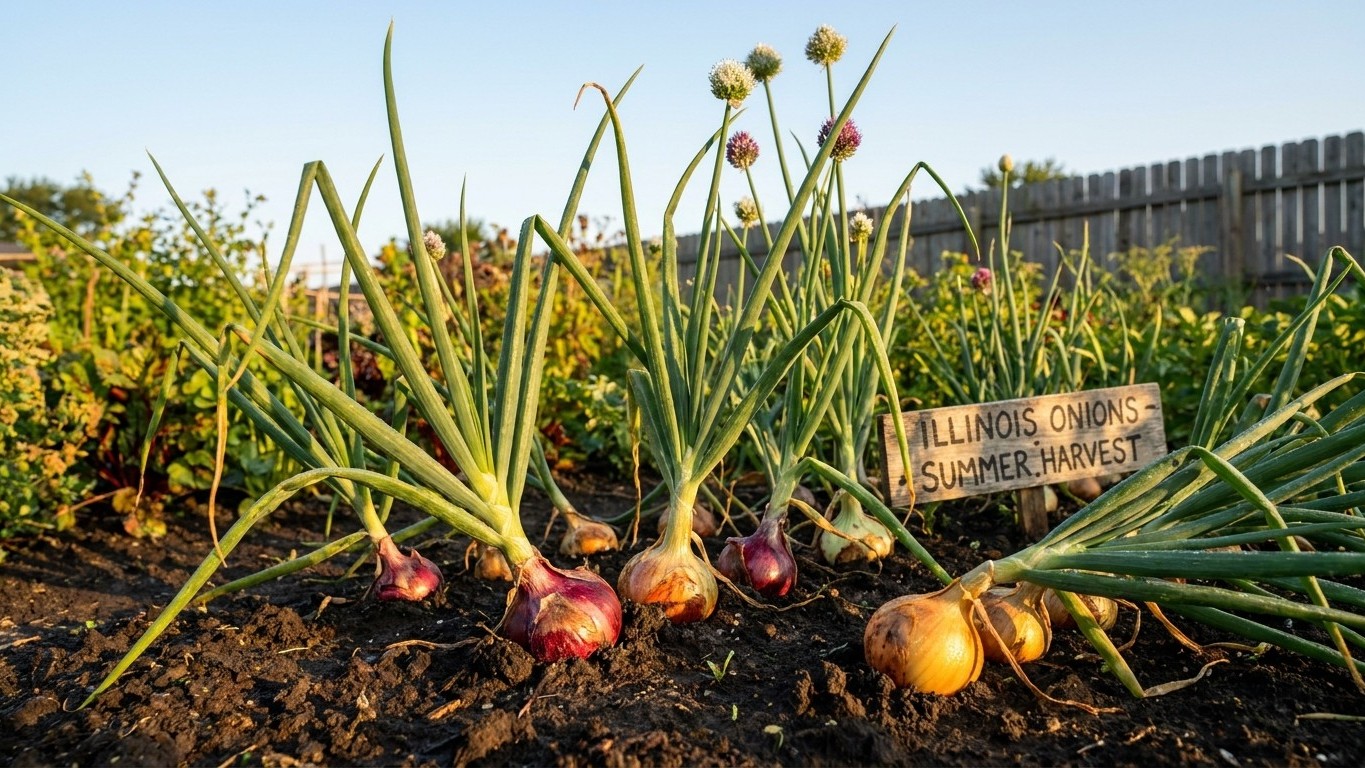

At Illinois’s reference latitude of 41.99 degrees north, the longest day of the year brings 15 hours and 4 minutes of daylight. That number decides everything for onions, because bulbing starts on a day-length trigger, not a temperature one. For most of Illinois, that means long-day and intermediate-day onions are the varieties that will actually form bulbs. Short-day types are built for a different sun angle entirely, and they don’t belong in an Illinois garden.
The short answer for Illinois

Onions read the calendar through their leaves, not the thermometer. A bulb starts forming once daylight reaches a variety’s trigger length, and everything the plant does after that point goes into the bulb rather than more leaf growth. At 15 hours and 4 minutes of daylight on the solstice, Illinois sits squarely in long-day country, with intermediate-day varieties also getting enough light to finish the job before the season turns.
Nineteen of the varieties documented for this territory have a published range that covers 41.99N. On the long-day side, that includes Ailsa Craig, Barolo, Blush, Bridger, Frontier, New York Early, Patterson, Red Carpet, Rossa di Milano, and Walla Walla Sweet. On the intermediate-day side, which bulbs a bit earlier in the season on somewhat less daylight, Illinois gardeners can grow Cabernet, Calibra, Elsye, Expression, Monastrell, Red Long of Florence, Red Long of Tropea, Scout, and Sierra Blanca.
Four more varieties sit right at the edge of their published range at this latitude: Powell, Redwing, Safrane, and Talon. All four are long-day types whose catalogue bounds start around 42 to 43 degrees north, so 41.99 lands them in a blurred zone. They may bulb reliably in an Illinois garden, but a reader growing them should treat the result as a test rather than a guarantee, and should watch closely rather than assume success the way they would with a variety squarely inside its range.
The practical takeaway is that Illinois growers have a wide bench to choose from, spanning red, yellow, and sweet types across both day-length groups. The variety decision here is less about whether an onion will bulb at all and more about what the gardener wants out of the harvest: something to eat fresh in August, or something that will still be good in a March stew.
What will not work here
Short-day onions are the wrong tool for this latitude, and the failure mode isn’t subtle. A short-day variety is bred to start bulbing once daylight hits roughly 12 hours, a threshold that Illinois clears by early spring, long before the plant has built enough leaf mass to make a decent bulb. The result isn’t a smaller onion. It’s often barely a bulb at all, sitting under a plant that spent the whole season growing tops it never got to use.
Five varieties on this site’s list carry published ranges that sit entirely below Illinois’s latitude, which means they’re built for southern gardens, not this one:
- Candy (intermediate-day, 33-40N): triggers well south of Illinois’s daylight profile, so it bulbs too early here and stays undersized.
- Gabriella (short-day, 20-35N): a Gulf Coast and Deep South variety; the 12-hour trigger arrives here while the plant is still small.
- Madalyn (short-day, 20-35N): same short-day mismatch, better suited to far southern winters.
- Red Rock (short-day, 30-36N): bulbs on cue in the Gulf states, not in Illinois’s longer summer days.
- White Castle (short-day, 30-38N): its range tops out well south of Illinois’s reference latitude.
None of this is a soil problem or a feeding problem. It’s a variety mismatch, and no amount of fertilizer fixes it. A short-day onion planted in Illinois will spend the season making leaves, hit its trigger early, form a small bulb prematurely, and then often rot in the ground or in storage because the bulb never matured properly before the plant’s energy ran out. Skip the short-day aisle entirely if you’re gardening anywhere in this state.
What changes across Illinois
Illinois is a long state, running from roughly 42.5 degrees north at its Wisconsin border down to around 37 degrees north at its southern tip near the Ohio and Mississippi confluence. The 41.99-degree figure used throughout this guide comes from the Chicago-area weather station, which sits close to the state’s northern edge, not its geographic middle.
That gap matters for anyone gardening south of the Chicago area. A grower near Springfield or Carbondale is working with noticeably less daylight on the summer solstice than a grower near the Wisconsin line, and a shorter, milder winter to go with it.
| Location | Approx. latitude | Longest-day daylight | What changes |
|---|---|---|---|
| Chicago area (reference) | 41.99N | 15h04 | Long-day varieties bulb comfortably; intermediate-day types finish early in the season |
| Southern Illinois (near Cairo) | ~37N | Meaningfully less than 15h04 | Intermediate-day varieties still bulb reliably; short-day types like Candy move closer to their published range |
The practical effect is that a gardener in the far south of the state has a bit more room to experiment with earlier-triggering intermediate-day onions and should treat the long-day recommendations above as a northern-Illinois baseline rather than a statewide rule. Someone near the Wisconsin border, on the other hand, is squarely in long-day territory and should lean toward the varieties with the widest published range above 42 degrees, since they have the least margin for error if a cool spring delays growth.
Anyone gardening near either edge of the state, rather than near Chicago itself, should treat their own latitude as the real reference point, not the one used for this article.
Sweet now, or onions that last
Every onion variety asks a gardener to pick a side, and it isn’t really a matter of taste. It’s chemistry. The compounds that give an onion its sharp bite are volatile sulfur compounds, and those same compounds are what keep the bulb from breaking down in storage. A variety with fewer of them tastes milder and sweeter raw, but it has less natural defense once it’s off the plant. University of Missouri Extension puts the rule plainly: sweet onions do not store as well as the more pungent types.
Day length ties into this directly. Short-day varieties, which run sweeter as a group, are grown for eating soon after harvest rather than for a pantry that needs to last through winter. Illinois’s long-day and intermediate-day varieties tend toward the sharper, more pungent end of that spectrum, which is exactly why they’re suited to this state in the first place. A variety like Walla Walla Sweet trades storage life for a milder bite, while a red or yellow storage type built for long-day country will hold up through winter but never taste as mild raw.
The result is a real fork in the road for anyone planning a harvest. Pick varieties leaning sweet, and the reward is a better onion on a summer sandwich, at the cost of a pantry that’s empty of onions by December. Pick the sharper storage types more typical of this state’s day-length group, and the March version of the same gardener is pulling a firm, usable onion out of a mesh bag, even if it was never the mild kind to begin with. Most Illinois gardeners end up growing a bit of both: a sweeter type for the first weeks after harvest, and a pungent long-day or intermediate-day variety set aside specifically for the bag that has to make it to spring.
Checking this against your own garden
Every figure in this guide comes from one weather station near Chicago, and Illinois is too long a state for one number to describe every backyard in it. Before ordering seed or sets, a few quick checks are worth the ten minutes they take:
- Look up your own latitude if you garden well north or south of the Chicago area, since a few degrees can shift which day-length group actually suits you.
- Confirm your local last-spring and first-fall frost dates, since those set your actual planting window, not just the day-length calculation.
- Call your county extension office and ask which onion day-length group they recommend for your specific county, since Illinois State’s own extension network tracks this county by county.
- If you’re growing a variety from the blurred-zone list, such as Powell, Redwing, Safrane, or Talon, plan to watch it closely in its first year rather than assuming it behaves like a variety squarely inside its range.
- Note your own soil warm-up timing in spring, since a late thaw can shift your effective planting date even if the calendar date stays the same.
A guide built around one station gets a gardener most of the way there. The last few miles, the ones specific to a particular yard, still belong to the person standing in it.