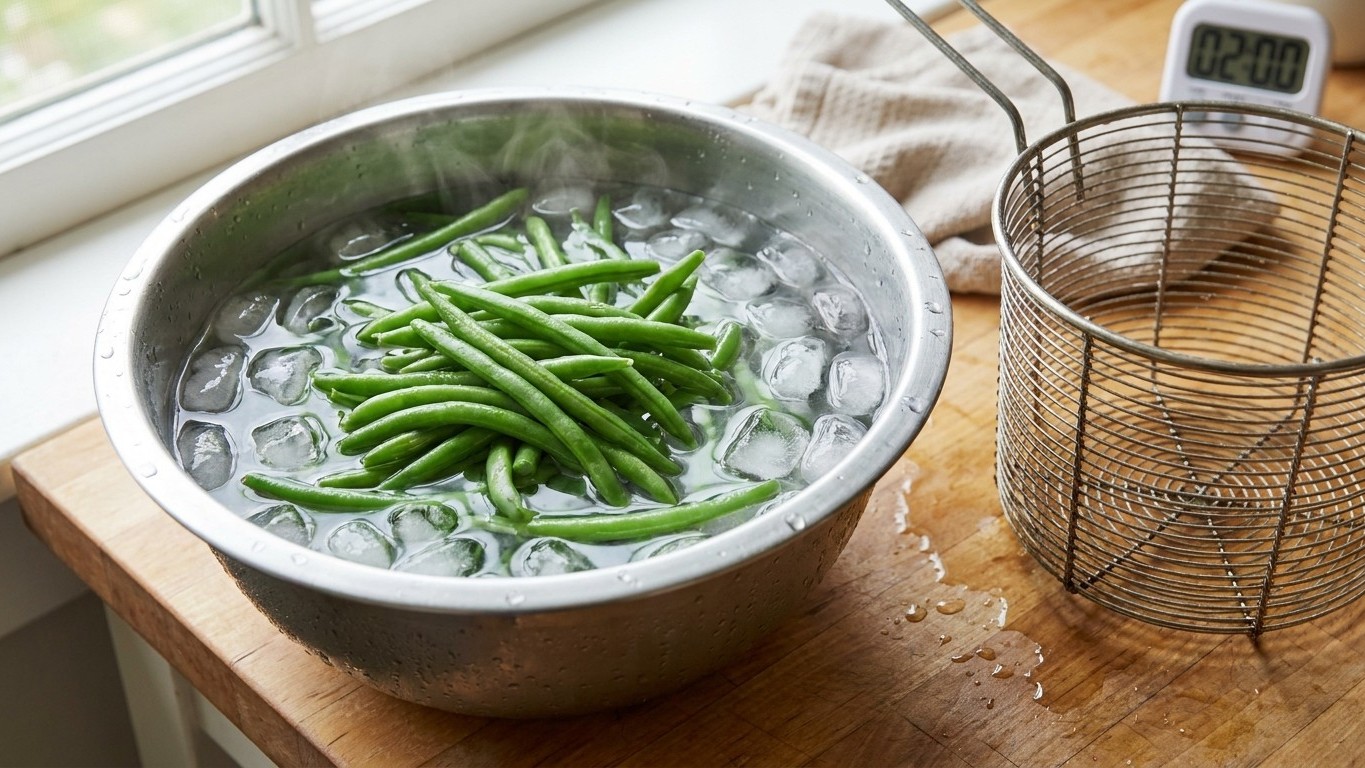

Cooling after blanching takes exactly as long as the blanching itself did. That’s the figure the National Center for Home Food Preservation gives, and it’s the half of the process most home cooks skip past, dropping vegetables into cold water for a few seconds before rushing to bag them for the freezer. Skimping here undoes the work blanching just did.
The short answer

The National Center for Home Food Preservation, based at the University of Georgia, is direct about this: cool vegetables at once in a large quantity of cold water at 60 F or below, and keep them there for as long as the blanching step took. Not a rough guess, not “until they feel cool.” The same duration, water for water, minute for minute.
Blanching itself exists to stop enzyme activity that would otherwise cost you flavor, color and texture over months in the freezer, and it also removes surface dirt and microorganisms and slows the vitamin loss that starts the moment a vegetable is harvested. But blanching is a heat treatment, and heat doesn’t stop the instant you lift the basket out of the pot. That’s what the cooling step is for, and it’s why the NCHFP treats it as inseparable from blanching rather than an afterthought.
Here’s the part that surprises people: underblanching is worse than no blanching at all, because a short, weak dose of heat stimulates enzyme activity instead of shutting it down. Skipping blanching leaves enzymes at their normal pace. Half-blanching kicks them into a higher gear, and that faster-acting enzyme keeps working during storage. So the instinct to blanch “a little” to save time or preserve nutrients backfires in exactly the way people are trying to avoid.
Overblanching has its own cost. Push vegetables through hot water or steam longer than needed and you start cooking them, losing flavor, color, vitamins and minerals in the process. The tested times published by the NCHFP for each vegetable exist precisely to land in that narrow window: long enough to disable the enzymes, short enough to leave the vegetable’s nutritional and sensory qualities intact.
Cooling sits on the other side of that same window. If blanching is measured in minutes to hit a precise target, cooling deserves the same discipline. Rushing it, or dunking vegetables in a small bowl of water that warms up after the first batch, means the vegetable keeps cooking on residual heat long after you’ve decided the job is done.
What actually decides it
Two separate mechanisms are running whenever you blanch and cool anything, and understanding both means you can reason through any vegetable, or even any food.
Residual heat and carryover cooking
A vegetable pulled from boiling water or steam is still hot all the way through, and that heat doesn’t vanish the moment it leaves the pot. It keeps moving from the center of each piece toward the surface, and if the surface is warm rather than cold, the vegetable keeps cooking. This is the same carryover effect that makes a roast continue rising in temperature after it’s out of the oven. The only way to stop it fast is to drop the internal temperature quickly, which is why the water needs to be genuinely cold (60 F or below) and plentiful. A small amount of water absorbs heat from the vegetables and warms up within moments, at which point it stops doing its job even though it still looks cold to the eye. Volume matters as much as temperature.
Density and piece size change how long that carryover lasts. A thick chunk holds and releases heat more slowly than a thin slice, which is one reason the tested blanching times differ so much from one vegetable to the next, and why the cooling time is tied to the blanching time rather than to a fixed number: a vegetable that needed longer in the heat also needs longer to shed that heat afterward.
Why freezing can’t undo a mistake
Freezing does not sterilize. It stops whatever is already present in its tracks, whether that’s an enzyme reaction, bacterial growth, or heat still traveling through a piece of squash. If cooling was rushed and the vegetable was still warm, or still enzymatically active, when it went into the freezer, that state gets locked in rather than corrected. Freezer storage buys time, but it doesn’t rewind a step that wasn’t finished properly. That’s the single fact worth carrying into any food safety question involving a freezer: the cold doesn’t fix problems, it just pauses whatever condition existed the moment it took hold.
How to do it
- Set up a large container of cold water at 60 F or below before you start blanching, so it’s ready the instant the vegetables need it.
- Remove the vegetables from the boiling water or steam as soon as their tested blanching time ends.
- Plunge them immediately into the cold water rather than letting them sit or air-cool first.
- Keep them submerged for a length of time equal to how long they were blanched.
- Replace or refresh the cold water as needed so it stays at 60 F or below throughout the cooling period, rather than gradually warming as it absorbs heat from the vegetables.
- Drain the vegetables thoroughly once cooling is complete, before moving on to packaging for the freezer.
What goes wrong
- Cooling in too little water. A small bowl or pot absorbs heat from the vegetables and warms above 60 F within moments, at which point it stops cooling effectively even though it looks cold. Use a large quantity of water, and refresh it if you’re processing more than one batch.
- Stopping the cooling too soon. Pulling vegetables out after a quick dunk, well short of a time equal to the blanching itself, leaves residual heat still moving through each piece. Match the cooling time to the blanching time, not to how cool the vegetable feels on the outside.
- Assuming the freezer will finish the job. Freezing does not sterilize and does not stop carryover cooking that’s already underway. Whatever state the vegetable is in when it goes into the freezer, whether fully cooled or still warm in the center, is the state that gets held. Finish cooling completely first.
- Treating a short blanch as time saved. Underblanching stimulates enzyme activity rather than halting it, making it worse than skipping blanching altogether. Check the tested time for the specific vegetable on the National Center for Home Food Preservation site rather than shortening it to save a few minutes.
- Draining poorly before freezing. Vegetables that go into freezer bags still wet develop excess ice crystals and freezer burn faster. Drain thoroughly once the cooling period is finished, before packaging.
Where the exact figures come from
The National Center for Home Food Preservation (University of Georgia, nchfp.uga.edu) publishes the tested table for each vegetable, and that’s the source to check before freezing anything at home.
Using a figure you half-remember, or borrowing a time from a different vegetable because it looks similar, isn’t a shortcut worth taking. Underblanching leaves enzymes more active than doing nothing at all, and freezing won’t correct that mistake once it’s locked into the food. The tested times exist because someone measured what actually happens at each duration. That’s not a step to guess around.
Common questions
Does the cooling water need to stay exactly at 60 F the whole time?
The NCHFP specifies 60 F or below for the cold water used to cool vegetables. Since the water absorbs heat from the vegetables as they cool, refreshing it or adding more cold water during the process helps keep it within that range rather than letting it drift upward.
Can I cool several batches of vegetables in the same water?
Each batch releases heat into the water, so reusing the same water for multiple batches without refreshing it risks the water climbing above 60 F partway through, which slows cooling for later batches. Check the water and replace it as needed between batches.
What happens if I only cool the vegetables for half the blanching time?
The vegetable pieces are likely still carrying residual heat, meaning they continue cooking after you’ve decided the job is finished. That carryover cooking affects texture and can leave the enzyme-halting effect of blanching incomplete, since the enzymes near the center may not have been fully addressed by the shortened process.
Is it fine to skip blanching entirely for vegetables headed to the freezer?
Blanching stops the enzyme activity that costs flavor, color and texture during freezer storage, and also removes dirt and microorganisms while slowing vitamin loss. Skipping it isn’t the worst option, underblanching is, but it does mean accepting the enzyme-related decline blanching is designed to prevent. Check the National Center for Home Food Preservation’s guidance for the specific vegetable before deciding.