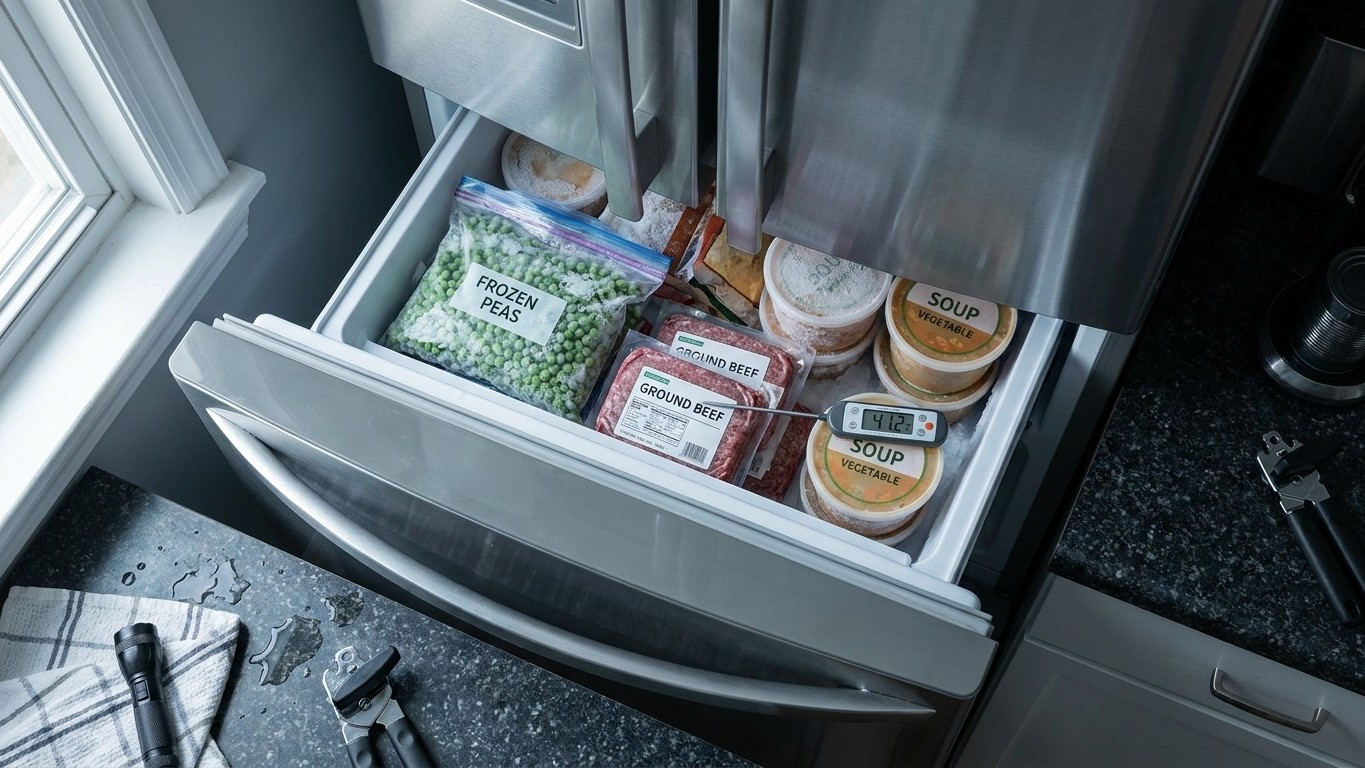

Food that still shows ice crystals and has stayed cold can usually go back into the freezer. Food that thawed all the way and sat too long has to be cooked right away, eaten now, or thrown out, following the guidance the National Center for Home Food Preservation publishes for that specific item. The deciding line has nothing to do with how the food looks. It’s about what happened to it, biologically, while the power was off.
The short answer

Here’s the fact that settles most of the confusion: freezing does not sterilize. It stops what is already there. A freezer doesn’t kill bacteria, mold spores, or the enzymes naturally present in vegetables and fruit. It just slows all of that activity down to nearly nothing. Cut the power, and the clock starts running again, at whatever pace the room temperature allows.
That single mechanism is why the National Center for Home Food Preservation, the research body most home cooks lean on for this kind of question, treats “can I refreeze it” as a case-by-case answer tied to the food category, not a blanket yes or no. A bag of peas behaves differently than a pound of ground beef, which behaves differently than a container of leftover soup, because each one carries a different risk once it warms up and a different rate of spoilage once it’s back in the cold.
What changes the answer isn’t how long the power was out in the abstract. It’s what that time did to the food: did ice crystals survive, meaning the item never got much above freezing? Did the item cross into a temperature range where microorganisms already present start multiplying? Those two questions point to two different outcomes, and no amount of eyeballing the food tells you for certain which one happened. Smell and appearance are late warning signs at best. Some of the organisms capable of making people sick produce no odor and no visible change at all, which is exactly why the guidance leans on freezer thermometers, timing, and documented behavior rather than a sniff test.
This page won’t hand you a specific number of hours or a specific temperature threshold for refreezing, because those figures are tested per food category and published on the National Center for Home Food Preservation’s site, not invented here. What it will do is walk through the mechanism driving the decision, so that when you check that resource for your own freezer full of items, you understand why the answer differs from one shelf to the next.
What actually decides it
Two separate processes are running inside every frozen item, and they don’t care about each other. One belongs to microorganisms. The other belongs to the food itself.
Microorganisms don’t need the freezer to multiply
Bacteria that were already present on raw meat, poultry, seafood, or in a cooked dish before it went into the freezer didn’t disappear when it froze. They went dormant. The moment the item’s temperature climbs back into a range where they can function, they resume growing, and they don’t need much time to do meaningful damage. This is the category where the stakes are highest, because some of the toxins these organisms produce survive cooking and give no warning through taste or smell. It’s also why the guidance for meat, poultry, seafood, dairy, and prepared meals is stricter and less forgiving than the guidance for most vegetables.
Enzymes never stopped working, they only slowed down
Vegetables carry their own built-in decay mechanism: enzymes that break down color, flavor, and texture whether or not any bacteria are involved. Blanching before the original freezing is meant to stop those enzymes cold, and it does something else useful along the way: it removes dirt and surface microorganisms and slows vitamin loss. But blanching has to hit a narrow target. Underblanching doesn’t just fail to stop the enzymes, it stimulates them, which the National Center for Home Food Preservation flags as worse than skipping blanching altogether. So a bag of vegetables that were only lightly blanched before freezing may already be carrying more active enzymes than one properly treated, and a power outage that lets them warm up even briefly gives those enzymes a head start they didn’t need. This is a quality problem more than a safety one for most vegetables, but it explains why two bags from the same freezer, both technically “still cold,” can come out of an outage in very different shape.
Apply that same logic to a food never mentioned here, say a container of homemade broth or a bag of frozen fruit, and the questions are the same: what organisms were present before freezing, and what internal chemical process was that item’s freezing meant to pause? Answer those two questions honestly and the refreeze decision mostly makes itself.
How to do it
- Check each item for ice crystals and firmness before touching anything else, since that’s the first physical clue about how warm it actually got.
- Sort the freezer’s contents into categories: raw meat, poultry and seafood; dairy and prepared meals; and vegetables or fruit, since each category carries a different risk profile.
- Set aside anything that shows signs of having fully thawed, rather than judging by touch alone on items buried deep in a stacked freezer.
- Look up the specific food on the National Center for Home Food Preservation’s site to confirm whether it falls into a refreeze-as-is category, a cook-then-freeze category, or a discard category.
- For vegetables you plan to cook rather than refreeze raw, cool them immediately afterward in a large quantity of cold water, keeping in mind that cooling takes as long as the initial heating step did.
- Drain and package anything you’re returning to the freezer promptly, rather than leaving it sitting at room temperature while you finish sorting the rest.
- Discard, without tasting, anything that the specific food’s guidance marks unsafe once it has thawed and warmed beyond the described point.
What goes wrong
- Assuming “smells fine” means “safe to refreeze.” Freezing never killed what was on the food to begin with, and some of the organisms capable of causing illness leave no smell at all. Judge by category and by how warm the item got, using the National Center for Home Food Preservation’s specific guidance, not by odor.
- Treating blanched vegetables as automatically low-risk during an outage. If the original blanching was too short, the enzymes inside those vegetables were stimulated rather than stopped, and a warm-up during a power cut gives them more time to keep degrading color and flavor. The vegetable may still be safe while tasting noticeably worse.
- Overcooking vegetables to “be safe” when re-processing them after an outage. Overblanching already costs flavor, color, vitamins and minerals, and stacking extra cooking time on top of that during an emergency doesn’t add safety, it just adds further quality loss. Cook only to the point the specific guidance for that food calls for.
- Rushing the cooling step if you choose to cook food before refreezing it. Cooling in a large quantity of cold water takes as long as the blanching or cooking step did. Cutting that short defeats the purpose of cooling quickly in the first place and leaves the food sitting in a temperature range where organisms can act.
- Applying one food’s rule to a different food. A rule that’s safe for a bag of corn doesn’t transfer to a container of stew or a package of chicken. Each category has its own tested guidance because the risks aren’t the same.
Where the exact figures come from
Nothing here states a specific number of hours, a specific temperature, or a specific quantity for any food, because those figures have to be tested per item and they differ for every food category. The National Center for Home Food Preservation, at the University of Georgia, publishes that tested guidance food by food, and it’s the resource to check before deciding what stays and what goes after an outage. Guessing at a figure, or borrowing one from a different food, is genuinely risky: some of the bacteria involved produce toxins with no taste and no smell, so a wrong number doesn’t announce itself before someone gets sick. When in doubt about a specific item in your freezer, look it up rather than estimate.
Common questions
Can I refreeze food that still has ice crystals in it?
Items that still show ice crystals generally never warmed up enough for microorganisms to become active again, which is the main condition the National Center for Home Food Preservation’s food-by-food guidance checks for. Confirm against the specific listing for that food before deciding.
Does a short power outage matter as much as a long one?
What matters is what happened to the food’s temperature, not the outage’s length in the abstract. A well-packed, mostly full freezer holds cold far longer than a half-empty one, so two households with the same outage length can face two different situations.
Are vegetables safer to refreeze than meat?
Vegetables mostly face a quality problem, enzyme activity degrading color, flavor and texture, rather than the bacterial growth risk that makes raw meat, poultry, seafood and dairy stricter categories. That doesn’t mean vegetables are automatically fine; it means the failure mode is different.
If a food looks and smells normal, is that enough to refreeze it?
No. Freezing doesn’t kill what was already on the food, and some organisms capable of making people sick leave no visible or detectable trace. Category and warming history, checked against the National Center for Home Food Preservation’s guidance for that specific food, matter more than appearance or smell.