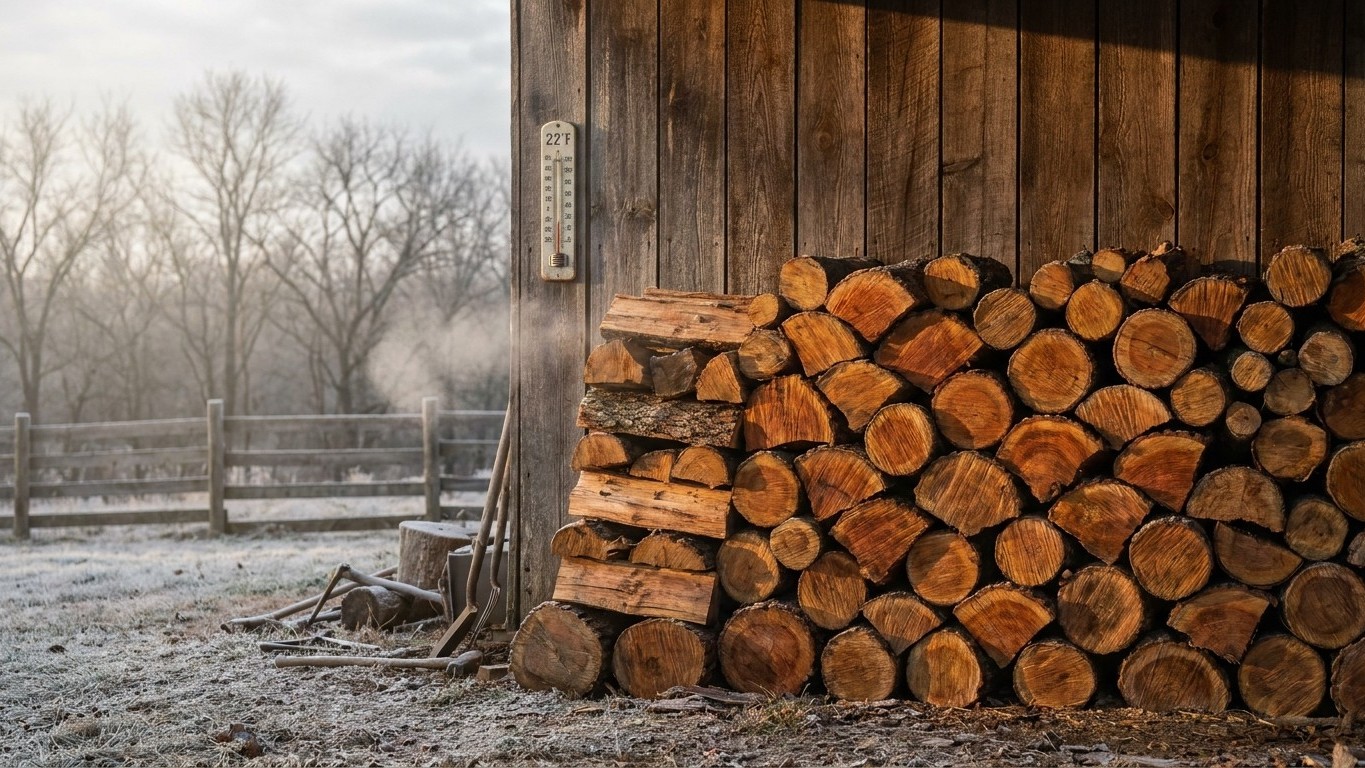

Firewood in Missouri works best when you match wood density to a winter that averages 19.5°F on its coldest nights in Kansas City. That’s not a record low, it’s the normal overnight temperature for the whole month of January, and it’s the number that should decide how many cords you stack, how dense a species you chase, and whether wood heat here is a necessity or just a nice fire to watch.
How cold it actually gets here

The reference figure for Missouri, drawn from NOAA’s 1991-2020 Climate Normals at the Kansas City station, is a mean daily minimum of 19.5°F for the coldest month. That’s an average low, not a one-night freak event, which means a big chunk of a Missouri winter sits well below freezing every single night for weeks at a stretch.
That number lands firmly in the range where wood heat matters for real warmth, not just ambiance. Anything under 40°F for a coldest-month average means a wood stove or fireplace insert is doing actual work keeping a house livable, not just adding a glow to the living room. At 19.5°F, a house relying on wood heat needs fuel that burns long and hot through the night, because outdoor temperatures aren’t giving anyone a break at 3 a.m.
What that means for a wood-burning household
A winter that bottoms out near 20°F on average nights, with plenty of dips colder than that, turns firewood choice into a practical decision rather than an aesthetic one. Softwoods that flare up fast and burn out in an hour won’t carry a house through a night at 19.5°F. Dense hardwood that holds coals for six or eight hours will. That single fact, more than any other, should steer what a Missouri household buys, cuts, or stacks for winter.
It’s worth being honest about what this figure doesn’t tell you. It’s a statewide reference point tied to one station, and Missouri stretches from the Ozark hills in the south to the flatter northern plains, where nights can run a few degrees colder still. But 19.5°F is close enough to plan around: it says wood heat here needs to perform, not just look good in a fireplace. Anyone treating firewood as pure atmosphere, the way someone in a mild coastal climate might, is setting themselves up for a cold house in February.
The practical takeaway is simple. Missouri’s cold is real but not extreme compared to the northern Great Lakes or the Rockies. It’s cold enough that density and seasoning both matter, but not so brutal that only the hardest hardwoods will do. That middle ground shapes everything in the next section.
Which woods are worth the effort here
Once you know the winter sits around 19.5°F on average cold nights, density becomes the deciding factor, because a cord is a fixed volume: 4 feet by 4 feet by 8 feet, or 128 cubic feet, no matter what species fills it. A cord of dense wood packs more actual wood fiber, and therefore more stored energy, into that same box than a cord of light, airy wood. Michigan State University Extension puts the benchmark at roughly 20 million BTU per cord for well-seasoned hardwood, which is about the heat equivalent of 145 gallons of #2 fuel oil or 215 gallons of LP gas. That average moves a lot depending on species and, even more, on how dry the wood actually is.
For a Missouri winter that demands overnight heat retention, the dense, slow-burning hardwoods native to the region, oak, hickory, and osage orange among them, are the ones worth the splitting and hauling effort. They hold coals through a long cold night the way a light wood simply can’t. Lighter, softer woods, think cottonwood, box elder, or pine, have their place too: they light fast, they’re good for kindling and shoulder-season fires in October or April, but they burn down too quickly to be trusted on a night dipping toward 19.5°F.
Comparing what’s actually available
Availability changes the math as much as any chart does. A dense species you can’t buy seasoned, or can’t source at all in your county, is worth less than a modest species you can actually get dry and stacked before the cold sets in. Missouri’s timber markets favor oak and hickory because they’re common in the state’s forests, which makes seasoned supply more realistic to find than it would be for a scarcer species.
| Wood type | Relative BTU output per cord | Smoke | Sparks |
|---|---|---|---|
| Dense hardwoods (oak, hickory, osage orange) | High, near or above the 20 million BTU average | Low once fully seasoned | Low to moderate |
| Medium hardwoods (ash, hackberry) | Moderate, close to the seasoned-hardwood average | Low to moderate | Low |
| Light woods (cottonwood, box elder, softer species) | Below average, burns fast | Higher, especially if not fully dry | Higher, more prone to popping |
The comparison matters more than any single number. A dense cord bought green and never properly dried will underperform a modest cord that’s been split and stacked a full season. Species is only half the equation here.
How much wood a winter takes
There’s no honest published figure for “cords per winter” that applies to a random Missouri house, because the real answer depends on three things that vary from one home to the next, not on the calendar. Anyone quoting you a flat number without asking about your house is guessing.
- The cold figure for your area: a winter averaging 19.5°F on its coldest nights demands more fuel than a milder one, and colder pockets of the state will push past that baseline.
- How well the house holds heat: insulation, air sealing, window quality, and even how tight the wood stove’s flue draft is all change how much of the wood’s stored energy actually stays inside the house.
- Whether wood is the primary heat source or a supplement: a household using wood to knock the chill off in the evenings alongside a furnace burns a fraction of what a house heating entirely with a wood stove goes through.
The mechanism that makes these estimates swing so widely is simple: a poorly insulated house sitting through a hard Missouri winter can burn through double what a tight, well-sealed house uses in that exact same climate, with the exact same wood. Heat lost through drafty windows, an uninsulated attic, or an old leaky door isn’t heat that stays in the room, no matter how many cords are stacked on the porch.
The practical move is to run your own numbers down that list rather than borrow someone else’s total. Start with how cold your specific location gets, be honest about your house’s insulation, and be clear about whether wood is carrying the whole load or just supplementing a furnace. Only then does a “cords per winter” figure mean anything for your address.
Drying wood in this climate
Seasoning matters more than species selection almost everywhere, and Missouri’s climate, humid summers with a real growing season, shapes how long that seasoning actually takes. The target doesn’t change: firewood needs to burn at 20 percent moisture or less, according to Michigan State University Extension. Green wood, by contrast, can sit above 60 percent moisture, and every bit of that water has to boil off inside the firebox before the wood gives up any real heat, which is energy stolen straight from the fire you wanted.
Split green wood typically reaches that 20 percent target after one full summer stacked so air can move freely through the pile. That last part isn’t optional. Wood left in whole rounds, or stacked tight against a fence with no airflow, dries far slower than wood that’s split and stacked loosely with sun and wind reaching the pile. Air and time dry wood, not sunlight by itself, which is why a shaded but breezy stacking spot often outperforms a sunbaked one with no airflow.
Missouri’s humid summers stretch that timeline compared to a drier western state, so the margin for error is smaller here than it looks. Red oak is the notable exception worth flagging by name: MSU points out that its cell structure makes it dry more slowly than other hardwoods, so it needs longer than a single summer to reach burnable moisture, especially in a humid climate like Missouri’s.
This is where the most common local mistake happens. Wood cut and split in spring for that same winter almost never reaches 20 percent moisture by the time the cold arrives in December. A spring cutting is really setting up next winter’s fuel, not this one. Anyone burning wood cut just months earlier is burning water as much as wood, losing a real share of that 20 million BTU per cord to steam instead of heat.