
The coldest month at Baltimore averages a low of 25.4°F, and that single number should shape every firewood decision you make in Maryland this year: how many cords you split or buy, how dense that wood needs to be, and how much margin you leave yourself before the first hard freeze. This is a real winter, not a mild one, so the choices below matter for comfort and for your wallet.
How cold it actually gets here

Baltimore’s coldest month has an average low of 25.4°F, according to NOAA’s 1991-2020 Climate Normals. That’s the mean daily minimum, not the record low and not the monthly average high, which means on a typical night in the deep of winter, the temperature settles into the mid-20s as a matter of routine, not as an outlier.
A number like that puts Maryland firmly in wood-heat-matters territory. This isn’t a climate where a fire is mostly for ambiance while a heat pump quietly does the real work. Nights in the mid-20s, stretched across a full January and into February, mean sustained heat demand: a stove or fireplace working for hours, sometimes overnight, without much room for error in fuel choice.
Compare that to states where the coldest month barely dips below 40°F. There, firewood is a mood, a weekend ritual, something you burn because you like the smell of it. Maryland doesn’t get that luxury in January. A 25.4°F average low means the wood you burn on the coldest nights needs to actually deliver, not just glow.
What that means for planning
Practically, it means treating firewood as a heating fuel with a budget, the same way you’d think about propane or heating oil. You’re not stocking a rack for the occasional evening fire, you’re provisioning for weeks of below-freezing nights, back to back, where the wood pile is doing real work keeping a house livable. That changes what you buy, how much you buy, and how far ahead you plan for it.
It also means the difference between a well-seasoned dense hardwood and a green, punky load isn’t cosmetic in Maryland. On a night that bottoms out near 25°F, a load of unseasoned wood that mostly steams and smolders instead of burning clean can leave a house genuinely cold by 3 a.m. That’s the stakes this climate sets, and everything below is built around it.
Which woods are worth the effort here
Because a cord is a fixed volume, 128 cubic feet stacked 4 feet by 4 feet by 8 feet, the density of the wood inside that volume decides how much actual heat you’re bringing home. A cord of well-seasoned hardwood averages about 20 million BTU, according to Michigan State University Extension, which is roughly the heat of 145 gallons of #2 fuel oil or 215 gallons of LP gas. But that 20 million figure is an average across species and moisture levels. Dense hardwoods pack noticeably more weight, and more stored energy, into that same 128 cubic feet than light, open-grained woods do.
For a Maryland winter with nights routinely near 25°F, the dense end of the hardwood spectrum, think oak, hickory, and black locust, is what you want stacked closest to the door for December through February. These woods burn slower and hotter, which matters most on the coldest overnight stretches when you need a fire that’s still producing usable coals eight hours later. Ash and hard maple sit in the middle: solid, dependable heat without quite the density of oak or hickory, useful across most of the season.
Lighter woods like pine and poplar have their place too, just not as your main fuel. They light fast, burn hot and quick, and are genuinely useful for starting a fire or getting through a mild shoulder-season evening in October or April when you don’t need eight hours of heat, just a couple. Burning them as your primary wood through a Maryland January means reloading the stove far more often than a dense hardwood would require, for less total heat per cord.
None of this matters if you can’t get the wood seasoned. A modest, available hardwood that’s been split and dried properly outperforms a theoretically superior species you can only find green or can’t source locally at all. Ask any Maryland firewood seller what’s actually seasoned and ready, not just what’s cut, before you commit to a species based on a table.
| Species | Heat per cord (vs. ~20M BTU average) | Smoke | Sparks |
|---|---|---|---|
| Oak (red/white) | Well above average | Low, once seasoned | Low |
| Hickory | Well above average | Low | Low to moderate |
| Black locust | Well above average | Low | Low |
| Ash | At or above average | Low | Low |
| Hard maple | Around average | Low to moderate | Low |
| Pine | Below average | Higher, especially green | High |
| Poplar | Well below average | Moderate | Low to moderate |
How much wood a winter takes
Any number you find online claiming Maryland households burn “X cords a winter” is close to meaningless without knowing your house and your setup. The honest answer is that you build the estimate yourself, from a short list of variables that move the total up or down by a lot.
- The cold itself: a winter that tracks close to Baltimore’s 25.4°F average low demands steady output for weeks, not occasional bursts, so total consumption climbs with how long and how consistently the cold holds.
- How well the house holds heat: insulation, air sealing, and window quality decide how much of the heat you make actually stays inside instead of leaking out.
- Whether wood is primary or supplemental: a household burning wood as its main heat source through January and February needs far more fuel than one running a stove a few evenings a week alongside a furnace.
- Stove or fireplace efficiency: an open fireplace loses most of its heat up the chimney; a modern airtight stove extracts far more usable BTU from the same cord.
- Species and seasoning: a stack of dense, properly dried hardwood delivers closer to that 20 million BTU average per cord than green or light wood does, meaning you burn less volume for the same warmth.
The mechanism worth understanding is this: a poorly insulated house heated primarily by wood through a hard Maryland winter can burn roughly double what a tight, well-sealed house uses in that same climate, running the same stove. That gap has nothing to do with species or seasoning. It’s the building itself deciding how much of your effort turns into comfort and how much escapes through the walls and windows before it ever gets the chance.
Drying wood in this climate
Seasoning matters more than species selection, and it matters everywhere, but Maryland’s humid summers stretch the timeline compared to drier climates. The target is the same no matter where you live: 20 percent moisture or less by the time you burn it, according to Michigan State University Extension. Green wood, by contrast, can hold over 60 percent moisture, and every bit of that water has to boil off before the wood produces usable heat, which is why a green log seems to hiss and smoke instead of burn.
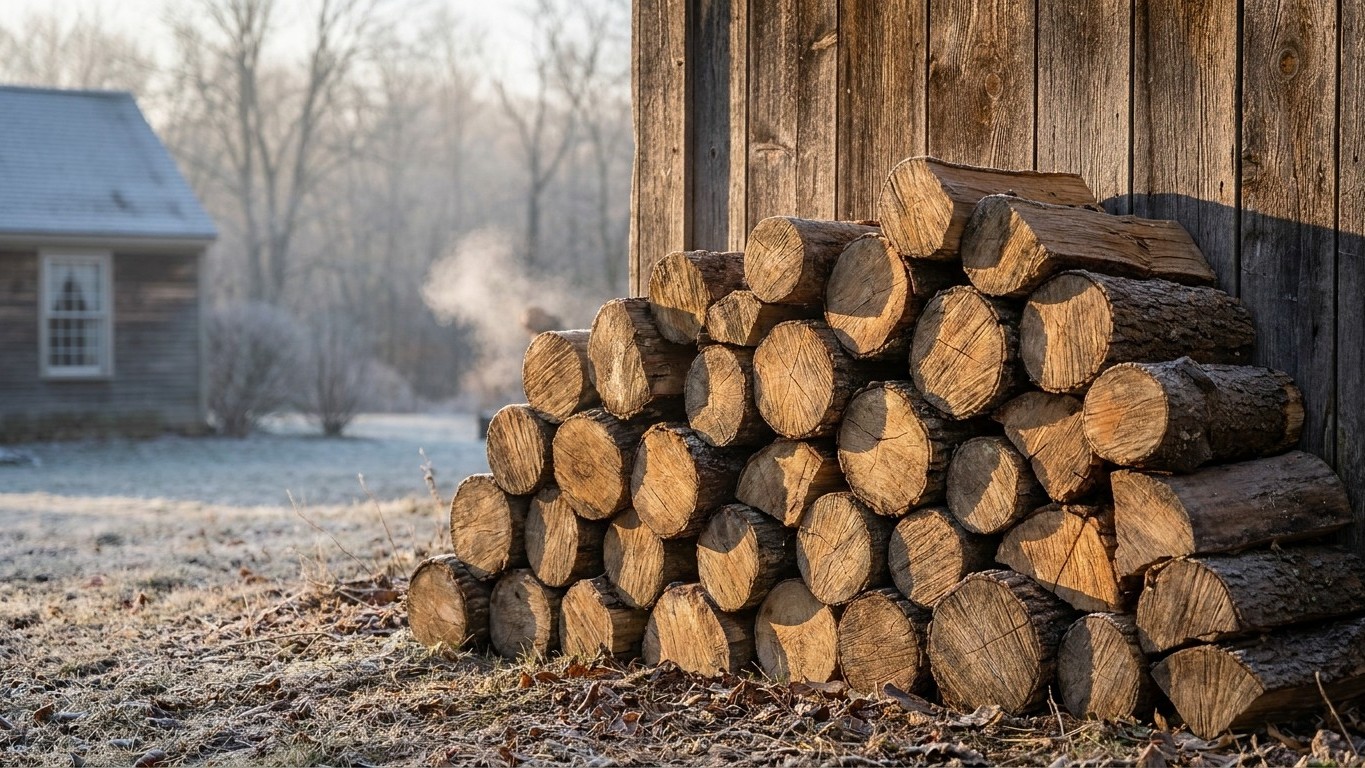
What dries wood isn’t sunshine sitting on top of a pile. It’s air moving through split wood that’s stacked with gaps, ideally off the ground, over enough time for the moisture to work its way out. A tarp thrown tightly over a woodpile can trap humidity and slow drying rather than help it. Split and stacked correctly, most hardwood reaches that 20 percent target after one full summer season. Red oak is the named exception: MSU notes it dries more slowly than other hardwoods because of its cell structure, so it needs extra time beyond a single summer to season properly.
Tie that timeline to Maryland’s cold months and the most common local mistake becomes obvious: wood split in March or April for the winter that starts in November usually isn’t ready. One summer isn’t always enough, especially for oak, and definitely isn’t enough if the wood sat in rounds instead of split and stacked with airflow. The wood you’re burning through nights near that 25.4°F average low should generally be wood you split at least a full year earlier, sometimes longer for the denser, slower-drying species that Maryland winters actually reward.