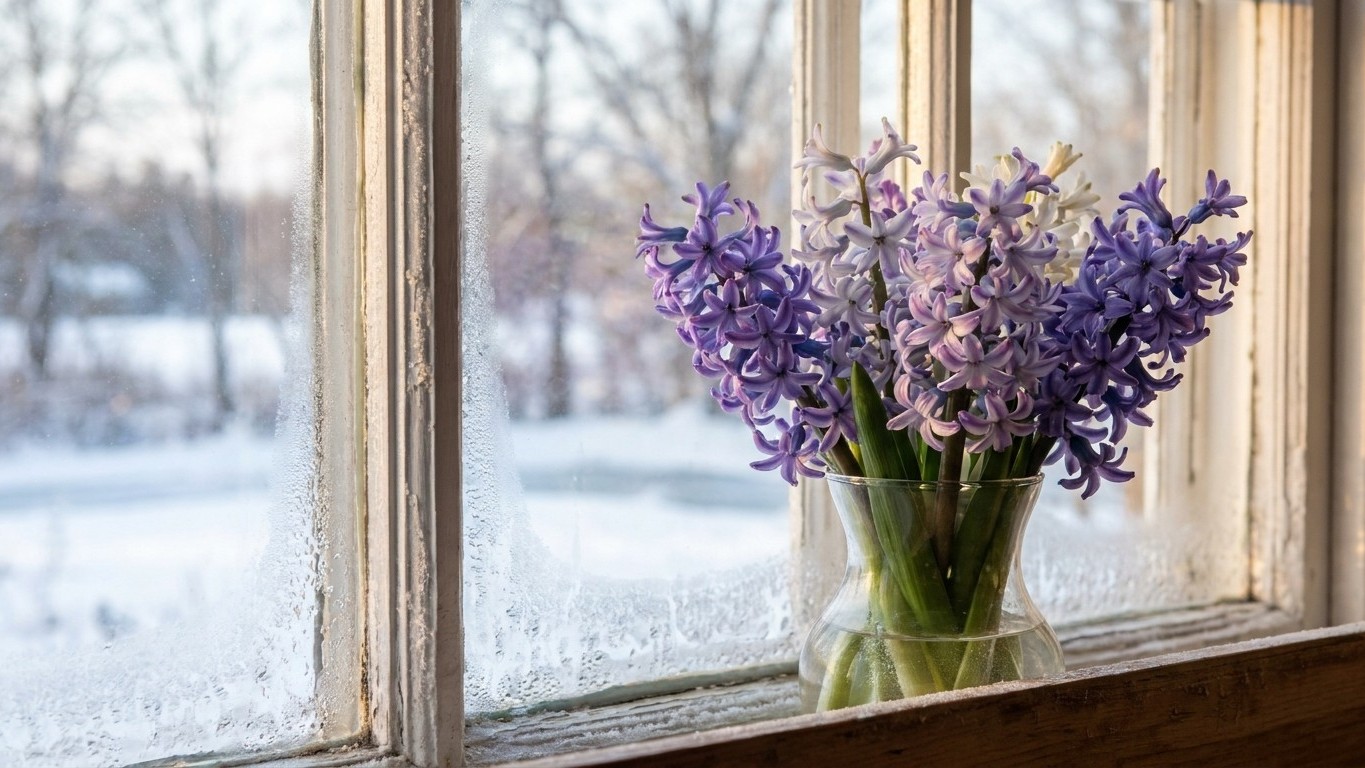

New Hampshire’s coldest month averages a low of 17.1°F at the Manchester reference station (NOAA climate normals, 1991-2020). A tulip or hyacinth needs roughly twelve to fourteen weeks below 45°F to finish forming its flower bud. At 17.1°F, this state delivers that chill every winter without any help from a gardener with a refrigerator.
Why this matters in New Hampshire

Forcing exists as a technique for two very different reasons, and it’s worth being clear which one applies here. In a warm-winter state where the ground rarely drops below 45°F for long, forcing is the only way to get a tulip or hyacinth to bloom at all, since the bulb never gets its required cold naturally. New Hampshire is not that state. With a coldest-month minimum of 17.1°F, the ground here delivers twelve to fourteen weeks of chill on its own, no fridge required. So the reason to force bulbs indoors in this state isn’t a shortage of cold. It’s timing: getting a hyacinth to bloom on a windowsill in February instead of waiting for the garden to catch up in May.
The real hazard specific to this territory is a different one, and it catches people off guard. A bulb planted in the ground sits below the soil surface, surrounded by earth mass that buffers temperature swings, so even in a hard winter the root zone rarely freezes solid the way the air above it does. A bulb in a container outdoors has no such buffer. A pot’s thin walls let cold reach every side at once, and a container can freeze straight through, roots and all, in conditions the same bulb would shrug off in a garden bed.
That gap matters because New Hampshire’s USDA hardiness zone isn’t a single number. The state spans zone 3b to 6a (USDA Plant Hardiness Zone Map, 2023 normals), with the coldest pockets in the northern mountains and the mildest strip near the coast and southern border. A bulb rated hardy to zone 5 might survive fine in a Portsmouth-area garden bed but die in an unprotected pot on a Berlin or Franconia porch during the same week. Any zone-based decision on this page should be checked against the specific zone at your address rather than the statewide range, since the two ends of that range behave nothing alike once a bulb is sitting in a container instead of the ground.
Put together, this is the situation New Hampshire gardeners are actually managing: plenty of natural cold for chilling requirements, but a container vulnerability that has nothing to do with how many weeks below 45°F a bulb needs and everything to do with how much insulating mass is around it.
How to do it here
The mechanics of forcing don’t change by state, but where you find twelve to fourteen weeks of steady cold does. In New Hampshire, that space is usually an unheated garage, a three-season porch, or a refrigerator, and each has a different failure mode worth checking before you commit a season’s worth of bulbs to it.
- Pick a cold space and verify its range with a thermometer. An unheated garage works if it stays consistently above freezing and below roughly 45°F through the chilling period; a thermometer left in the space for a few days tells you more than a guess, since an attached garage that shares a wall with a heated house often runs warmer than expected.
- Pot the bulbs in a container with drainage holes, using a standard potting mix, with the bulb’s shoulder at or just below the soil surface and bulbs close but not touching.
- Water once at planting, then keep the soil barely moist for the entire cold period. Soggy soil in cold storage is the single most common cause of rot.
- If using a refrigerator, keep the pot away from ripening fruit. Apples, pears, and bananas release ethylene gas, which can damage or abort the flower bud developing inside the bulb before it ever gets a chance to bloom.
- Hold the cold for the full twelve to fourteen weeks before checking for root growth at the drainage holes or a pale shoot at the soil surface; either sign means the bulb is ready to come out of the cold.
- Move the pot to a cool, dim spot for about a week before bringing it into full light and room temperature, so the stem has time to elongate gradually instead of freezing in place at a stubby height.
For containers left outdoors through winter rather than moved into cold storage, the rule that matters is the zone gap. A pot should be treated as roughly two hardiness zones colder than the same spot at ground level, since it lacks the soil mass that buffers a planted bulb. In practice, that means either sinking the pot into the ground and mulching heavily over it, moving it into an unheated but enclosed space like a garage or shed for winter, or choosing a bulb rated hardy well past your zone with two full zones of margin.
Which bulbs are worth it
Some bulbs force with almost no fuss, and some fight you the entire way. The difference usually comes down to two things: how long a cold period the species demands, and how tall and heavy the flower stem gets once it’s blooming indoors without the wind and structure of an outdoor bed to hold it up.
- Crocus, short cold requirement and a stem too short to topple
- Hyacinths, reliable bloomer with a sturdy stem that rarely needs staking
- Grape hyacinth (muscari), compact and forgiving of slightly uneven cold
- Species and dwarf tulips, shorter and stiffer than the large hybrid varieties
- Paperwhite narcissus, needs no cold period at all, which makes it the fastest option for an indoor bloom
- Large trumpet daffodils, tall stems that flop without staking once indoors
- Giant alliums, both a long cold requirement and a top-heavy flower head
- Fritillaria imperialis, narrow temperature window during chilling and a strong odor many people don’t expect indoors
- Large hybrid tulips, the classic tall single or double varieties that lean hard toward the nearest window within days
One thing worth knowing before buying a bag of bulbs for this purpose: most forced tulips and hyacinths are treated as a one-season purchase anyway, since the chilling and forcing process depletes the bulb and rebloom rates outdoors afterward are inconsistent. If the bulb was never going to be planted out for a second year of garden bloom, forcing it doesn’t cost you anything you’d otherwise have kept.
What goes wrong, and when you can still fix it
Leaves, but no flower
This means the cold period ran short, cutting off flower development before the bud finished forming inside the bulb even though the leaves kept growing. There’s no fix for the bulb this season. The bulb can be planted out in a garden bed once the ground can be worked, where it may rebuild enough reserves to flower in a future year outdoors, but it won’t produce a bloom indoors now.
A flower buried low in the leaves
A short, stunted stem usually means the bulb was moved from cold storage straight into a warm, bright room instead of passing through a cool, dim transition first. The stem never got the signal to elongate. The flower itself is often still fine to enjoy at that shorter height; there’s nothing to reverse this season, but giving the next batch a week in a cooler, dimmer spot before full light usually solves it.
Rot in the pot
Soft, discolored bulb tissue or a moldy smell during the cold period almost always traces back to drainage: no holes in the container, a saucer holding standing water, or soil kept too wet through the entire chilling stretch. This one isn’t fixable. A rotted bulb won’t recover, and the safest move is to discard it and start the next attempt with a container that drains freely and a lighter hand with the watering can.