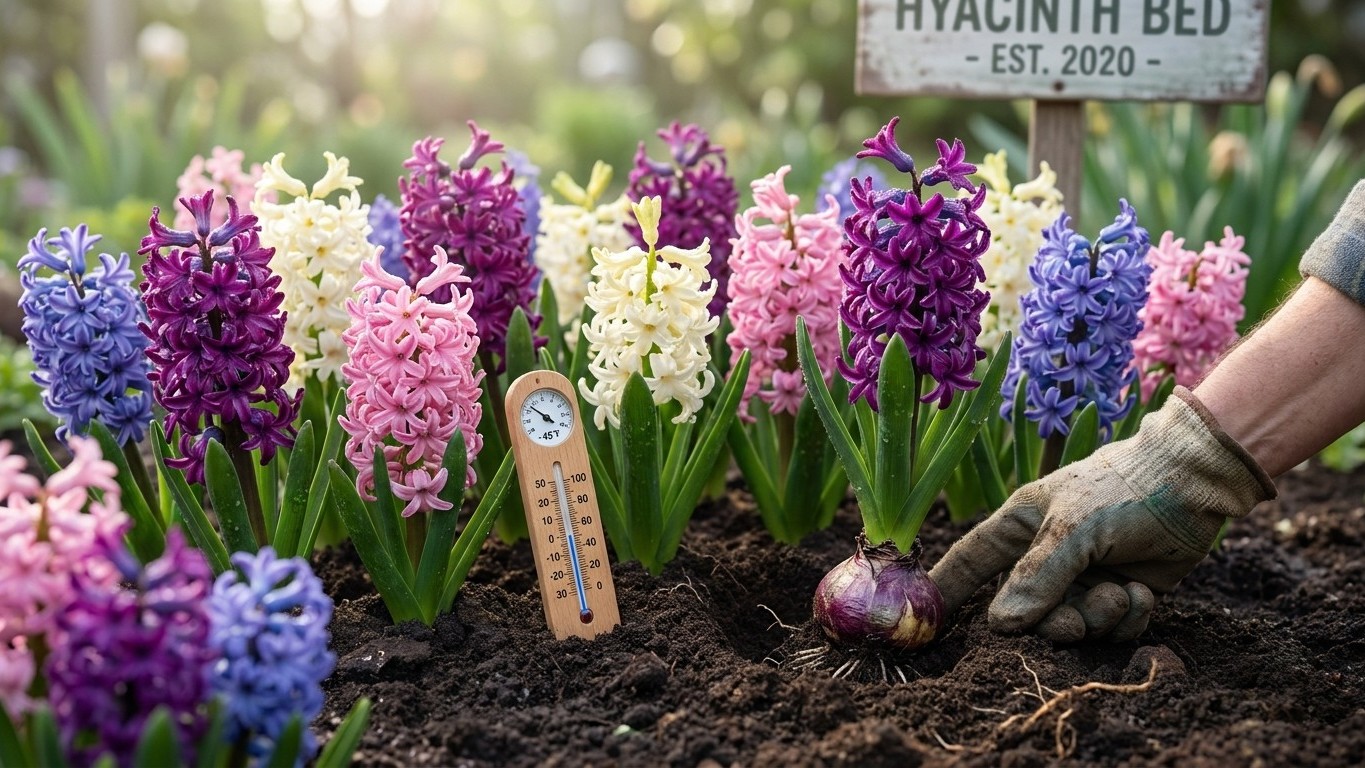

Two numbers decide whether hyacinths bloom at all: they need 12 to 14 weeks of temperatures below 45F, and they only thrive in USDA zones 4 through 8. Get the depth right too, 6 inches down, and the rest of the planting is straightforward.
What Hyacinth actually is

Hyacinth is hardy across USDA zones 4 through 8, which covers most of the continental United States outside the Deep South and the hottest parts of the Southwest. Within that range, the bulb has one non-negotiable requirement: 12 to 14 weeks of soil temperatures below 45F before it will send up a flower stalk. According to Cornell University, Department of Horticulture : Flower Bulb Research Program, a bulb that gets less chilling than that produces leaves with no flower, or a flower spike so short it hides in the foliage. If your winters run mild and you’re near the edge of zone 8, don’t assume failure outright, a bulb just short of its chilling requirement often flowers poorly rather than not at all. It’s a warning sign, not a guarantee of disaster.
Hyacinth blooms in mid spring, giving it a middle slot in the spring bulb calendar rather than an early or late one. The color range is wide, essentially “many,” which is why hyacinth beds tend to look more like a paint sample chart than a single-tone drift when several varieties are mixed.
The habit worth knowing before you plant, not after, is that the flower spikes get looser and smaller with each passing year. A first-season hyacinth stands dense and tight. By year three or four, the same bulb often produces a looser, more open spike. That’s not disease or neglect. It’s simply what this bulb does as it ages in the ground, and it’s worth setting expectations accordingly rather than assuming something went wrong in your soil.
How deep and how far apart
The planting figures are fixed and worth writing down before you kneel in the dirt:
- Depth: 6 inches, measured from the soil surface to the base of the bulb
- Spacing: 5 to 6 inches apart, bulb to bulb
Depth isn’t an arbitrary number picked for tidiness. Six inches of soil buffers the bulb against the freeze-thaw cycles that otherwise push bulbs upward out of the ground over a few winters, a problem gardeners call frost heave. Plant too shallow and you’ll find bulbs sitting half-exposed by the second spring. Spacing is the other decision that shapes the look of the bed: 5 to 6 inches apart reads as a continuous, informal drift once the plants fill in, while spacing bulbs farther apart produces a more scattered, row-like effect. Neither is wrong, but they look different, so decide which effect you want before you dig.
Hyacinth bulbs go in pointed end up, flat side down, since the flat side is where the roots emerge. Most bulbs make this obvious at a glance. If a bulb is oddly shaped or you genuinely can’t tell which end is which, plant it on its side rather than guessing wrong. The shoot will find its way upward regardless; roots are less forgiving about growing into compacted soil below them.
One handling note matters more than most gardeners realize: hyacinth bulbs contain oxalate crystals that irritate skin on contact. Wear gloves when handling them, especially if you have sensitive skin or you’re planting a large quantity in one sitting. It’s a minor precaution, but skipping it is a common reason people end up with itchy, irritated hands for no good reason.
Will it come back next year
Hyacinth is a genuine perennial within its hardiness range, but it isn’t a bulb that multiplies vigorously or holds its best form indefinitely. As already noted, flower spikes get looser and smaller each year. That’s the honest trajectory: not disappearance, but a slow decline in the dense, uniform look most buyers picture when they first plant it. Treat it as a bulb that persists for years rather than one that improves with age, and you won’t be disappointed by year four or five.
The single biggest factor gardeners control is what happens to the leaves after the flower fades. The foliage needs to be left in place until it yellows and dies back on its own, because that’s the window when the bulb is photosynthesizing and storing the energy that becomes next year’s flower. Cut the leaves back while they’re still green, even if they look messy or floppy, and you’re removing the bulb’s only chance to rebuild itself. This is the single most common reason a hyacinth planting stops flowering after its first strong season, and it has nothing to do with soil, fertilizer, or variety. It’s timing, plain and simple.
If you want to tidy the bed while the foliage finishes its job, interplant hyacinths with later-emerging perennials that can screen the yellowing leaves without you needing to cut them.
What eats it, and what leaves it alone
Rodents avoid hyacinth bulbs. That’s a real advantage over other spring bulbs, and it’s worth knowing before you decide where to plant. The same oxalate crystals that irritate human skin on contact appear to make the bulb unappetizing to squirrels and voles, the two animals most likely to dig up a fall planting before it ever gets the chance to chill through winter.
That single fact changes how you plant. Bulbs known to attract rodents typically need wire mesh laid over the planting bed until the ground freezes solid, a step meant to physically block digging during the vulnerable weeks right after planting. Hyacinth doesn’t require that precaution. If you’re planting a mixed bed of spring bulbs, hyacinths are a reasonable choice for the sections you can’t easily protect, while more vulnerable bulbs get the mesh treatment closer to the house where you can check on them.