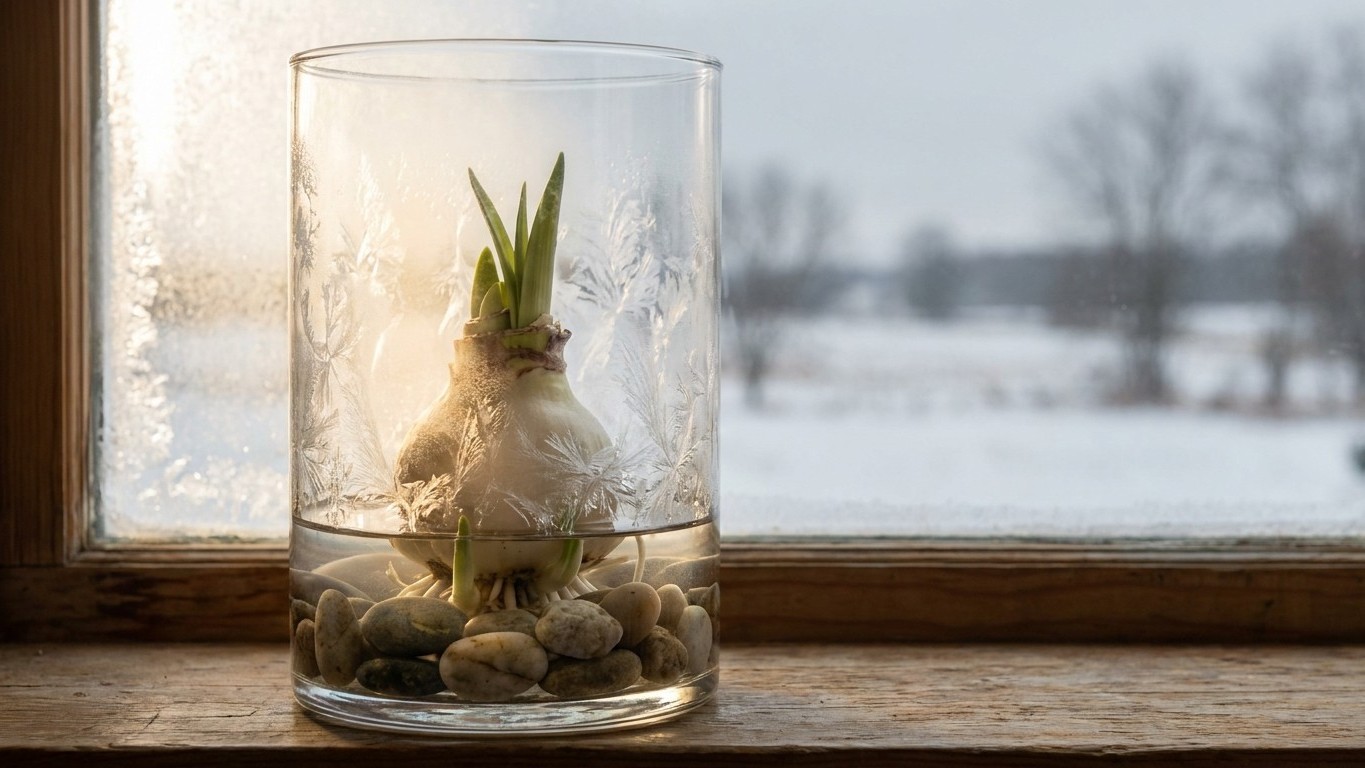

Forcing spring bulbs indoors here means giving them the 12 to 14 weeks of chill a bulb needs to bloom, but doing it in a fridge or an unheated garage instead of outdoor soil. Saskatchewan winters supply plenty of natural cold already. The real complication isn’t a lack of chill outdoors, it’s that a bulb sitting in an unprotected pot outside faces a much harsher freeze than the same bulb planted in a garden bed.
Why this matters in Saskatchewan

The coldest month here averages a daily minimum of -5.3°F, based on Environment and Climate Change Canada’s 1981-2010 normals for the Saskatoon reference station. That’s not a record cold snap. That’s the typical low, night after night, for the whole month. A spring bulb only needs 12 to 14 weeks below 45°F to set its flower bud. Saskatchewan’s ground delivers that in a matter of days each fall and keeps delivering it for months past what any tulip or crocus actually requires. So if the question is whether outdoor winter here is cold enough for spring bulbs, the answer isn’t close. It’s overkill.
That changes what forcing indoors is actually for in this province. It isn’t rescuing bulbs from a winter too mild to trigger bloom, the way it might in a place with short, wet winters. Here, forcing is almost always about timing and location: getting a hyacinth to flower on a windowsill in February instead of waiting for a garden bed to thaw in May, or growing a bulb in a container on a balcony where there’s no bed at all.
That second scenario is where Saskatchewan’s numbers actually bite. The region sits in Canadian plant hardiness zone 3a, according to Natural Resources Canada’s Plant Hardiness Site (1991-2020 normals, read 2026-08-26). That’s a Canadian zone rating, built from seven climate variables, and it does not convert to a USDA zone on any simple scale, so don’t read it against a hardiness map from south of the border. What it tells you locally is that a bulb planted in the ground has soil mass and snow cover buffering it. A bulb left in a pot outdoors has none of that. The pot’s sides are exposed to air on every face, so it freezes clean through, roots and all, at something close to that -5.3°F average minimum. The same species that overwinters fine in a bed can die in a pot left on a step or a deck.
That’s the situation this territory is actually in: not a shortage of outdoor cold, but a container problem. Anyone forcing bulbs indoors here needs to control the cold period deliberately, in a fridge or a garage that stays above freezing, rather than assuming a pot outside will behave like garden soil.
How to do it here
The sequence matters more than any single step. Skip the order and you either get leaves with no flower or a rotted bulb by January. Here’s the process, built around what’s actually available in a Saskatchewan household rather than a generic garden guide.
- Pot the bulbs in fall using a well-draining mix in a container with drainage holes. Water once, thoroughly, right after potting. Don’t feed or water again until the cold period ends.
- Choose the cold space. An unheated but attached garage that stays reliably above freezing works well, since it stays well warmer than the outdoor mean minimum of -5.3°F without ever getting into indoor-heated territory. A refrigerator crisper drawer set between 35°F and 45°F is the other common option, and it’s the more predictable of the two because it doesn’t fluctuate with outdoor weather.
- Keep the fridge drawer away from ripening fruit. Apples, pears, and other ripening produce release ethylene gas, and ethylene damages the flower bud forming inside the bulb before it ever gets the chance to open.
- Hold the pots at that temperature for 12 to 14 weeks. Mark the start date. This isn’t a step to eyeball; guessing short is the single most common reason forcing fails here.
- Check the garage temperature periodically. If a cold snap threatens to push it near outdoor lows, move the pots into a basement or an interior closet for a few days rather than risk a freeze-through, which behaves the same in a garage as it would outdoors in an unprotected pot.
- Look for root growth and a shoot tip an inch or two tall before ending the cold period. That’s the signal the bud has finished forming, not the calendar alone.
- Bring the pot into a cool, dim room first, not straight to a sunny windowsill. Let it adjust for several days, then move it toward light and warmth gradually to bring on bloom.
If a gardener wants to skip the fridge and chill pots outdoors instead, the container needs to be at least two hardiness zones hardier than the bulb itself, or it has to be moved somewhere insulated and packed with mulch. In zone 3a, that’s a high bar. It’s usually simpler to use the garage or the fridge and skip the guesswork of an outdoor trench.
Which bulbs are worth it
Not every bulb rewards the effort of forcing. Some have a short cold requirement and a compact stem that holds up in a small pot. Others need a long chill, grow tall, and flop over indoors where there’s no wind or structure to hold them up. A few, like paperwhites and amaryllis, aren’t hardy in this climate anyway and were never going to survive a Saskatchewan winter outdoors regardless, so forcing them costs nothing in the long run beyond the price of the bulb itself.
Force reliably here
- Crocus
- Muscari (grape hyacinth)
- Dwarf iris (Iris reticulata)
- Hyacinth
- Paperwhite narcissus (needs no cold period at all)
- Amaryllis (also needs no cold period)
Tend to sulk
- Large trumpet daffodils (tall, floppy stems indoors)
- Tall Darwin-type tulips (topple without outdoor wind resistance)
- Large ornamental alliums (long cold requirement, awkward height)
- Fritillaria (inconsistent bloom timing indoors)
Paperwhites and amaryllis are the easiest entry point for anyone new to forcing, since there’s no chill period to track and no risk of guessing the weeks short. Crocus and dwarf iris are the best second step, since their short cold requirement means the whole process, start to bloom, wraps up faster than a hyacinth or tulip will.
What goes wrong, and when you can still fix it
Leaves but no flower
This means the cold period ran short. The bulb has enough energy stored to push up leaves, but the flower bud never fully formed inside it during the chill. It can’t be fixed this season. The bulb itself may still be viable if planted out in the garden this fall, where Saskatchewan’s natural winter will give it a full, uninterrupted chill well past the 12 to 14 weeks it needed the first time.
Flower on a stem too short to see
This happens when the pot was moved from cold storage straight into full light and warmth, skipping the gradual transition. The bloom itself is usually fine, just compressed and low to the soil line. There’s no way to stretch the stem after the fact this season, but the bulb isn’t wasted, the flower will still open and can be enjoyed at that height.
Rot in the pot
Rot almost always traces back to drainage. A pot without holes, or a mix that stays soggy through the cold weeks, keeps the bulb’s base wet and cold at the same time, and that combination breaks it down before it ever gets the chance to root. Once rot has set in, the bulb is lost for this attempt. The fix is for next time: drainage holes, a gritty mix, and a single deep watering rather than repeated top-ups during the chill period.