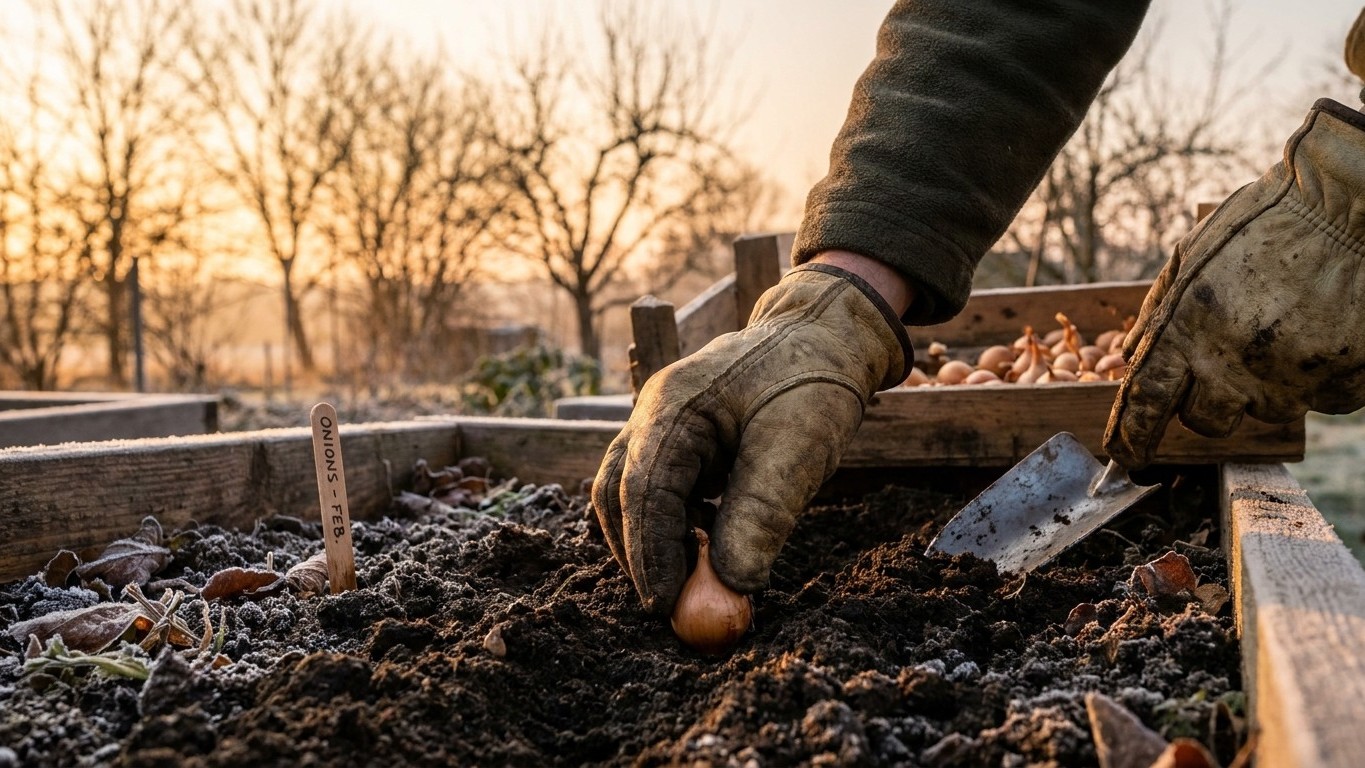

Plant onions in Virginia during late winter to early spring, not fall, because the state sits at 36.82 degrees north latitude (measured at Richmond) where the longest day of the year brings only 14 hours and 32 minutes of daylight. That number determines everything else: which onion varieties can bulb here, how big those bulbs get, and why planting a week late costs you size, not just time.
The short answer for Virginia

Richmond’s 14 hours and 32 minutes of daylight on the summer solstice places Virginia squarely in intermediate-day onion territory. That’s the middle ground between the short-day onions grown across the Deep South and the long-day onions that dominate gardens in the upper Midwest and New England. Onions don’t bulb because the weather warms up. They bulb because daylight crosses a threshold their genetics are tuned to detect. Get the timing wrong and the trigger fires before the plant has built enough leaf mass to support a decent bulb.
For most of Virginia, that means planting onion sets or transplants from late February through March, as soon as the soil can be worked and the worst hard freezes have passed. Onions tolerate a light frost once established, and getting them in the ground early gives the plant six to eight weeks to grow leaves before day length starts pushing it toward bulbing in June. Wait until April and you’ve cut that leaf-building window roughly in half.
Gardeners in Virginia’s mildest pockets, the far southeastern corner near the Chesapeake Bay and Hampton Roads, sometimes get away with a fall planting of hardy varieties for overwintering, similar to what growers do across the Gulf Coast states. But that’s the exception, not the rule, and it depends on a mild winter holding. For the rest of the state, spring planting is the safer bet, and it’s the one that matches Richmond’s day-length profile.
This is also why the seed rack matters as much as the calendar. A short-day onion planted in Virginia will start bulbing while it’s still tiny. A long-day onion built for latitudes above 40 degrees may never bulb at all here, no matter how early you plant it. The calendar and the variety label have to agree, or the planting date won’t save you.
What will not work here
Planting an onion late doesn’t push its harvest back a few weeks the way it does with tomatoes or beans. It shrinks the harvest, because whatever size the plant has reached when day length crosses its bulbing trigger is roughly the size the bulb will be. A short-day onion started in March, when the trigger arrives fast, gives you a golf-ball onion instead of a fist-sized one. There’s no catching up once bulbing starts; the plant redirects its energy into the bulb and stops building leaves.
The bigger mistake, though, isn’t timing within the season. It’s planting a variety whose day-length requirement doesn’t match Richmond’s 14 hours and 32 minutes at all. Two groups fail here, for opposite reasons:
- Gabriella (short-day, rated for 20-35N), bulbs too early at this latitude, producing an undersized onion regardless of planting date.
- Madalyn (short-day, rated for 20-35N), same problem: the trigger fires while the plant is still small.
- Red Sensation (short-day, rated for 25-35N), bulbs prematurely in Virginia’s longer summer days.
- Texas Grano 1015Y (short-day, rated for 25-35N), built for Gulf Coast day length, not Mid-Atlantic.
- Vidora (short-day, rated for 25-35N), will size up poorly if grown this far north.
- Frontier (long-day, rated for 40-50N), the day here never gets long enough to trigger bulbing.
- Powell (long-day, rated for 43-47N), same failure: leaves all season, no bulb.
- Red Carpet (long-day, rated for 40-45N), day length requirement is never met in Virginia.
- Redwing (long-day, rated for 43-65N), built for far-northern summers, not this latitude.
- Safrane (long-day, rated for 42-50N), the trigger simply never arrives here.
- Talon (long-day, rated for 42-50N), same story as the others in this group.
The long-day list is the harsher failure. Those varieties don’t give you a small onion. They give you no onion at all, just a season’s worth of leaves that eventually rot in the ground when fall arrives and the plant has nothing to show for it.
What changes across Virginia
Richmond’s figures describe one point on the map, not the whole state. Virginia stretches roughly two and a half degrees of latitude, from close to the North Carolina line near Virginia Beach up to the Washington, D.C. suburbs of Northern Virginia, and that spread matters for anyone gardening near either edge.
| Region | Approximate latitude | What it changes |
|---|---|---|
| Southeastern Virginia (Hampton Roads, Eastern Shore) | Slightly south of Richmond | Milder winters make fall planting of overwintering onions more realistic; day length close to the reference figure |
| Richmond (reference city) | 36.82°N | 14h32 on the longest day; solid intermediate-day territory |
| Northern Virginia (Fairfax, Loudoun, Arlington) | Noticeably north of Richmond | Longer summer daylight, edging toward conditions where some long-day varieties become plantable; plant a bit earlier due to a later last-frost thaw pattern in some years |
Gardeners in far northern Virginia sit closer to the group of varieties in the blurred zone: Ailsa Craig, Barolo, Blush, New York Early, Patterson, and Rossa di Milano (all long-day, rated from 38N upward) may bulb successfully there even though they’re a poor bet in Richmond. That’s a continuum, not a hard line, and the closer a garden sits to 38 or 39 degrees north, the better those varieties’ odds. Elevation matters too. The Blue Ridge and points west run cooler and see later last-frost dates than the Piedmont or Tidewater, even at similar latitude, which pushes planting a week or two later regardless of what the day-length math says.
Sweet now, or onions that last
Virginia’s spot in the intermediate-day zone hands gardeners a real trade-off, and it isn’t about luck or variety marketing. The compounds that give an onion its bite are volatile sulfur compounds, and those same compounds are what keep the bulb from breaking down in storage. Fewer sulfur compounds means a milder, sweeter onion that tastes great sliced raw on a burger, and also means it won’t survive past a few weeks in the pantry. More sulfur compounds means a sharper onion, harder to eat raw, but one that holds up in a mesh bag through the winter.
Short-day varieties grown across the Deep South lean sweet and short-keeping. Long-day varieties grown in the northern states lean pungent and long-keeping. Virginia’s intermediate onions land in between: Candy, Cabernet, Calibra, Elsye, Expression, Monastrell, Red Long of Tropea, Scout, and Sierra Blanca all fall in this middle range, offering moderate sweetness with moderate storage life, typically a couple of months rather than a couple of weeks.
For a Virginia gardener who wants both, two long-day varieties happen to reach far enough south to work here: Bridger and Walla Walla Sweet, both rated down to 35 degrees north. Growing a mix of an intermediate variety for fresh summer eating and one of these longer-keeping types is a reasonable way to hedge. What a Virginia pantry looks like in March depends heavily on that choice: an all-sweet intermediate crop is usually gone by New Year’s, while a portion planted with a longer-keeping variety can realistically stretch into late winter.
Checking this against your own garden
Richmond’s 36.82 degrees north and 14 hours 32 minutes of summer daylight are a starting point, not a guarantee for every yard in the state. A garden forty miles away, especially north toward the D.C. suburbs or west into the mountains, is working with different numbers and possibly a different frost calendar entirely.
- Look up your own latitude if you’re gardening well north or south of Richmond, since even one degree shifts your day-length trigger.
- Check your local average last-frost date rather than relying on a statewide figure. Virginia’s frost dates vary by several weeks between Tidewater and the mountains.
- Contact your county’s Virginia Cooperative Extension office for planting windows calibrated to your specific soil and elevation.
- Track how many hours of daylight your area gets around the solstice if you’re near a variety’s published boundary and want to know which side you fall on.
- Note your garden’s microclimate, since a south-facing slope or a low frost pocket can shift real-world timing by a week or two either direction.