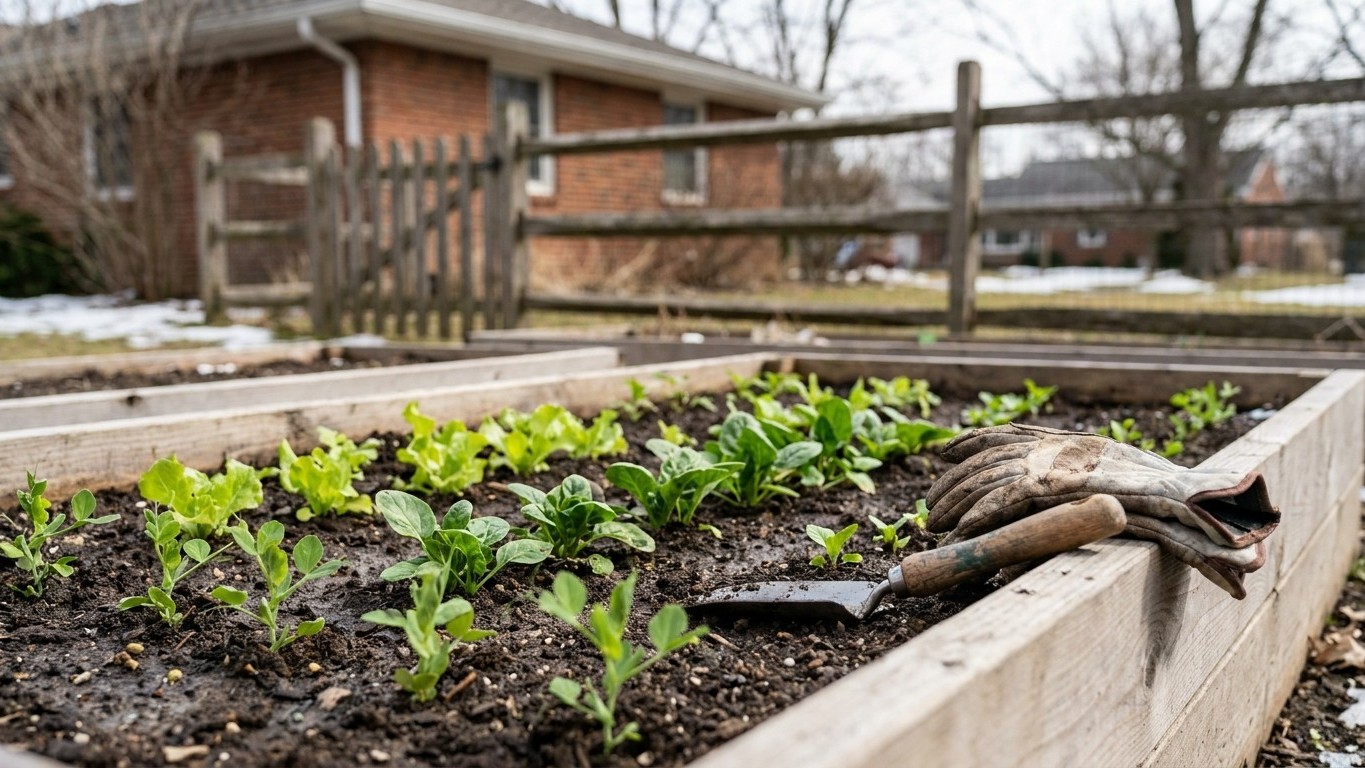

Cold-hardy crops go in through March across most of Virginia: peas, onion sets, lettuce, spinach, and brassica transplants can all handle open ground. But the state’s last spring frost falls somewhere between March 20 and April 3 at the coastal reference station, so warm-season crops like tomatoes and peppers still wait. What decides your exact date is soil temperature and local frost history, not the calendar page.
What goes in the ground in March

Soil temperature runs the show here, not the number on the wall calendar. Peas germinate once the ground sits around 45°F, and they don’t mind a light frost after they sprout. Spinach, lettuce, and kale behave the same way. If you can work the soil with a trowel and it isn’t a frozen brick or a mud slurry, these crops are fair game through March in most of the state.
Onion sets and onion transplants belong in the ground now too, along with seed potatoes once the soil has dried out enough to avoid rot. Garlic planted the previous fall keeps growing right through this window and needs nothing more than a weed check. Radishes and carrots can go in as direct-sown seed since both tolerate a stray frost better than a stretch of soggy, waterlogged soil.
Where the gamble starts
The frost window matters here because Virginia’s last spring frost runs March 20 to April 3 at the coastal reference station (NAS Oceana, per NOAA’s 1991-2020 Climate Normals). That means for most of March, the state is still sitting inside its frost risk period. Setting out tomato, pepper, eggplant, or squash transplants before that window closes is a bet against a probability, not a sure loss, but a bet nonetheless. A single 28°F night can wipe out a flat of transplants in one evening.
This is also where the USDA Plant Hardiness Zone Map matters, and where it gets misread. Virginia spans zones 5a through 8b, built from the average annual extreme minimum temperature, a single winter-cold metric that says nothing about your actual frost-free date. The coastal Tidewater area sits at the mild end of that range. The Blue Ridge and far southwest Virginia sit weeks behind it in spring. Treat every date here as calibrated to the coast and push it back for higher, more inland ground.
What to start under cover
Work backward from the frost window instead of forward from today’s date. Tomatoes, peppers, and eggplant need roughly six to eight weeks indoors before they go outside, and they can’t go outside until that March 20 to April 3 frost window has closed. Counting backward from the early end of that range puts seed-starting for these crops in early to mid-February for gardeners near the coast; inland growers with a later frost date get a bit more room and can start into March without falling behind.
Broccoli, cabbage, and other cole crop transplants run a shorter clock, closer to five to six weeks, and they tolerate a light frost once hardened off, so they can move outside earlier than tomatoes. Starting them under cover now, alongside a second round of lettuce and spinach transplants, keeps the garden supplied without a gap once the earliest sowings bolt in the coming heat.
Two mistakes show up every year at this stage. Start too early and the seedlings outgrow their pots weeks before it’s safe to plant, turning leggy and rootbound on a windowsill with nowhere to go. Start too late, particularly with peppers and eggplant, which are slow to size up, and the plants never catch up to a full-length growing season. Neither error is fatal on its own, but both cost real yield, and the fix for both is the same: do the backward math from your own last-frost estimate rather than a fixed date on a seed packet.
What is ready to pick
Overwintered greens are the main harvest right now. Kale, collards, and leeds that made it through winter under mulch or row cover are usually at their sweetest this month, since cold exposure converts starches to sugars in these crops. Spinach that overwintered under a low tunnel or cold frame is often ready for a first cutting as soon as growth resumes.
Cold-frame lettuce and spinach can be picked leaf by leaf rather than harvested whole, which stretches a small planting over several weeks. Indoors, sprouts and microgreens fill the gap between what’s stored and what’s still weeks from the garden, and they cost nothing more than a windowsill and a jar or tray.
Stored crops need a hands-on check this month. Winter squash, potatoes, and onions held in a cool, dark spot since fall are prone to turning right about now as the stockpile ages. Squash with a soft spot near the stem, potatoes that have started sprouting heavily, and onions that feel spongy at the neck should come out of storage and get used first, before they take the rest of the batch down with them.
The jobs that matter this month

Dormant pruning of fruit trees and cane berries needs to wrap up before buds break, and March is often the last clean window to do it. Pruning after growth starts stresses the plant and costs a portion of that season’s fruit, so apple, pear, and stone fruit trees, along with raspberry and blackberry canes, should get their cuts now while they’re still fully dormant.
Soil preparation earns its keep here too. Testing pH and amending beds now gives lime or sulfur time to adjust the soil before the main planting season arrives; add either at transplant time and it simply hasn’t acted yet when the roots need it. Turning finished compost into beds destined for heavy feeders, and cleaning and sharpening pruners, hoes, and shovels before the season’s workload arrives, are both an hour of effort now against a much longer delay later.
Seed ordering belongs on this month’s list as well, particularly for popular tomato and pepper varieties that sell out early. Chitting seed potatoes, meaning setting them in a bright, cool spot to sprout before planting, gives them a head start once soil conditions allow. And a walk through winter beds and fencing to spot frost heave, sagging trellis wire, or rot in raised bed frames catches small repairs before they turn into a rebuilt bed in the middle of the growing season.
What not to do in March
The single most common mistake is planting warm-season crops because the air felt warm for a few days. Soil holds cold far longer than air does, and a 70°F afternoon can sit over 50°F soil that’s still too cold for tomato or pepper roots to function. Check soil temperature directly with a simple probe thermometer rather than trusting how the day feels on your skin.
Uncovering row covers and cold frames too early after a mild stretch is the second trap. Virginia’s frost window runs into early April at the coastal reference point and later inland, so a run of 60°F days in March does not mean the risk has passed. Pulling protection off cold-hardy crops too soon exposes them to exactly the kind of late frost the covers were meant to prevent.
Nitrogen timing trips up a lot of gardeners too. Feeding a heavy dose of nitrogen to overwintered greens or newly planted alliums right now can push soft, leafy growth that a returning cold snap damages more easily than slower, hardened growth would. Hold off on a full feeding program until the plants are actively growing and the frost risk has meaningfully eased, and lean on compost or a balanced, slow-release feed in the meantime rather than a quick nitrogen boost.
Checking this against your own county
Everything above is calibrated to a single coastal reference station near Virginia Beach. It’s a starting point, not an instruction specific to your yard. Elevation changes things fast in Virginia: the Blue Ridge and the far southwest run weeks behind the coast in spring and cross back into frost risk weeks earlier in fall, and a valley bottom or hilltop within the same county can differ by a week or more on its own.
For a planting window tuned to your actual location, check with Virginia Cooperative Extension, which publishes county-level guidance and local planting calendars built for the state’s different growing regions.
Common questions
Is it too early to plant tomatoes in March in Virginia?
For most of the state, yes. The last spring frost runs March 20 to April 3 at the coastal reference station, and inland and higher-elevation areas run later still. Tomato transplants set out before that window closes risk frost damage or death.
What vegetables can survive a Virginia frost in March?
Peas, spinach, lettuce, kale, collards, onions, garlic, radishes, and carrots all tolerate a light frost once established, which is why they’re the safe direct-sow and transplant choices for this month.
When should I start seeds indoors for a Virginia garden?
Count backward from your local last-frost date. Tomatoes, peppers, and eggplant need about six to eight weeks indoors before transplanting outside; cole crops like broccoli and cabbage need closer to five to six weeks.
Does Virginia’s hardiness zone tell me when to plant?
Not directly. The USDA hardiness zones (5a-8b across the state) are based on average annual extreme minimum winter temperature, a different measurement than frost-free date. Use the frost window and your local extension office for planting timing, not the zone number alone.
Gardeners who plant by the Moon can check the March 2027 moon planting calendar, a tradition rather than a proven method.