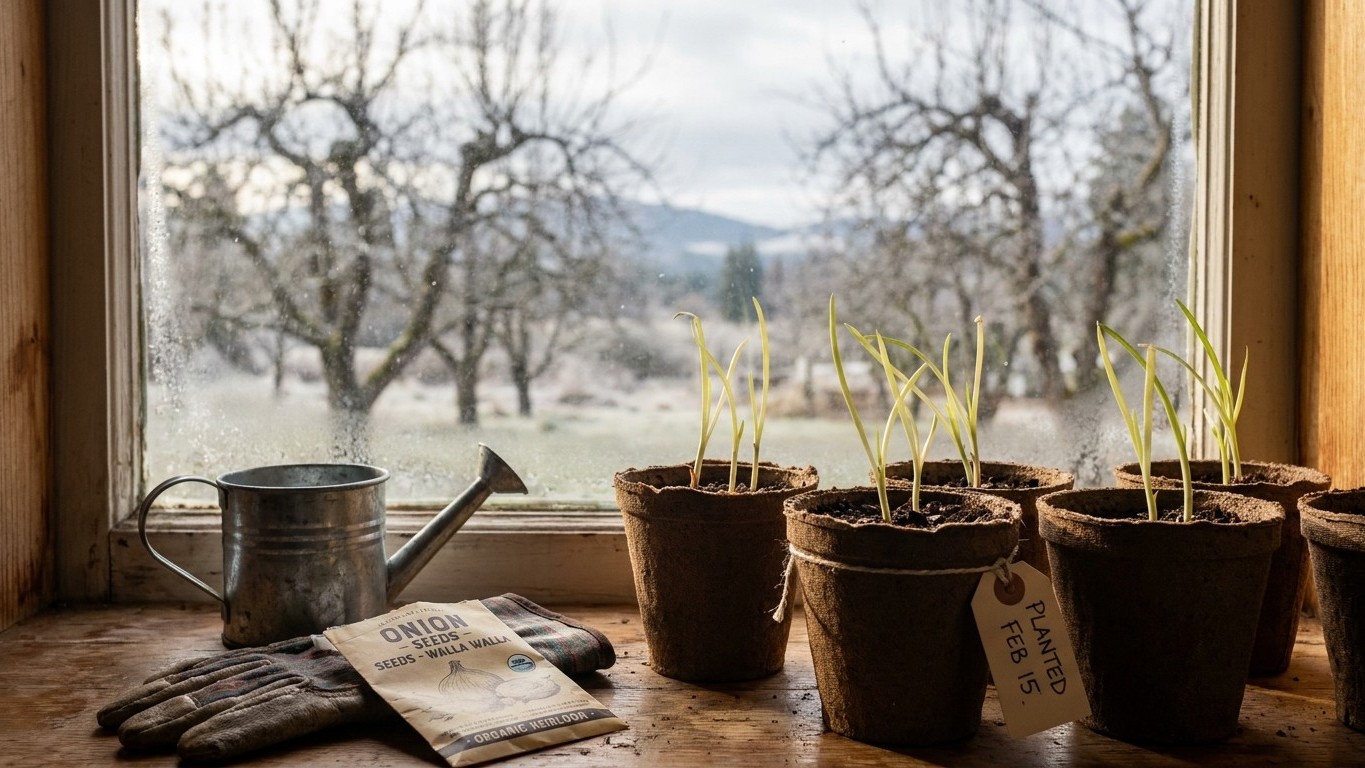

Onions in Washington go in the ground in late winter to early spring across most of the state, not in fall. That timing comes straight from geography: Washington sits far enough north that summer days run long, and long-day onions need those extra hours of light to swell into full-size bulbs before the plant shuts down leaf growth for good.
The short answer for Washington

The reference point for this page is the Seattle-Tacoma area, at 47.44 degrees north latitude. On the longest day of the year, that location gets 15 hours and 45 minutes of daylight. That single number is what decides everything else about onion timing here, because onions don’t bulb because of heat. They bulb because of day length. Once daylight hours cross a variety’s threshold, the plant stops making leaves and starts pushing all its energy into the bulb, whatever size the plant happens to be at that moment.
That’s why Washington falls squarely into long-day onion territory, and why the planting window is late winter through early spring rather than autumn. In warm-winter states, gardeners can plant onion sets or transplants in fall, let the plants overwinter as small seedlings, and count on mild temperatures to keep them alive until spring growth kicks in. Washington’s winters, even in the milder Puget Sound lowlands, aren’t reliably warm enough to make that gamble pay off across the state. Instead, the standard approach is to start onion seed indoors roughly 8 to 10 weeks before the last expected frost, then move transplants outside 4 to 6 weeks before that frost date, or set out onion sets as soon as the soil can be worked in late winter.
The goal of that early start is simple: give the plant as many weeks as possible to build leaf mass before the 15-hour-45-minute mark arrives in June. A transplant that goes in the ground in March has three extra months of leaf growth compared to one planted in May. Since bulb size tracks plant size at the moment bulbing triggers, those extra weeks of leaf growth are the difference between a fist-sized onion and one barely bigger than a golf ball.
This is also why the calendar shifts from state to state. A gardener in Georgia works with a much shorter summer day length and short-day varieties that trigger bulbing around 12 hours, so fall planting and an early spring harvest make sense there. A gardener in Washington is playing a different game entirely, built around long-day varieties and a planting window that front-loads growth before the solstice rather than racing to beat summer heat.
What will not work here
Planting onions late in Washington does not push the harvest back a few weeks. It shrinks the harvest, permanently. Because bulbing is tied to day length rather than the calendar date you happened to plant, a late-started onion still stops making leaves right on schedule when the days get long enough. It just does so while still small. There is no catching up once that trigger fires. A transplant set out in May instead of March doesn’t harvest a smaller onion two weeks later than usual, it harvests a smaller onion on the same date as everyone else’s, permanently undersized.
The same math rules out an entire category of varieties, regardless of when you plant them. Short-day and most intermediate-day onions are bred to trigger bulbing at day lengths well under what Washington summers provide, which means they start bulbing while the plant is still tiny, no matter how early you get them in the ground. That’s a variety mistake, not a timing mistake, and no amount of good soil or fertilizer fixes it. Based on published latitude ranges, the following varieties will not bulb properly at 47.44 degrees north:
- Cabernet (intermediate-day, 35-45N): range falls well south of Washington, bulbs too early and stays small
- Calibra (intermediate-day, 35-45N): same southern range, same undersized result
- Candy (intermediate-day, 33-40N): even further south, triggers bulbing far too early here
- Elsye (intermediate-day, 32-45N): upper range still short of Washington’s latitude
- Expression (intermediate-day, 32-45N): same gap, same small-bulb outcome
- Gabriella (short-day, 20-35N, no page of its own on this site): far too southern a range for this latitude
- Madalyn (short-day, 20-35N, no page of its own on this site): same issue
- Red Carpet (long-day, 40-45N): long-day, but its range still stops short of Washington
- Red Rock (short-day, 30-36N, no page of its own on this site): triggers bulbing far too early here
- Red Sensation (short-day, 25-35N): same result
- Sierra Blanca (intermediate-day, 32-45N): upper range falls short of 47.44N
- Texas Grano 1015Y (short-day, 25-35N): built for a much shorter summer day
- Vidora (short-day, 25-35N): same mismatch
- White Castle (short-day, 30-38N, no page of its own on this site): far too southern for Washington summers
What changes across Washington
Washington isn’t one latitude, and the 47.44-degree figure belongs specifically to the Seattle-Tacoma reference station, not the whole state. Washington stretches from around the Oregon border near 45.6 degrees north up to the Canadian border past 49 degrees, a spread of roughly three and a half degrees. That’s enough to shift both day length and planting timing at the edges.
| Location | Approximate latitude | Longest-day daylight | What changes |
|---|---|---|---|
| Southern Washington (near Vancouver, WA) | ~45.6N | Slightly less than 15h45 | Marginally shorter summer days; planting timing tracks close to the reference city |
| Seattle-Tacoma (reference station) | 47.44N | 15h45 | Baseline figures used throughout this page |
| Northern Washington (near Bellingham) | ~48.7N | Slightly more than 15h45 | A touch more daylight margin for long-day varieties to fully size up |
The practical effect for most gardeners is small: the difference between the state’s southern and northern edges amounts to a matter of degrees, not a jump into a different day-length category. A reader gardening near Vancouver, Washington, or up near Bellingham is still solidly in long-day territory and should still be planting in late winter to early spring. The three varieties sitting in the blurred zone of published ranges, Monastrell, Powell, and Scout, may bulb here depending on exactly where in the state you garden and how the season plays out, but none of them come with a guarantee at this latitude. Treat them as an experiment, not a sure thing, and keep expectations modest the first year.
Sweet now, or onions that last
Washington’s long-day climate pushes gardeners toward onions that keep rather than onions that eat sweet right out of the garden, and the reason isn’t tradition, it’s chemistry. The compounds that give an onion its sharp bite are volatile sulfur compounds, and those same compounds are what protect the bulb from rot in storage. A variety bred to be mild and sweet simply has fewer of them. That makes it better on a sandwich in July and worse in a root cellar in January.
Short-day and intermediate-day varieties, common in southern gardens, tend to run sweeter and softer, and they’re typically eaten within weeks of harvest rather than stored through winter. Long-day varieties, the kind that actually bulb properly in Washington, generally carry more of those protective sulfur compounds, which means a sharper bite fresh but a bulb that holds up in storage for months.
Washington’s most famous exception proves the rule rather than breaking it. Walla Walla Sweet is a long-day onion, bred specifically to be mild despite belonging to a category that normally runs pungent, and it’s a legitimate choice at this latitude according to its published range. But it comes with the same trade-off as any sweet onion: it doesn’t store the way a sharper long-day variety would. A Washington gardener growing a mix of Walla Walla Sweet alongside something like Redwing or Patterson ends up with the best of both pantries, sweet onions to eat fresh through late summer, and firmer, sharper bulbs still holding up in a cool, dark corner of the garage well into March.
Checking this against your own garden
Every figure on this page comes from one weather station near Seattle-Tacoma, and a state-wide number is never a substitute for what’s actually happening in your own yard. Before locking in a planting date, it’s worth checking a few things specific to your location.
- Look up your own latitude if you garden well north or south of the Seattle-Tacoma area, especially near the Oregon or Canadian border
- Confirm your local last spring frost date, since transplants should go in the ground 4 to 6 weeks before that date, not on a fixed calendar day
- Call or check the website of your county extension office for planting guidance calibrated to your specific microclimate
- Note your local elevation, since higher gardens in the Cascades or foothills often see a later last frost than the valley floor
- Track actual daylight hours where you live around the solstice, using any almanac or sunrise-sunset calculator, if you’re near the edge of the state