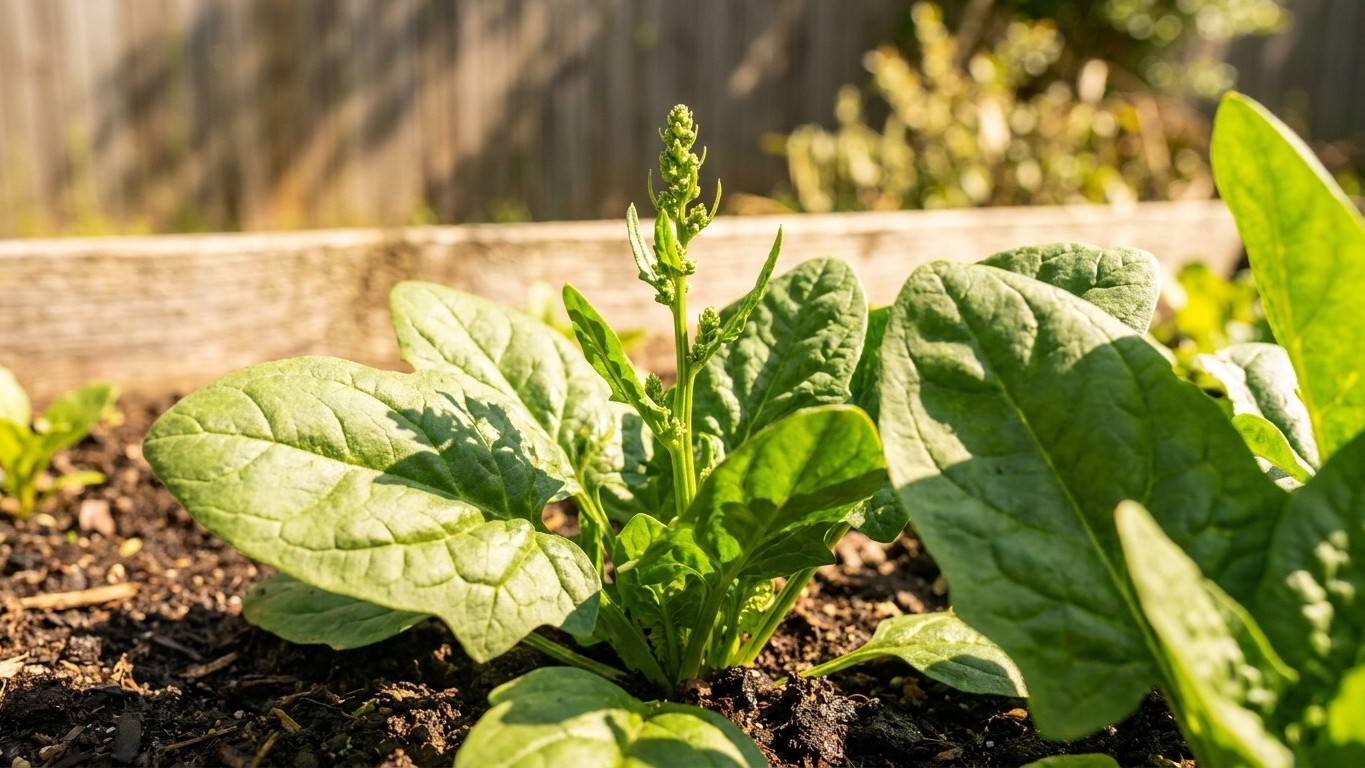

Spinach will bolt early across western Washington, but not because summer turns hot. The reference station near Seattle averages just three days a year above 90°F, so heat rarely pushes past spinach’s 75°F comfort ceiling. What ends the spring crop is daylight itself: as the calendar slides toward the June solstice and its 15 hours 45 minutes of daylight, spinach reads that long light and switches from making leaves to throwing a flower stalk, whether the thermometer cooperates or not.
The short answer
Western Washington’s growing conditions split spinach’s two triggers apart in an unusual way. Long days force the plant to bolt everywhere on this site’s coverage area, since day length is a fixed astronomical fact tied to latitude, not to a state’s climate. But heat, the other trigger, barely shows up here. With only three days a year reaching 90°F at the reference station, the region almost never delivers the kind of sustained warmth that pushes spinach past its 75°F growth ceiling through brute temperature alone.
That split matters for how a gardener should think about the crop. In a hot inland climate, spinach often bolts because afternoon heat stresses the plant directly, and a grower might reasonably hope that a cooler summer buys extra harvest weeks. That hope does not translate here. Western Washington’s mild, cloudy, marine-influenced summers keep air temperatures well under stress levels for much of the season, yet spinach still bolts on schedule, because the plant is responding to how many hours the sun is up, not to how warm the air feels. A cool, damp June in Seattle carries the same 15 hours 45 minutes of daylight as a scorching June anywhere else at that latitude, and that daylight total alone is enough to flip the plant into flowering mode.
So the practical answer splits into two parts. The limiting factor for how long the spring crop lasts is day length, full stop. Heat plays a secondary role, mostly by narrowing the window at the tail end of a warm spell rather than by driving bolting on its own, since 75°F is reached only occasionally in this climate. A gardener who blames a hot spell for a bolted spinach patch in Tacoma or Olympia is usually misreading the cause. The plant almost certainly bolted because the calendar reached the long-day stretch of late May and June, not because a brief warm afternoon pushed it over an edge that a maritime climate rarely approaches.
This distinction should reshape expectations rather than kill them. Spinach grown in western Washington behaves less like a plant fighting summer heat and more like a plant racing a clock that starts ticking the moment days begin lengthening past a certain point in spring. Understanding that clock, rather than watching a thermometer, is the real key to timing a spinach planting correctly in this climate.
How long the spring window really is
Working out the usable spring stretch in western Washington means stacking three separate facts on top of each other: the last frost window, the growth ceiling, and the solstice daylight trigger. Here is how that stacks up in practice.
- Sowing date. Spinach seed goes in two to three weeks ahead of the last frost. NOAA climate normals for the reference station put that last frost window between February 27 and March 18, which pushes an earliest reasonable sowing date into mid-February for gardeners working the mildest, best-drained beds close to Puget Sound.
- Early growth. Through late February, March, and into April, air temperatures in this maritime climate stay comfortably under the 75°F ceiling almost every day, so the plant grows without heat stress. Cold, wet soil and low late-winter light are the real obstacles at this stage, slowing germination and early leaf growth even though the frost risk itself has mostly passed.
- Peak harvest. By April and into May, established plants are producing steadily, still shielded from bolting because day length has not yet climbed into the range that triggers flowering.
- Bolting trigger. As the calendar moves through May toward the June 21 solstice, daylight climbs toward that 15 hour 45 minute peak, and the plant shifts into reproductive mode regardless of how mild the air still feels. This is the wall that ends the crop, not a heat spike.
- Practical close. Most spring plantings in this region are finished, one way or another, by late May to early June, closing out a usable spring season of roughly fourteen to fifteen weeks from that mid-February sowing date.
That window is longer than a hot-climate gardener would expect, precisely because heat is not the constraint doing the work. It is also firmer than it looks, because no amount of favorable weather pushes the daylight-driven bolting date back once the solstice approaches.
The autumn crop, and when the soil lets you sow
Fall spinach flips the two obstacles from spring. Instead of frost limiting the early end and daylight limiting the late end, the fall crop is bounded by warm soil at the start and hard frost at the finish.
Soil still too warm to germinate
Utah State University Extension notes that spinach seed germination drops off once soil temperatures climb above 80°F. That threshold matters far more in hot inland or desert climates than it does here. With only three days a year reaching 90°F in the air, western Washington soil rarely holds sustained heat anywhere near 80°F even in late summer, especially once August afternoons shorten and nighttime cooling sets back in. That means the fall sowing window in this climate opens comparatively early and without the long wait for soil to cool that gardeners in hotter regions have to plan around. Late August soil here is typically workable for spinach seed well before that ceiling becomes a concern.
Counting back from the first frost
The source gives no fixed days-to-maturity figure for spinach, only a planting rule: sow 50 to 75 days before the date you want to harvest. NOAA’s 1991-2020 climate normals put the first fall frost at this reference station between November 13 and November 30. Counting back from the earlier end of that range, a gardener aiming to harvest by November 13 should have seed in the ground somewhere between late August and late September, depending on where in that 50-to-75-day range the season actually falls. Aiming for a harvest closer to November 30 shifts sowing later, into September, while still leaving margin before frost. Because soil rarely runs too warm here for long, the earlier end of that sowing range is usually available without forcing a delay, giving western Washington gardeners a wider practical fall window than a hot-summer region would get under the same 50-to-75-day rule.
Four spinach varieties commonly discussed for home gardens are Bloomsdale, Melody, Teton, and Olympia.
Common questions
Does a cool Washington summer delay spinach bolting?
No. Bolting is triggered by day length as well as by heat, and day length at this latitude reaches 15 hours 45 minutes on the June solstice regardless of how mild the air stays. A cool summer does not buy extra weeks once that long-day threshold arrives.
Why doesn’t the region’s mild climate keep spinach growing longer?
Because the crop is not primarily reacting to temperature here. With only three days a year above 90°F, western Washington rarely stresses spinach through heat alone, but the daylight clock keeps running regardless, and that clock is what ends the spring season.
Is fall sowing blocked by warm soil in this region?
Rarely for long. Germination drops above 80°F soil, but this maritime climate seldom sustains soil that warm, so the fall window generally opens earlier here than in hotter inland climates working around the same 50-to-75-day planting rule.
Should eastern Washington gardeners use these same dates?
No. These frost and heat figures come from a western Washington reference station with a mild, maritime climate. Eastern Washington beyond the Cascades is high desert with a shorter season and a different heat profile, and applying this same calendar there would be inaccurate.