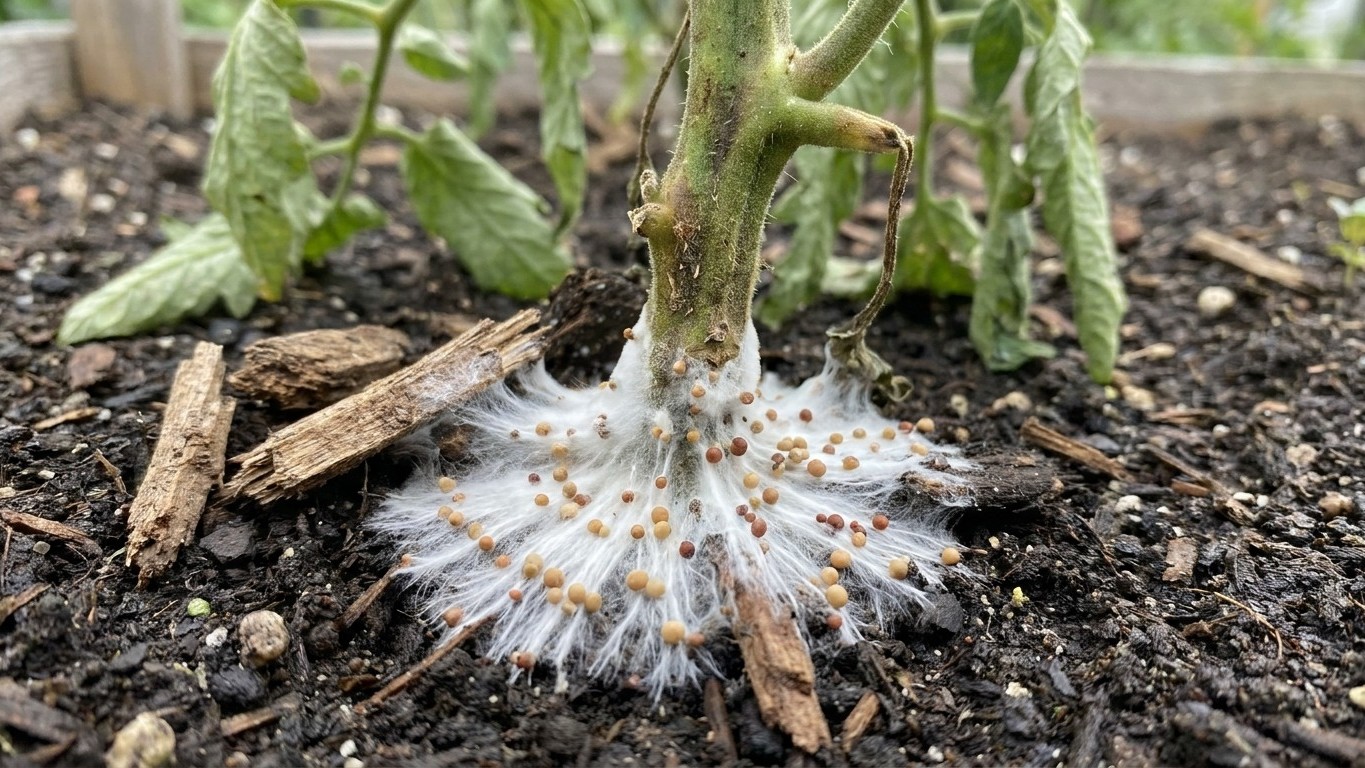

Southern blight is serious and it moves fast. The telltale sign is a white, fan-shaped mat of fungal threads spreading across the stem right at the soil line, often followed within days by the whole plant wilting and collapsing, because the fungus has girdled the stem and cut off its water supply.
What you are looking at

The first clue rarely shows up on the leaves. It shows up at the base of the plant, exactly where the stem meets the soil, and by the time the foliage wilts the damage underneath is already done. This disease does not creep through a planting the way a leaf spot does. It kills individual plants outright, one at a time, sometimes in under a week once the stem is girdled.
The white fungal mat at the soil line
Look for a coarse, cottony to fan-shaped growth of white fungal threads hugging the stem right where it enters the soil. It is not fuzzy mold floating in the air like powdery mildew; it lies flat against the tissue, radiating outward in a pattern that looks almost like a small white hand pressed against the stem. Peel back mulch near a wilting plant and you will often find this mat extending an inch or two onto the surrounding soil surface as well.
The mustard-seed sclerotia
Within that white mat, small round bodies form, tan to reddish-brown, roughly the size and shape of a mustard seed. These are sclerotia, the fungus’s survival structures, and they are one of the most reliable identifying features of this disease. They sit scattered across the mat or embedded just at the soil surface, dozens of them on a single infected stem.
The sunken, water-soaked stem lesion
Beneath the fungal mat, the stem itself turns brown and water-soaked, then dry and papery as the tissue collapses. The lesion girdles the stem completely, which is why the wilt above it is sudden and total rather than gradual. Cut into that lesion and you will find the outer tissue rotted through, but the vascular core stays relatively clean, no dark discoloration running up the stem, which matters for telling this apart from the wilts below.
The sudden, whole-plant wilt
Above the girdled stem, the entire plant wilts at once, leaves drooping from top to bottom rather than yellowing from the bottom up. There is no slow decline over weeks. A plant can look normal in the morning and be flat on the ground by evening once the stem lesion closes off the water supply. Fruit already set usually does not show direct lesions from this fungus, since the infection stays concentrated at the crown and lower stem.
What it is not
Three other problems get mistaken for this one, and the mix-up matters because the wrong response wastes time on a plant that is already beyond saving, or worse, treats a curable problem as a lost cause.
Fusarium and Verticillium wilt
Both of these soilborne wilts cause a similar collapse, but the tell is inside the stem, not on the outside. Slice through the stem near the base and look for a ring of brown discoloration in the vascular tissue, often running well up into the plant. Southern blight does not produce that internal streaking; its damage stays external, in the rotted outer stem tissue under the white mat. Wilts from Fusarium or Verticillium also tend to progress unevenly, one side of the plant or one branch yellowing before the rest, whereas southern blight takes the whole plant down together once the girdle is complete.
Bacterial wilt
Bacterial wilt causes a wilt that can look just as sudden, sometimes with no yellowing at all before the plant collapses. The quick field test settles it: cut a section of lower stem and suspend it in a glass of clear water. Bacterial wilt releases a milky, thread-like ooze from the cut end within a few minutes. Southern blight shows no such ooze, and it always comes with the visible white mat and sclerotia at the soil line, features bacterial wilt never produces.
Sclerotinia (white mold)
This is the closest look-alike, because Sclerotinia also produces white fungal growth and its own sclerotia. The difference is in the size and shape of those survival structures. Sclerotinia’s sclerotia are larger, black, and irregular, closer in shape to a rat dropping than a mustard seed, and they tend to form inside hollowed-out stems rather than scattered across an external mat. Sclerotinia also favors cool, wet weather, while southern blight is a warm-season problem, so the season in which the plant collapses is itself a useful clue.
Getting this identification wrong has real costs. Treat a vascular wilt like southern blight and a gardener wastes effort trying to remove a soil-line fungal mat that was never there, while ignoring the actual need to pull the plant and think about resistant seed for next year. Treat southern blight like a curable leaf disease and a gardener keeps a doomed plant in the ground, feeding sclerotia production and contaminating the bed for seasons to come.
Where it comes from and when it strikes
Southern blight is caused by the soilborne fungus Sclerotium rolfsii (also classified as Athelia rolfsii), and it survives between seasons almost entirely as those small sclerotia sitting in the top few inches of soil or in buried plant debris. It does not need a live host to persist. The sclerotia simply wait, sometimes for years, until conditions turn favorable again.
Arrival at a new plant usually comes from soil contact rather than wind. Splashing water during rain or irrigation carries sclerotia and fungal threads onto the stem, and contaminated soil moved on tools, boots, or transplant flats spreads the fungus to previously clean beds. Infected mulch or compost that was never heated enough to kill sclerotia is another common route.
The fungus is a warm-weather organism through and through. As a universal biological threshold, Sclerotium rolfsii germinates and grows most actively once soil temperatures move into the range typically reached during high summer, well above what most other soilborne fungi need, and it favors soil that stays consistently moist at the surface rather than soaked or dry. Dense mulch or crowded plantings that trap humidity right at the soil line create exactly the microclimate this fungus wants, warm, still, and damp against the stem for extended stretches.
What to do about it now
Once the stem is visibly girdled and the plant has wilted, there is no cure. That plant is lost, and the honest move is to remove it rather than wait to see if it recovers. Pull the whole plant, roots and all, along with the top few inches of soil immediately surrounding the stem, since that soil now carries sclerotia. Bag and discard this material; do not add it to a home compost pile unless that pile reliably reaches a sustained hot temperature, because sclerotia can survive ordinary backyard composting.
For neighboring plants that still look healthy, a few changes reduce the odds of new infections spreading through the same bed. Pull mulch back an inch or two from each remaining stem so the crown stays drier and less hospitable to fungal growth. Switch to drip irrigation or water at the base rather than overhead, since wet foliage and splashing water both help move sclerotia and fungal threads onto new stems. Thin crowded plants where airflow around the stem base has been reduced to almost nothing.
Fungicide drenches labeled for soilborne fungi exist and can help protect stems that are not yet infected, but they will not reverse damage on a plant that has already wilted. Once again, that plant is finished, and no product changes that outcome. As for the harvest, fruit from a plant killed by southern blight is safe to eat as long as it is otherwise firm and shows no rot of its own; this fungus concentrates its damage at the crown and lower stem, not on the fruit itself, unless a fruit has been resting directly against contaminated soil.
Keeping it out next season
Sclerotium rolfsii has an unusually wide host range, attacking hundreds of plant species across vegetable and ornamental families, which makes standard two-year rotation far less effective than it is against narrower pathogens. Rotating away from tomatoes and their relatives, and away from beans, peppers, and other known hosts, for at least three to four years gives sclerotia time to lose viability, though some will still survive that long in undisturbed soil.
Deep tillage that buries sclerotia several inches below the surface, beyond where they readily germinate, helps reduce the active population near new transplants. Unlike Fusarium, Verticillium, or nematode pressure, tomato southern blight does not currently have widely marketed resistant cultivars carrying a letter code on the seed packet; growers should not expect an “S” or similar designation the way they would look for V, F, N, T, or A codes tied to other diseases, and any claim otherwise is not supported by published cultivar information.
Sanitation still matters even without resistant varieties to lean on. Stakes, cages, and tools that touched infected soil should be scrubbed and disinfected before reuse, since sclerotia can cling to rough surfaces. A layer of clean mulch kept a couple of inches back from the stem acts as a splash barrier without holding constant moisture against the crown. Give plants enough spacing and prune lower foliage so air moves freely at the soil line, and source transplants from growers who use pathogen-free potting mix rather than field soil, since contaminated seedling flats are one of the more overlooked ways this fungus enters a garden in the first place.
Common questions
Can a plant survive southern blight if caught early enough?
Once the white fungal mat and girdling lesion are visible at the stem base, the infection has already progressed past the point of recovery. Early removal helps protect neighboring plants, not the infected one.
Does southern blight affect other vegetables besides tomatoes?
Yes. Sclerotium rolfsii has one of the widest host ranges of any soilborne plant pathogen, which is why rotating to a single “safe” replacement crop rarely works as well as it does with more host-specific diseases.
Is it safe to reuse the same garden bed the following year?
Sclerotia can persist in soil for an extended period, so replanting a known host crop in the same spot the very next season carries real risk. Rotation to non-host crops and deep tillage both help lower that risk over time.
Will raised beds or container growing avoid this problem?
Containers filled with fresh, pathogen-free potting mix largely avoid southern blight, since the fungus has no established sclerotia to draw on. Raised beds only help if the soil brought in is itself clean; reused garden soil carries the same risk it would at ground level.